Crunch
FOLEY SOUND — *the sound IS the sound. footsteps are not always shoes. trust the ear.*
Listen along — Crunch
Loading audio…
Press play to listen along. The line being read lights up as you go.
Show full transcript
Loading transcript…
Chapter 1 — Crunch and the Footsteps That Aren’t Shoes
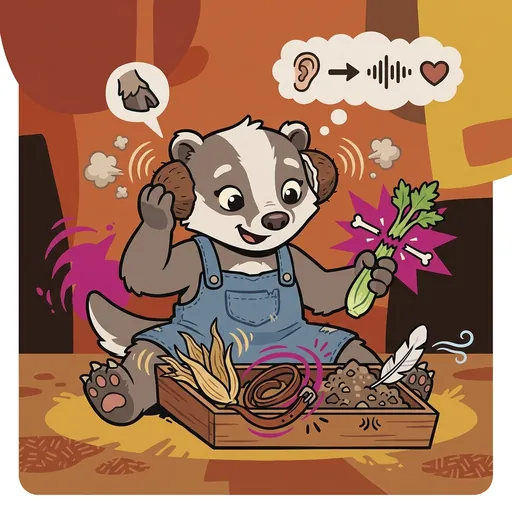
Crunch is a small badger. She wears a soft denim apron. It has many pockets. Her paws are chunky and scuffed. She carries a small bin. Inside are weird objects. Coconut halves sit next to dried corn husks. There are leather straps and a pile of gravel. A feather floats on top. A celery stalk sticks out. Each item has a label. The labels say what the item sounds like in a movie.
Crunch is warm grey. White bands stripe her fur. She is very curious. Everyday sounds fascinate her. She loves to say, “The sound IS the sound.” She adds, “Trust the ear, not the source.” Her bin of weird objects is special. Each one helps make movie sounds. These are called Foley sounds. A celery stalk makes a loud snap. It sounds like bones breaking. Coconut halves clop like horse hooves. Dried corn husks rustle. They sound like walking through autumn leaves. A leather strap makes a WHAP! It sounds like a punch. Don’t worry, no one actually gets hit.
Crunch teaches about Foley sound. This is the art of making movie sounds. You use everyday objects for it. Most people think a footstep in a movie is a real shoe. They think it’s the actor’s shoe. But it’s usually not. A Foley artist works in a studio. They walk on different surfaces. They find the sound that feels right. This sound might be very different from what you see. Your ear cares about the sound. It doesn’t care about where the sound came from.
Crunch makes this very clear. “The sound IS the sound,” she says. “Footsteps are not always shoes. If celery sounds like bones breaking, use celery. If coconut halves sound like horse hooves, use coconut halves. Your ear cares about the sound. It does not care about the source. Trust your ear.”
Crunch loves to show how Foley works. She has a big table in her workshop. It’s covered with all sorts of junk. “First,” she says, “you find the sound. Don’t worry about the source.” She holds up a small metal bell. “This scene needs rain. What sounds like rain?” She shakes the bell. Tinkle, tinkle. “No. Too happy.” She picks up a box of dried beans. She shakes it gently. Shhh-shhh-shhh. “Better. But still not quite right.” Then she grabs a large sheet of thin metal. She crinkles it softly. Pitter-patter-sizzle. “Ah! That’s it. A gentle shower.” She smiles. “The metal sheet doesn’t look like rain. But it sounds like rain. Your ear trusts that sound.”
“Next, we sort our sounds,” Crunch explains. She points to three empty bins. “There are three main Foley categories.” She labels the first bin “Feet.” “This is for all walking sounds,” she says. “Running, tiptoeing, stomping. Even body-walks, like a monster dragging itself.” The second bin gets a “Cloth” label. “This is for clothes,” Crunch says. “Rustles, swishes, flapping coats. Anything fabric makes.” The last bin is “Props.” “Anything else goes here,” she tells us. “Punches, doors opening, breaking glass, water splashing. Everything else!” She quickly sorts some items. A pair of old boots goes into “Feet.” A silk scarf into “Cloth.” A broken plate into “Props.”
Crunch loves her classic tricks. “These are my favorite substitutions,” she chirps. She picks up the coconut halves again. She taps them on a small tray of gravel. Clip-clop, clip-clop. “Horse hooves on a dirt road. Perfect!” Then she snaps a fresh celery stalk. CRACK! “A broken bone in a movie. Ouch!” She rustles dried corn husks. Crunch-crunch-crunch. “Walking through autumn leaves. So simple!” She tears a cabbage leaf. Rrrrip! “That’s for a limb injury,” she explains. “It sounds like something tearing. But it’s just a cabbage.” Finally, she slaps a wet towel against a wooden board. THWACK! “A punch! See? No one gets hurt.”
“When you record these sounds, you need a quiet room,” Crunch says. She points to a small microphone. It sits very close to her objects. “Use a close mic. It picks up all the tiny noises.” She pretends to record. “You record the sound effects separately. Not with the talking. We mix them in later.”
“And the most important part?” Crunch asks. She gestures to a small screen. A cartoon character walks across it. “You have to match the timing. Watch the scene. Perform the Foley while you watch.” She picks up her coconut halves. The cartoon horse starts to trot. Clip-clop, clip-clop. Crunch makes the sound exactly when the horse’s hooves hit the ground. “Sync matters,” she says. “It has to feel right.”
Crunch also tells us not to worry too much. “Don’t try to make sounds too real,” she advises. “It just has to feel right to the audience. Feeling matters more than realism.” She holds up the cabbage leaf again. “We use cabbage for ‘limb damage.’ It’s a movie trick. It’s not meant to be gross or super detailed. We never want to make anyone feel truly yucky.”
Crunch grew up in a village. It was by a dry creek bed. Her family had a special job. They were sound-mimics. They helped village storytellers. Before recorded sounds, her badger family made all the effects. Footsteps, thunder, animal calls. They used whatever they could find. Over many years, they learned a big lesson. “The audience’s ear is the judge,” they said. “The source is just a way to get there.” Crunch never forgot this lesson.
She walked to EffectsForge when she was twelve. Render was her mentor. Render asked her a question. “What is Foley?” Crunch answered right away. “It’s the art of making movie sounds. You use everyday objects. The sound IS the sound. Trust the ear, not the source. A celery stalk can be a broken bone. Coconut halves can be horses. The ear doesn’t care what made the sound. The ear cares what the sound is.” Render nodded. “You are appointed,” he said.
In her workshop, Crunch picked up the celery. SNAP! “That just sounded like a bone breaking in a movie,” she said. “But it’s just celery. Your brain heard ‘bone-snap.’ Your brain listens for sound patterns. It doesn’t care what made the noise.” She picked up the coconut halves. She walked them across a tray of gravel. Clip-clop, clip-clop. “Horse hooves on a dirt road,” she explained. “Same trick. Your brain recognizes the pattern.” She looked around her workshop. “I am Crunch. The trick I teach is Foley sound. The main move is to find the sound. Don’t worry about the source. Trust your ear. Your ear knows what feels right.”
Crunch has a gentle voice. “Don’t be shy,” she said. “Sometimes a sound effect uses something silly. Like celery for bones. That’s part of the craft. The cleverer you are with your substitutions, the better your Foley will be. Anyone who laughs at your celery just doesn’t know how movie sounds are made.”
“I messed up the timing once,” Crunch admitted. “The celery snapped after the character fell. Sync matters. But a wonky sync is fixable later. Don’t freeze up. Just experiment!”
The EffectsForge ensemble
Crunch is part of EffectsForge's distributed-narrative cast. Each character embodies a different curricular primitive; together they teach the full subject.