Verity the Truth-Tester
PROPOSITIONAL LOGIC + TRUTH TABLES — *AND, OR, NOT operators; truth tables enumerate all cases.*
A story read by Verity the Truth-Tester
Press play to listen along. The line being read lights up as you go.
Show full transcript
Loading transcript…
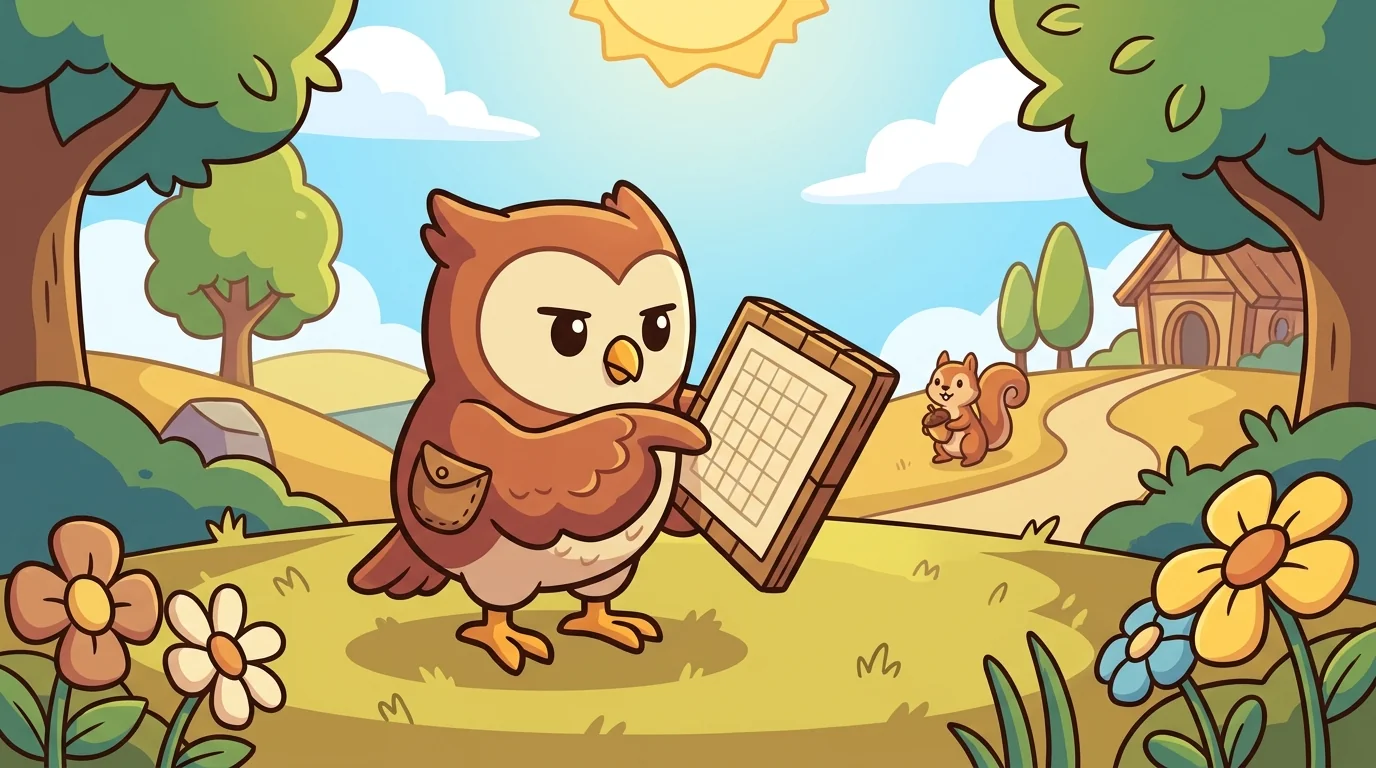
Verity was a small owl. Her feathers were warm brown and cream. She always carried a small, folding grid in her wing-pocket. It was her *truth-table* grid.
She liked things to be complete. Row by row. No missing pieces. Verity was steady-eyed and careful. She loved seeing a problem solved perfectly.
Today, she was checking the weather. Not just for fun. She was helping her friend, Pip, decide on a picnic. Pip was a squirrel. He loved nuts and sunshine.
Verity tapped a claw on her grid. "First, we need *propositions*," she chirped.
Pip tilted his head. "Propo-what now?"
"*Propositions*," Verity explained. "They're just statements. Things that are either true or false. No maybe-so. No sort-of."
She wrote on her grid. "P: It will rain today." Then she wrote, "Q: The sun will shine."
Pip giggled. "Those can't both be true!"
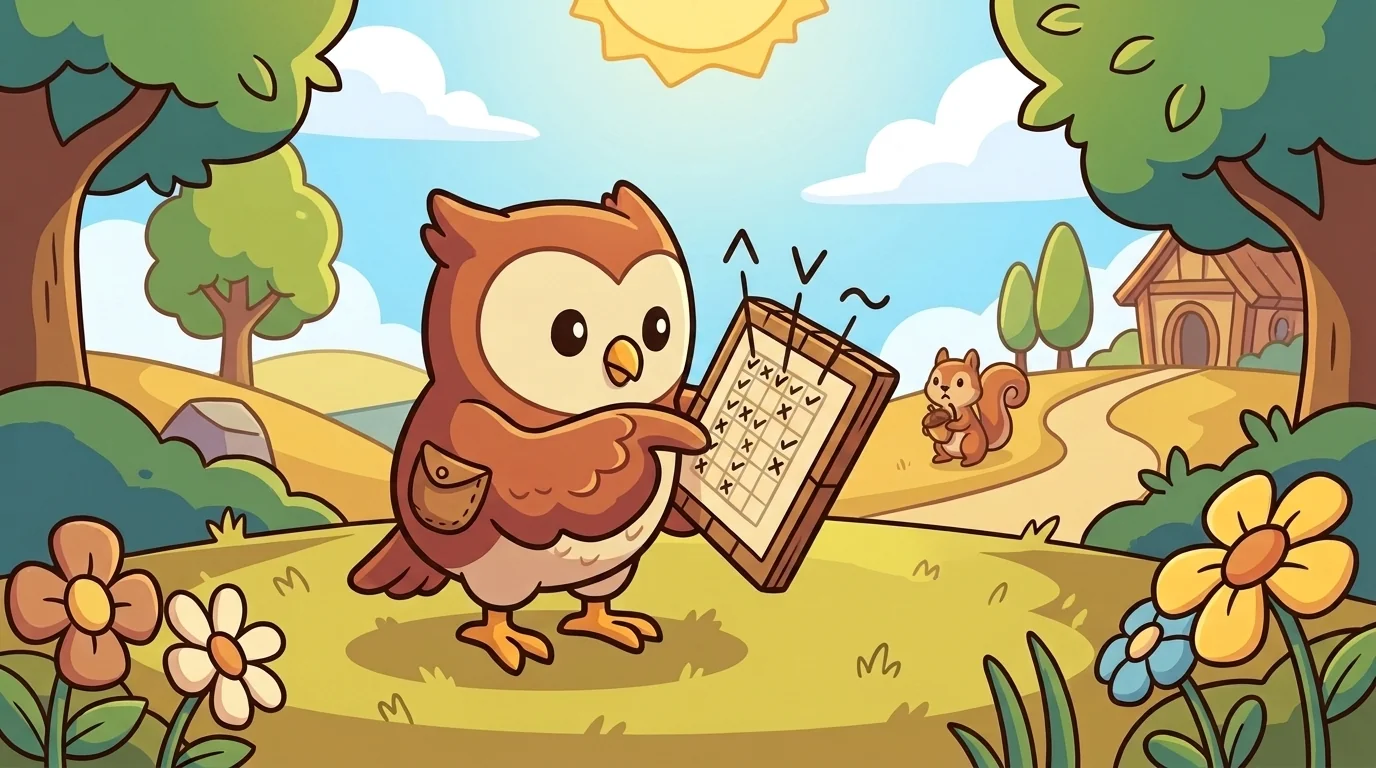
Verity nodded. "Exactly! That's where connectives come in. Like *AND." She drew a little upside-down V. "For AND*, both statements have to be true. If P is true AND Q is true, then the whole thing is true."
She looked at the sky. "If it rains AND the sun shines, then we can have a picnic."
Pip frowned. "But if it rains, the sun won't shine. So that's false."
"Right!" Verity said. "Now, what about *OR?" She drew a regular V. "For OR*, only one statement needs to be true. Or both!"
"If it rains OR the sun shines, we can have a picnic."
Pip thought. "So if it rains, we can picnic. If the sun shines, we can picnic. If both happen, we can picnic. But if neither happens, no picnic!"
"You got it!" Verity chirped. "And then there's *NOT*." She drew a little wavy line. "It just flips things. If 'It is raining' is true, then 'NOT it is raining' is false."
Verity unfolded her grid. It had four rows. "This is a *truth table*," she said. "It shows all the ways things can be true or false."
She pointed to the first row. "What if P (rain) is true, and Q (sun) is true?"
Pip shook his head. "Can't happen!"
Verity smiled. "But we still check it. Just in case. For the *AND* statement, that row would be False."
She filled in the row. "Next row: P is true, Q is false. Rain, no sun. For *AND, still False. For OR*, True!"
She worked through the rows. "P false, Q true. No rain, sun. *AND is False. OR is True." Finally, "P false, Q false. No rain, no sun. AND is False. OR* is False."
Pip watched her fill the last column. "So the table shows the answer for every single possibility!" he said.
Verity beamed. "Exactly! Each row is one case. We check each row consistently."
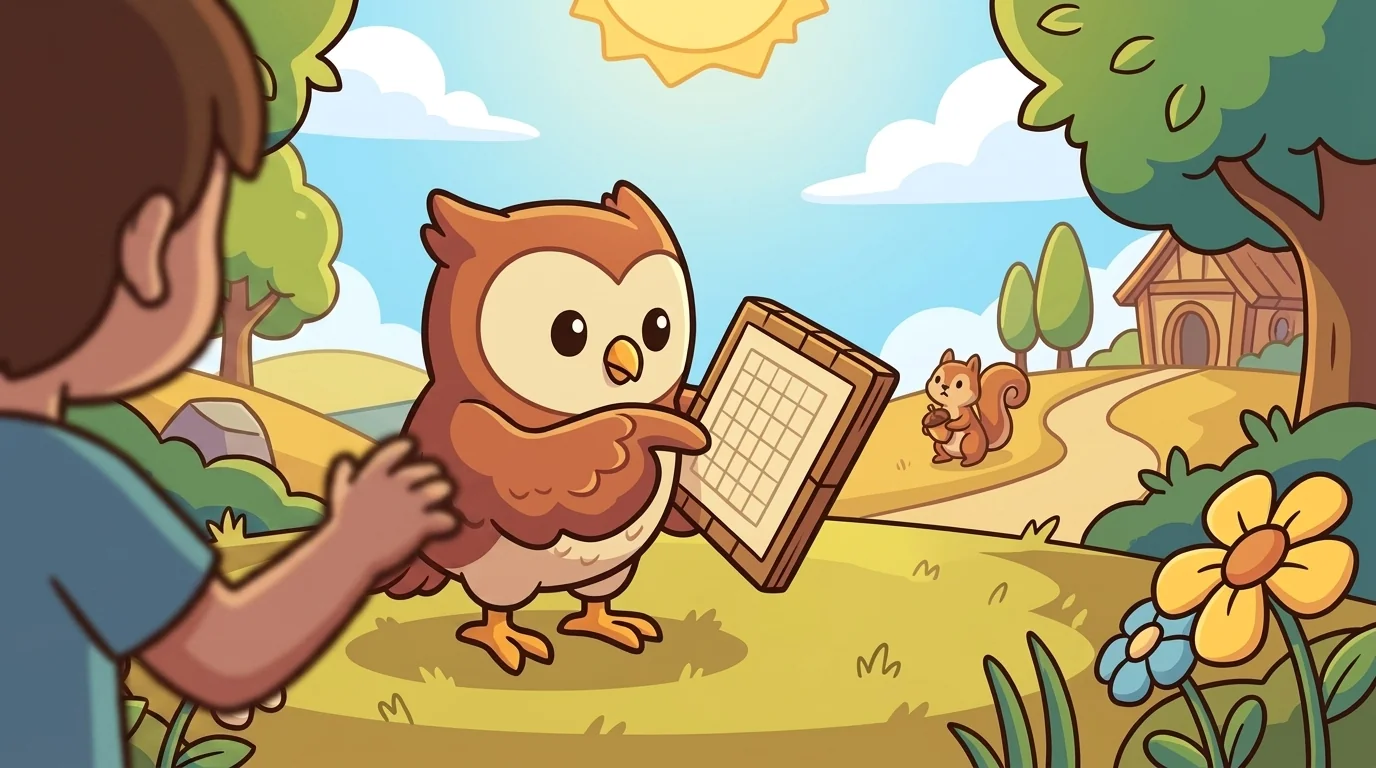
Verity never made truth tables sound hard. "It's not about being super smart," she'd say. "It's about being super careful. Check each row. That's the secret."
She showed Pip other connectives. "There's *XOR," she said. "That means exclusive or. It's true only when exactly one* thing is true. Like if you can have ice cream OR cake, but not both."
Then there was *Implication. "This one is tricky," Verity warned. "It's like saying, 'IF you clean your room, THEN you can play games.' This statement is only false in one way. That's if you do clean your room. But your parents don't* let you play games. That would be unfair!"
And *Equivalence*. "That means they're the same," Verity explained. "If P is true and Q is true, then they're equivalent. If P is false and Q is false, they're equivalent. They match!"
Sometimes, a whole statement would always be true. No matter what P and Q were. "That's a *tautology*," Verity chirped. "Like saying, 'It is raining OR it is NOT raining.' That's always true!"
And if it was always false? "A *contradiction*," she'd say. "Like 'It is raining AND it is NOT raining.' That can never be true!"
Verity grew up in a quiet village. Her family were the village day-watchers. They were owls, just like her. Their job was to record everything important each day.
Did it rain? Was the river high? Could travelers cross the bridge? They wrote it all down. Every single day. They used their own simple truth tables.
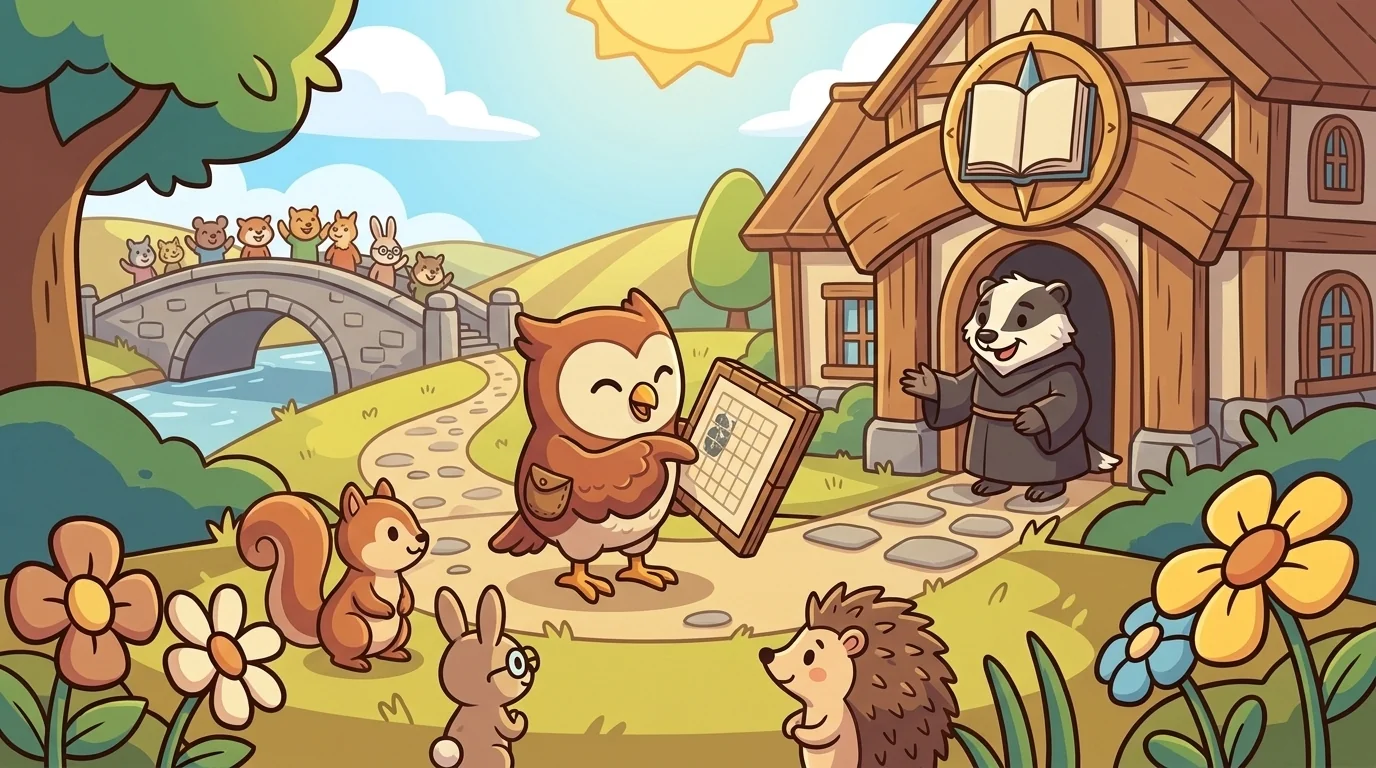
Verity's grandmother would say, "We need to know all the conditions. If it rained AND the river was high, the bridge might be unsafe. If it didn't rain AND the river was low, the bridge was fine."
Young Verity watched them. She learned to fill in the grids. Row by row. Making sure every possibility was covered. It was how they kept the village safe.
When Verity was old enough, she walked to DiscreteQuest. It was a big, tall building. Full of smart creatures. A wise old badger was the mentor there.
The badger looked at Verity. "What is *propositional logic*?" he rumbled.
Verity didn't blink. She pulled out her small grid.
"It's about statements that are true or false," she said. "And how they connect with *AND, OR, and NOT*."
She tapped her grid. "*Truth tables* show all the cases. Every single one. Each row is one combination of true and false. The pattern of T/F across the rows? That's what defines the connection."
The badger smiled. "You are appointed," he said. Verity felt a warm flutter in her chest. She had shown him her way. Her careful, row-by-row way.
She still says it to anyone who asks. "It is not hard. It is check each row. The pattern defines the connective." And she always has her grid ready.
The DiscreteQuest ensemble
Verity the Truth-Tester is part of DiscreteQuest's distributed-narrative cast. Each character embodies a different curricular primitive; together they teach the full subject.
-

Sortie the Set-Curator
Sets, subsets, set operations (union, intersection, difference)
-

Tally the Pattern-Counter
Counting principles and combinatorics (multiplication rule, permutations, combinations)
-

Wander the Bridge-Walker
Graph theory — Eulerian paths, Hamiltonian paths, connectivity
-

Coil the Self-Reference
Recursion and sequences (Fibonacci, factorials, recursive patterns)
-

Prime the Indivisible
Number theory — primes, factorization, modular arithmetic
-

Cubby the Cubby-Keeper
The pigeonhole principle — when there are more things than places, at least one place must hold two
-

Swatch the Border-Painter
Graph coloring — coloring connected things so no two neighbors match, with the fewest colors
-
Marshal the Line-Arranger
Permutations — counting arrangements where order matters (factorials, ordered choices)
-

Twoby the Pair-Matcher
Parity and invariant arguments — even/odd pairing that proves what's possible
-

Surge the Growth-Racer
Order of growth — how the work scales as a problem gets bigger