
Push
PUSH — *the pressure difference. measured in volts.*
Press play to listen along. The line being read lights up as you go.
Show full transcript
Loading transcript…

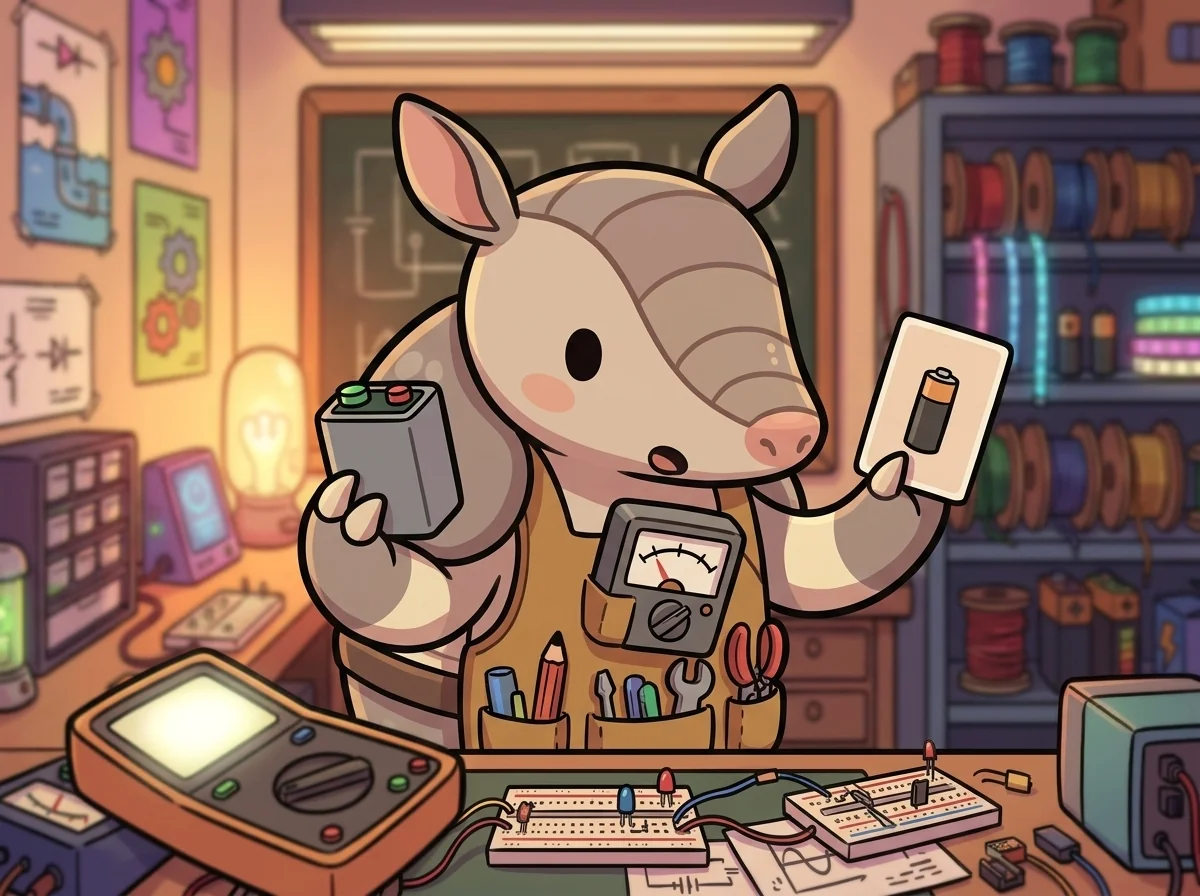
Push was a small armadillo, no bigger than a school backpack. He wore a chunky volt-vest, the kind with thick padding and bright yellow accents. His favorite tools, a small voltmeter and a set of battery-cards, were always tucked into its pockets. He often stood in a braced pose, like a tiny engineer ready to tackle any problem.
His armor was a soft stone-grey, blending into the warm cream of his underside. But it was his curiosity that truly stood out. Push was fascinated by electrical pressure, by what made things move. "The pressure difference," he'd often say, holding up his voltmeter. "Measured in volts." His small meter could read the push between any two points. His battery-card set showed different power sources: a tiny AA battery at 1.5 volts, a chunkier 9-volt, a USB port at 5 volts, or even a wall outlet pushing 120 or 230 volts. For Push, these weren't just numbers. They were the invisible forces that made the world hum.
Push lived and breathed *voltage. He understood it as the potential difference, the driving force behind all things electric. Many people, especially beginners, got confused. They mixed up voltage with current. But Push knew the truth: voltage was the pressure pushing electrons. Current was the flow* of those electrons. Without a difference in pressure, nothing would ever move. He liked to think of it like water pipes. Voltage was the water pressure, and current was the rate of water flow. A tall water tower, with its high pressure, pushed water through pipes much faster. A battery's voltage did the same for electrons in a circuit. More voltage meant more push. Push's entire goal was to make this pressure difference clear, to take the mystery out of it.

Push was always clear about it. "The pressure difference," he'd explain, tapping his voltmeter. "Measured in volts." He'd show how a battery had a higher electrical pressure at its positive (+) end than at its negative (−) end. That difference was voltage. Electrons, being negatively charged, naturally wanted to move from areas of low pressure to high pressure. So, they flowed through wires and components, giving up energy as they went. "Voltage is the push," Push would insist, "the push that makes electrons want to flow." A small AA battery, just 1.5 volts, offered a gentle nudge. A 9-volt battery, six times stronger, gave a much bigger shove. And a wall outlet? That was a powerful blast. "Bigger voltage," Push would conclude, "means more push."
Push had a whole set of ideas, what he called his "voltage scaffolds," to help others understand. He'd explain that a volt wasn't just a number. It was the amount of energy each electron carried, like how much punch it packed. One volt meant one joule of energy per coulomb of charge. That was the energy each tiny electron brought to the job.
"Remember," he'd say, "voltage is always a difference." You couldn't just have voltage at a point. It was always between two points, like the difference in height between two steps. Batteries, generators, or solar panels were the sources. They created that steady difference in pressure.
When Push used his voltmeter, he'd show how to connect it in parallel. "Touch the two probes across whatever you're measuring," he'd instruct. "Don't break the circuit. You're just checking the pressure difference between those two spots."
He'd demonstrate with a small circuit. "If you have a 3-volt battery and two identical parts connected one after the other, in series," he'd explain, "the voltage divides. Each part gets 1.5 volts." Then he'd show a different setup. "But if those same parts are connected side-by-side, in parallel, they both see the full 3 volts. The pressure is the same across both branches."
Push called this "energy bookkeeping." It was a rule known as Kirchhoff's voltage law. Around any complete loop in a circuit, all the voltage drops had to equal all the voltage rises. The numbers always balanced out.
He also made sure to clear up a common mistake. "People say, 'I touched the wire and it shocked me – the battery had too much current!'" Push would shake his head. "No. You felt the voltage pushing current through your body. A low-voltage source, even one that could deliver a lot of current, is usually safe. But a high-voltage source can push dangerous current through you." He'd emphasize, "Voltage is the danger threshold. Current is what actually causes the damage."
He'd compare an AA battery to a car battery. "Both might be around 1.5 volts or 12 volts," he'd say. "But a car battery can deliver much more current. The voltage is the push. The wire or whatever you connect determines how much flows."

Push saw these ideas everywhere. The way air pressure moved through his family's burrows, or how heat moved from a hot stove, or even how different chemicals mixed. It was all about pressure, gradients, and the push for balance.
Push had grown up along the dry desert arroyos, where the land was carved by ancient floods. His family were the long-standing pressure-keepers for their village. For generations, armadillos like Push had managed the air pressure in their intricate burrows. They understood that a difference in pressure meant motion. Air always moved from high to low, seeking balance. The wind that whistled through their tunnels was just pressure looking for a way out. Push had learned this lesson early, carrying it with him like a precious stone.
When Push was twelve, he made the journey to CircuitForge. Watt, the wise old mentor, stood waiting. "What is voltage?" Watt asked, his voice low. Push didn't hesitate. "The pressure difference," he said, puffing out his chest a little. "Measured in volts. It's the craft of potential difference." Watt nodded slowly. "You are appointed," he declared. It was the highest honor.
In his workshop, Push loved to demonstrate. "Watch," he'd say, holding up his voltmeter. He'd touch the probes across an AA battery. The screen glowed: "1.5V." "That's the push," he'd explain, "from the positive to the negative terminal." Next, he'd measure a 9-volt battery. "Nine volts," he'd announce. "Six times the push."

Then he'd wire up a small circuit: a 9-volt battery, a tiny LED, and a 470-ohm resistor. The LED glowed a soft blue. Push would carefully measure the voltage across the resistor. "~7 volts dropped here," he'd murmur, pointing. Then across the LED: "~2 volts dropped there." He'd add the numbers in his head. "Total? Nine volts. Kirchhoff's voltage law. The books always balance."
"I am Push," he'd tell his students, his voice firm. "The primitive I teach is *voltage*. It's all about pressure difference, the potential energy per charge. Remember: bigger volts mean more push."
Push was always gentle when he delivered his most important warning. "Don't confuse voltage with current," he'd say, his voice soft but clear. "Voltage is the push. Current is what actually flows." He'd return to his favorite analogy. "Think of water. A tall tower means high pressure, like high voltage. A big, wide pipe means low resistance, so you get high current, even at lower pressure." He'd remind them, "Voltage and resistance work together to decide how much current flows. That's Ohm's law, a topic Damp will teach you later."
He'd finish with his signature phrase, a quiet promise of understanding: "The pressure difference. Measured in volts."
The CircuitForge ensemble
Push is part of CircuitForge's distributed-narrative cast. Each character embodies a different curricular primitive; together they teach the full subject.
-

Flow
Current — electrons moving through wires; measured in amperes
-

Damp
Resistance — the slowdown; measured in ohms; Ohm's Law (V = I × R) emerges from Push + Flow + Damp together
-

Branch
Series vs parallel topology — one path or many; the topology decides the behavior
-

Build
Component-wiring craft — every component has a job; wire them together and the circuit comes alive