Ridge
RIDGE — climb the mountain, change the biome.
Listen along — Ridge
Loading audio…
Press play to listen along. The line being read lights up as you go.
Show full transcript
Loading transcript…
Chapter 4 — Ridge and the Stacked Biomes Going Up
Ridge started the morning in a warm oak forest and, by lunchtime, was standing in snow, and she had never once teleported.
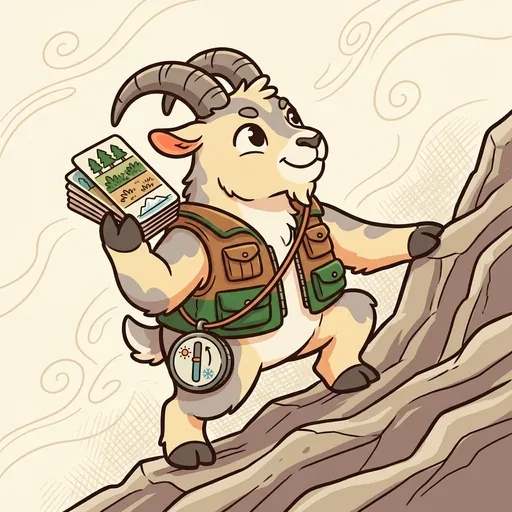
She was a small ibex-tween with a cream coat gone stone-grey down her back, and she climbed the way other people walked — steadily, hoof over hoof, not showing off. Beside her scrambled a squirrel who kept stopping to complain.
“We’re going the wrong way,” the squirrel puffed. “It’s getting cold. There were acorns back there.”
“There were acorns back there,” Ridge agreed, and kept climbing.
By the time they passed the oaks, the trees had gone pointy and dark — firs, packed close, smelling of resin. Higher still, the firs got short and bent, then quit altogether, giving up to a low carpet of tough little cushion-plants and lichen that clung to bare rock. The squirrel’s breath fogged. There was actual snow in the shadows now, in July.
“See?” Ridge said, tapping a hoof on the frozen ground. “Same mountain. Same morning. Whole different world.” She looked back down the slope, at the green forest they’d left far below, warm and buzzing. “You didn’t go north. You went up. But the mountain gave you the same trip — hot at the bottom, cold at the top, and every kind of living thing stacked in between, like floors in a very tall, very slow building.”
The squirrel stared down at the layers. From up here you could see all of it at once — forest, then fir, then scrub, then rock and snow — laid out in bands, like the mountain had sorted the world by temperature.
Ridge learned to read those bands the summer she got lost.
She’d been small, and she’d climbed too high chasing a smell of new grass, and when the fog rolled in she couldn’t find her way back down. The cold got into her. The plants up there were strangers — nothing she knew, nothing like home. She remembered sitting on cold stone thinking: I climbed so far that I climbed right out of everywhere I understand. It felt like being homesick in a place that was only an hour from home.
Her aunt found her at dusk — an old ibex who’d lived on the mountain her whole life, who knew things the way Andean and Tibetan herders had always known them, passed hoof to hoof and voice to voice across more years than anyone could count.
She didn’t scold. She sat down beside Ridge in the cold and pointed back down the slope.
“You’re not lost, little one. You just climbed through the floors too fast.” She traced the bands with a hoof. “See the grass-scrub there? That’s one country. The firs below it, that’s another. The oaks under those, another again. Every band is a home for something — you just can’t live in all of them at once, and neither can anyone else.” She nudged Ridge to her feet. “Home isn’t gone. It’s three floors down. Walk toward the warm and you’ll walk right back into it.”
They did. And with every band they dropped through, Ridge felt the mountain hand her back a little more of the world she knew — the firs, then the smell of oak, then the buzzing warmth. The cold, out-of-everywhere feeling had a shape now. It wasn’t lost. It was just high.
She came to Biomeforge at twelve, because a place that studied living worlds ought to understand the one stacked sideways up a mountain.
The mentor who kept the field station met her at the trailhead — didn’t test her strength, didn’t ask if she was tough enough. Just asked, “What lives on a mountain?”
Ridge didn’t answer with a list. She started walking uphill, and beckoned the mentor along. As they climbed she named what changed: the oaks thinning, the firs crowding in, the firs shrinking, the trees quitting, the cushion-plants and lichen taking over the bare cold rock. By the time they stopped, they were standing in a completely different band of life than they’d started in — and they’d walked less than an afternoon.
“You could ride a whole continent’s worth of climates,” Ridge said, a little out of breath, “without ever leaving one hill. Up a thousand paces is about the same as walking a thousand miles toward the cold. The mountain does the trip for you.”
The mentor looked back down through all the stacked bands, quiet for a while. “You belong here,” she said.
Ridge’s corner of the field station was a wall of cards, each one a band of the mountain, painted in its true colors.
A girl came in one afternoon, upset. She’d been tracking a little alpine flower that only grew in the cold cushion-zone near the top — and this year she couldn’t find it where it had always been. “It’s just gone,” she said. “Did I do something wrong?”
Ridge knew that worried look. She’d worn it, lost in the fog.
“Show me where you looked,” she said. The girl pointed at a card, high up but not at the very top. Ridge tapped the card above it — the last thin band before bare rock and snow. “Try up here.”
“But it’s colder up there.”
“It’s getting warmer down where you looked,” Ridge said gently. “The whole mountain’s warming, just a little, every year. And your flower can’t live warm — it needs cold. So it’s doing the only thing it can. It’s climbing.” She traced a hoof up the wall, band by band. “It’s chasing the cold uphill, higher and higher.” Then she stopped, because the wall stopped, at the snowy peak.
“And when it runs out of mountain?” the girl asked quietly.
Ridge didn’t dress it up. “Then it runs out of up.” She let that sit. “That’s why we watch. That’s why we count. Somebody has to notice which floor everything’s standing on — because the floors are moving.”
The girl found the flower that afternoon, one band higher than the map said. She came back grinning and worried in equal parts, which, Ridge thought, was exactly the right way to feel.
Later, with the station empty, the girl lingered at the wall of cards.
“When you climb,” she said, “does it ever feel like leaving home? All those different worlds so close together?”
Ridge thought about the fog, and the cold stone, and her aunt’s hoof tracing the bands in the dusk.
“At first it feels like leaving,” she said. “Cold air, strange plants, nothing you know — like you climbed right out of everywhere that made sense. But then you learn to read the floors, and it stops feeling like leaving. It starts feeling like the mountain is showing you every home it’s got, all stacked up, all at once.” She looked out toward the peak, pale in the late light. “Warm at the bottom. Cold at the top. And a living world tucked into every band in between, each one holding on to exactly the height that keeps it alive.”
The girl nodded slowly, and Ridge watched the worry ease off her shoulders — not gone, just settled — the same way, years ago, her own had, walking downhill into the warm.
The BiomeForge ensemble
Ridge is part of BiomeForge's distributed-narrative cast. Each character embodies a different curricular primitive; together they teach the full subject.