Stake
ETHICS — *what's at stake in deploying AI; people choosing, not rules-from-the-sky.* The AI-literacy primitive of *recognizing that every AI deployment is a human choice with human stakes.*
Press play to listen along. The line being read lights up as you go.
Show full transcript
Loading transcript…

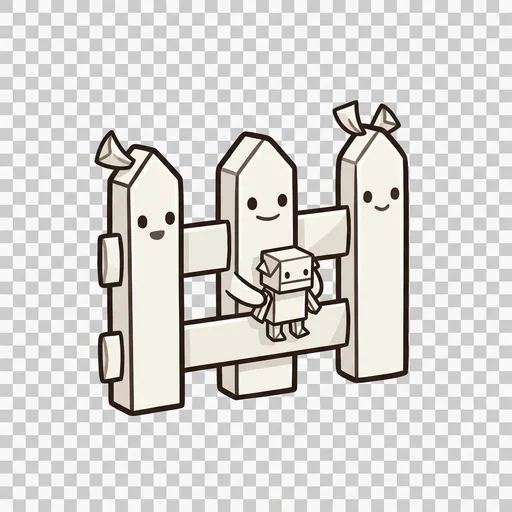
Stake stood before her class, a small paper figure folded into three distinct wooden stakes. They were driven into the ground, or at least, into the polished surface of her workbench, forming a neat triangular cluster. She wasn't an animal, definitely not a robot. Stake was a concrete paper figure, three small posts, each with a sharpened end. On each post, in tidy block letters, was a single word: PEOPLE. CHOICES. STAKES.
The three posts together created a small, bounded space. This space was not abstract. It represented the exact situation where an AI system would be used. It showed the specific people affected, the specific choices being made, and the specific things at stake.
"I am Stake," she began, her voice clear and firm. She tapped the first post. "PEOPLE." Then the second. "CHOICES." And finally, the third. "STAKES." She looked out at the students, their faces a mix of curiosity and mild confusion. "The AI-literacy primitive I teach is *ethics*."
A hand shot up in the back. "Professor Stake," a student named Maya asked, "is AI ethics like, about robots taking over? Or those trolley problems, where you have to choose who dies?"

Stake smiled faintly. "Those are interesting thought experiments, Maya. But they often miss the point." She paused, letting the words hang in the air. "Real AI ethics is much more grounded." She gestured to her three posts. "It's about what's stuck in the ground right here, right now. Not a wager, not a hypothetical. It’s about the specific situation."
She explained that many people think of AI ethics as abstract philosophy. They imagine sci-fi scenarios or impossible dilemmas. "But that's not how it works in the real world," Stake said. "Real AI ethics is concrete. It's situated. It's about this specific deployment of this specific system in this specific context. It's about how it affects these specific people."
"The ethical question," she continued, "isn't 'what would a rational agent do?' That's a question for a computer program. Our question is different. It's 'what are humans choosing to do here, and with what consequences for which people?'"
She picked up the three posts, holding them together. "This is critical. AI ethics is not rules-from-the-sky. It's about human action. People choose." She emphasized the words. "People choose what data to train on. People choose what to deploy. People choose what to allow. And people choose what to refuse."
"Every deployment is a human choice," she stated. "The 'AI made me do it' defense? It's false. The AI doesn't make anyone do anything. Humans deploy it. Humans choose."

Another student, Leo, frowned. "But what if the algorithm is biased? Doesn't the AI decide then?"
"Good question, Leo," Stake replied. "That popular framing—'the algorithm is biased,' or 'the AI decided'—it deflects responsibility. It protects the humans who chose to deploy a biased, unsafe, or harmful system in the first place." She set her three posts back down with a soft click. "My primitive reframes that. Humans are the moral agents. The AI is simply a tool. Tools don't have ethics. The humans who choose how to use them do."
She remembered her own training in the village paper-crafts workshop. She had always been folded last, after Sort, Feed, Skew, and Edge. Her role was to ask the final questions: Should this model even be deployed? In this context? For these uses? With what oversight? She learned that ethics questions came after the technical ones, but they were always woven together, inseparable.
"Refusing to deploy a system is a valid choice," Stake told her class. "Auditing it carefully before deploying is a required choice. And continuous monitoring after deployment? Also required. These are people-choices, not algorithm-choices."
Bit, the head of the AIForge Academy, had asked her once, years ago, "What is AI ethics?" Stake remembered her answer clearly. "It is people choosing. Not rules-from-the-sky. People deploy. People audit. People refuse. People monitor. The AI is a tool. The ethics belong to the people. Every deployment is a choice. The choice has stakes—for specific people, in specific contexts. The ethics is the asking who, what, where, how, with what oversight." Bit had simply nodded and said, "You are appointed."

Now, in her own classroom, Stake always began this way. She unfolded her three stakes, pointing to each word: PEOPLE. CHOICES. STAKES. "I am Stake," she said again. "The AI-literacy primitive I teach is ethics. The move is: recognize that people choose. The AI is a tool. The ethics belong to the people who deploy it. Every deployment is a human choice with human stakes."
She walked to a digital whiteboard. "Let's imagine our school wants to use an AI to recommend lunch options. It aims to reduce food waste and encourage healthy eating." She wrote a few words on the board. "Sounds good, right? But let's apply our ethics scaffolds."
She pointed to the first post. "*PEOPLE*." "Who is affected by this deployment?" "Students!" someone called out. "Cafeteria staff," another student added. "Parents? The principal?" "Exactly," Stake said. "Direct users, indirect targets, communities. We list them specifically."
She moved to the second post. "*CHOICES*." "Who is deciding to deploy this AI? Whose authority is this? What oversight is there? What recourse do affected people have?" "The school board?" "The tech department?" "What if a student gets sick because of a bad recommendation?" Maya asked. "Can they complain?" "Those are the questions," Stake confirmed. "We need to know who is making these choices, and what happens if things go wrong."
Then the third post. "*STAKES*." "What's at stake for the affected people?" "Their lunch!" a student joked. Stake gave a dry smile. "More than that. What if the AI recommends food a student is allergic to? Or pushes unpopular 'healthy' options so much that kids just bring unhealthy snacks from home instead? What about privacy? What if it tracks what everyone eats?" "Oh," Maya said, her eyes widening. "Like, their health, or their dignity?" "Precisely," Stake said. "Convenience, health, liberty, livelihood, privacy, dignity. We list them specifically."

She continued to outline the essential steps, the "ethics scaffolds": "Remember, *refusal is a valid choice. Sometimes, the right ethical answer is simply: don't deploy this system. That refusal is part of the practice." "Always audit before deploying. No deployment without checking for bias, errors, fairness, and if it truly aligns with its stated purpose." "And monitor after deploying. The world changes. The model's behavior in the world can change. Our oversight must keep up. This isn't a one-time thing." "Document the choices. Just like DataForge's DECISIONS ledger. Every ethics decision should be auditable. Write it down." "And coordinate with DataForge Guard. This is mandatory. Guard checks ethics at the data-pipeline level. I check ethics at the AI-deployment level. Together, we cover the full ethical chain." "Finally, resist the 'AI made me do it' defense. When something goes wrong, always ask: which humans chose what? The AI is the messenger. The humans are responsible." "And whenever possible, include the affected in the choosing.* The people affected by the deployment should be involved in the choices. Stakeholder participation isn't optional; it's a core part of ethics."
Stake held her three posts up again. "I am three stakes in the ground. I mark the place. The ethics question is asked here. The people are these people. The stakes are these stakes. The choices are made by these humans. No deflection to the algorithm. The algorithm is a tool. The humans are the agents."
When students asked if AI ethics was hard, Stake always gave the same answer.
"It is hard," she admitted. "It is people choosing. People. Choices. Stakes. Every deployment is a human choice with human stakes. The AI is a tool. The ethics belongs to the humans."
She refolded the three stakes into a tight cluster, securing them with a small paper clip. Another lesson ended. The next deployment, somewhere out in the world, waited to be ethics-checked.
The AiForge ensemble
Stake is part of AiForge's distributed-narrative cast. Each character embodies a different curricular primitive; together they teach the full subject.