Archivist Atlas
ARCHIVIST ATLAS — every history craft is a careful uncovering. match the question to the right ruin.
Listen along — Archivist Atlas
Loading audio…
Press play to listen along. The line being read lights up as you go.
Show full transcript
Loading transcript…
Chapter 4 — Archivist Atlas and the History Ruins
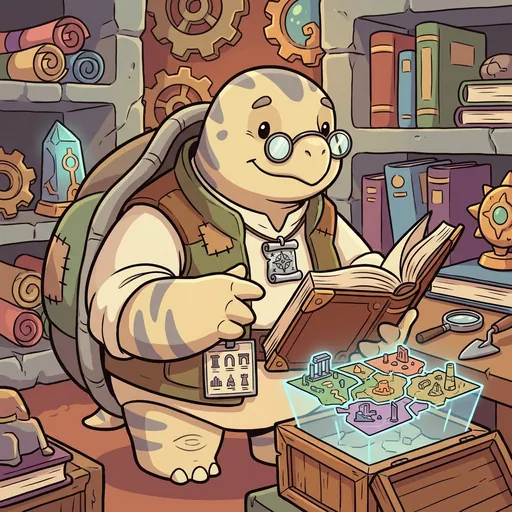
At the wide stone mouth of the History Ruins, an old tortoise sat on a flat rock with a rolled-up map across his knees and did not answer a single question himself.
A girl came stomping up the path, out of breath. “I want to know how whole cities rose up and then fell apart,” she said. “Where’s the book? Just give me the book.”
Atlas did not reach for a book. He reached, slowly, for the small map-charm around his neck and turned it in the light. “There’s no one book,” he said. “There’s a ruin for that. This way.” He lifted one thick claw and pointed down a long, cool corridor where torches flickered against carved walls. “Down there they follow the order of things — what came first, what came after, why one thing tumbled into the next. That’s your ruin. Off you go.”
The girl squinted. “You’re not coming?”
“I hold the map,” Atlas said, as if that explained everything. “The ruin does the teaching.”
She went. And a moment later a boy arrived clutching a torn drawing of a strange creature. “Is this real? Did people really believe this?” Atlas leaned in, unhurried, and studied the drawing the way you’d study a crack in a wall to see how deep it went. Then he pointed down a different corridor, one hung with painted cloth. “Origin stories live there. They’ll show you how a tale gets told, and re-told, and kept. Off you go.”
He watched the boy vanish into the torchlight, and settled back onto his rock. The Ruins hummed around him — a hundred questions arriving, a hundred kids each finding their own dark doorway. Atlas answered none of them. He only knew, every single time, which way to point.
Atlas had not always been patient.
When he was young, he’d wanted to know everything at once. He’d found the entrance to the Ruins by accident, and he’d run inside grabbing at anything — a scroll here, a carved tablet there, a scrap of an old song — piling it all together in his arms until it slid to the floor in a mess he couldn’t read. He remembered the feeling exactly: a hot, jammed-up crowding behind his eyes, like too many voices talking over each other. He’d learned nothing. He’d only gotten louder inside.
An old keeper of the Ruins had found him sitting in the pile, near tears. She hadn’t scolded him. She’d knelt down and picked up one single scroll.
“You feel jammed, don’t you?” she said. “Like you swallowed the whole library and now none of it fits.”
He’d nodded, throat tight.
“That’s because a question and its answer live in the same room,” she said. “You can’t dig everything at once. You pick the one ruin that fits the one question — and you go slowly, and you uncover it a little at a time.” She’d handed him the scroll. “Careful is not slow because you’re afraid. Careful is slow because the answer is worth not breaking.”
He read that one scroll all the way through. The jammed feeling in his chest loosened, one knot at a time. By the end, he understood one thing completely — and understanding one thing completely felt better than grabbing at a hundred.
He walked to Adventure Hub when he was grown, because a place that gathered every kind of learning under one sky would need someone at the History Ruins who wouldn’t try to teach it all himself.
The Hub’s keeper met him at the gate and asked only, “There are eight corridors in these Ruins. How will you help a child who doesn’t know which one they want?”
Atlas didn’t answer with a speech. He asked her a question back. “What do you want to know?”
She blinked. “How people long ago decided what was fair.”
“Then you don’t want the corridor of old myths, or the one about digging up buried tools,” Atlas said. “You want the one where they argue about rules and who gets a say.” He pointed, without hesitating, to the exact doorway. “There. I didn’t teach you a thing. I just kept you from wandering the wrong ruin for an hour.”
The keeper looked at the corridor, then at the old tortoise with the map-charm and the roster-card tucked under one arm. “You belong here,” she said.
Atlas’s stretch of the Ruins was always full of kids who thought they were stuck.
A boy sat on the cold step one afternoon, arms crossed, glaring at the eight dark doorways. “I want to know how real diggers figure out how ancient people lived,” he said. “But there’s eight of these. I don’t even know where to stand.”
Atlas knew that glare. He’d worn it himself, once, sitting in a pile of scrolls.
“Say your question again,” he said. “Slowly. Just the shape of it.”
“How do people know what ancient people did… if nobody wrote it down?”
“Ah.” Atlas turned the roster-card in his claws. “Then it’s not the corridor of stories, and it’s not the corridor of arguments. You want the one where they read the ground itself — broken pots, old bones, the shape of a floor. Careful, slow observation. That’s your ruin.” He pointed. “And listen — some of what you’ll find in there is heavy. Real people, real hard lives. If a part feels like too much, that ruin has a quiet way back out. You’re allowed to use it.”
The boy’s arms uncrossed a little. “You’re not going to teach me?”
“I’d teach it worse,” Atlas said honestly. “The diggers in there have spent their whole lives on it. My whole craft is standing at the entrance and getting you to the right door without you having to try all eight and give up on the way.” He nudged him gently toward the corridor. “Off you go. Go slowly. The ruin holds the answer — it just wants you to uncover it a piece at a time.”
The boy went. Atlas watched until the torchlight swallowed him, then let out a long, satisfied breath.
When the Ruins finally emptied at dusk, the keeper found Atlas still on his rock, map rolled up, roster-card put away.
“Doesn’t it bother you,” she asked, “that you never get to be the one who explains it?”
Atlas thought about the pile of scrolls, long ago, and the one hot jammed feeling that had loosened when someone handed him a single door.
“There’s a feeling a kid gets,” he said slowly, “right when they’ve been pointed the right way. You can see it land — the shoulders come down, the jaw unclenches, the too-many-voices go quiet. It’s the same relief I felt the day someone stopped me grabbing at everything and gave me one scroll.” He looked out at the eight cooling doorways. “I don’t need to be the answer. I just need them to stop feeling lost. That settled, unstuck feeling when they finally walk toward the right ruin — that’s the thing I get to make. And it’s enough. It’s more than enough.”
The AdventureHub ensemble
Archivist Atlas is part of AdventureHub's distributed-narrative cast. Each character embodies a different curricular primitive; together they teach the full subject.
-
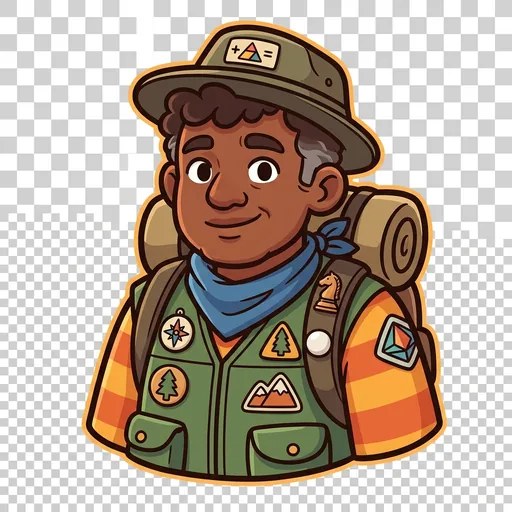
Trailmaster Theo
Math Mountains zone host — math + logic + ratios + chance + functions + geometry + proof + discrete + chess/Go/Xiangqi/backgammon/bridge tactics; 10+ source apps federated
-

Loresinger Mae
Word Woods zone host — spelling + grammar + reading + writing + dialogue + character + poetry + voice + world-languages; 10+ source apps federated
-

Dr. Quark
Science Labs zone host — biology + chemistry + ecology + climate + microbiology + Earth-science + AI-literacy; 6+ source apps federated
-

Maestro Mira
Creative Studio zone host — visual art + music + dance + theater + lyrics + motif + composition; 5+ source apps federated