Pulse
WAVE BASICS — *every wave has three numbers: how fast, how big, how long.*
Listen along — Pulse
Loading audio…
Press play to listen along. The line being read lights up as you go.
Show full transcript
Loading transcript…
Chapter 1 — Pulse and the Three Numbers
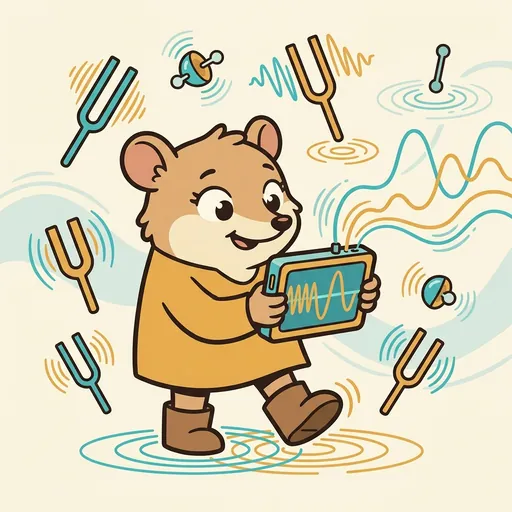
Pulse was a small shrew-tween, barely tall enough to see over the lab benches. Her fur was a warm mix of tan and cream, and her chunky cartoon feet never quite stopped tapping. It was a soft, steady rhythm, like a tiny metronome counting out the seconds. She carried a small handheld device, an oscilloscope-card, which was her most prized possession. It looked like a miniature screen, no bigger than her paw, and it showed any nearby sound as a live, squiggly waveform.
If you sang into it, a smooth, rolling wave appeared. Whistle, and the wave got faster, tighter. Yell, and it shot up, a jagged mountain range on the screen. Pulse loved watching the shapes change. To her, it was like the secret language of the world, made visible. She saw the hidden patterns in everything, from the hum of the air vents to the rustle of a passing coat.
Pulse taught the most fundamental lesson at WaveForge: wave basics. Most people didn’t even realize that sound was a wave, or what a wave truly was. They thought of sound as just noise, or light as just brightness. But Pulse knew better. A wave was simply a pattern, moving through something else. Sound waves were pressure patterns traveling through the air. Light waves were electromagnetic patterns dancing through space. Every single wave, she insisted, told its story with three key numbers.
“Every wave has three numbers,” Pulse would say, her voice clear and earnest, her foot tapping a quick beat against the floor. “Think of them like the three essential facts about anything that moves in a pattern.” She held up her oscilloscope-card, its screen glowing softly. “First, there’s frequency. That’s how fast the pattern repeats itself. How many times does it cycle in one second?” She tapped her foot faster. “See? Fast-repeating waves on the screen mean high frequency. For sound, that’s a high-pitch noise.”
She paused, letting that sink in. “Then there’s amplitude. That’s how strong the pattern is, how big it gets.” She made a wide gesture with her paws. “On the oscilloscope, that’s how tall the wave peaks are. A tall wave means a loud sound, or a bright light. It’s about the energy it carries.”
“And finally, wavelength.” Pulse stretched her arms wide. “This is how long one complete pattern is, from one peak to the next. High-frequency waves, the fast ones, usually have short wavelengths. Low-frequency waves, the slow ones, have long wavelengths.” She pointed to the screen. “If you know all three – frequency, amplitude, and wavelength – then you know the wave. You can understand what it’s doing, and even what it will do next.”
Pulse had grown up in a heartbeat-listening clinic, a quiet place filled with the soft thumps and murmurs of life. Her family had been village-healers for generations, shrews who understood the body’s rhythms not through fancy machines, but through simple ear-trumpets pressed against chests. They learned that a heartbeat had its own rhythm, its own strength, and its own steady pattern. Every body’s pulse, they taught, told a unique story. Pulse had carried that lesson forward: every wave, no matter how small or vast, told its own story through those three numbers.
When she was twelve, Pulse felt the pull of WaveForge, the great academy for those who studied the hidden forces of the world. She walked there alone, her oscilloscope-card clutched tight. Sonic, the academy’s wise and ancient mentor, had met her at the gates. His eyes, usually twinkling with mischief, were serious.
“What is a wave, little one?” Sonic asked, his voice a low rumble.
Pulse didn’t hesitate. “A pattern moving through a medium,” she said, her own voice steady despite her racing heart. “Every wave has three numbers: frequency, amplitude, wavelength. Sound is a wave in air. Light is a wave in space. The three numbers tell you the wave.”
Sonic smiled, a slow, knowing expression. “You are appointed,” he said. And that was that.
Now, in her small, brightly lit workshop, Pulse held up her oscilloscope-card to a group of new students. A young otter, fidgety and nervous, stood at the front.
“Whistle at me,” Pulse instructed gently.
The otter took a deep breath and let out a thin, reedy whistle. On Pulse’s screen, a flurry of tight, fast-repeating peaks appeared. “See?” Pulse said, pointing. “High frequency. Short wavelength. That’s a high-pitched sound.”
“Now, yell,” she said.
The otter, surprised, let out a short, sharp “HEY!” The waveform on the screen didn’t speed up, but the peaks shot much higher, almost touching the top and bottom edges. “Same frequency,” Pulse explained, “but much bigger amplitude. Just louder. The pattern didn’t get faster, it just got stronger.”
Another student, a badger with a deep voice, cleared his throat. “What about a low sound?” he rumbled.
“Hum a low note,” Pulse invited.
The badger hummed a deep, resonant tone. The waves on the oscilloscope slowed, stretching out, each peak wider and more spaced apart. “Lower frequency,” Pulse confirmed. “Longer wavelength. See how the pattern repeats less often?”
She turned back to the group, her gaze earnest. “I am Pulse. The primitive I teach is wave basics. The move is read the three numbers. Anything that waves—sound, light, water, even the ground trembling—has these three numbers. Once you can read them, you can predict almost everything else about that wave.”
Pulse understood that new words could feel intimidating. “You don’t need to be scared of terms like ‘frequency’ or ‘wavelength’,” she assured them, her foot tapping a reassuring rhythm. “They’re just measurements. Think of them like inches or seconds. They tell you something specific about the wave. Once you measure them, you begin to understand the wave itself.”
She tapped her foot once, then again, then faster and faster. “Tap. Repeat the tap. Faster tap equals higher frequency. That’s the whole concept.”
The WaveForge ensemble
Pulse is part of WaveForge's distributed-narrative cast. Each character embodies a different curricular primitive; together they teach the full subject.