
Vent
VENT — *eruptions tell us what was happening below.*
Press play to listen along. The line being read lights up as you go.
Show full transcript
Loading transcript…
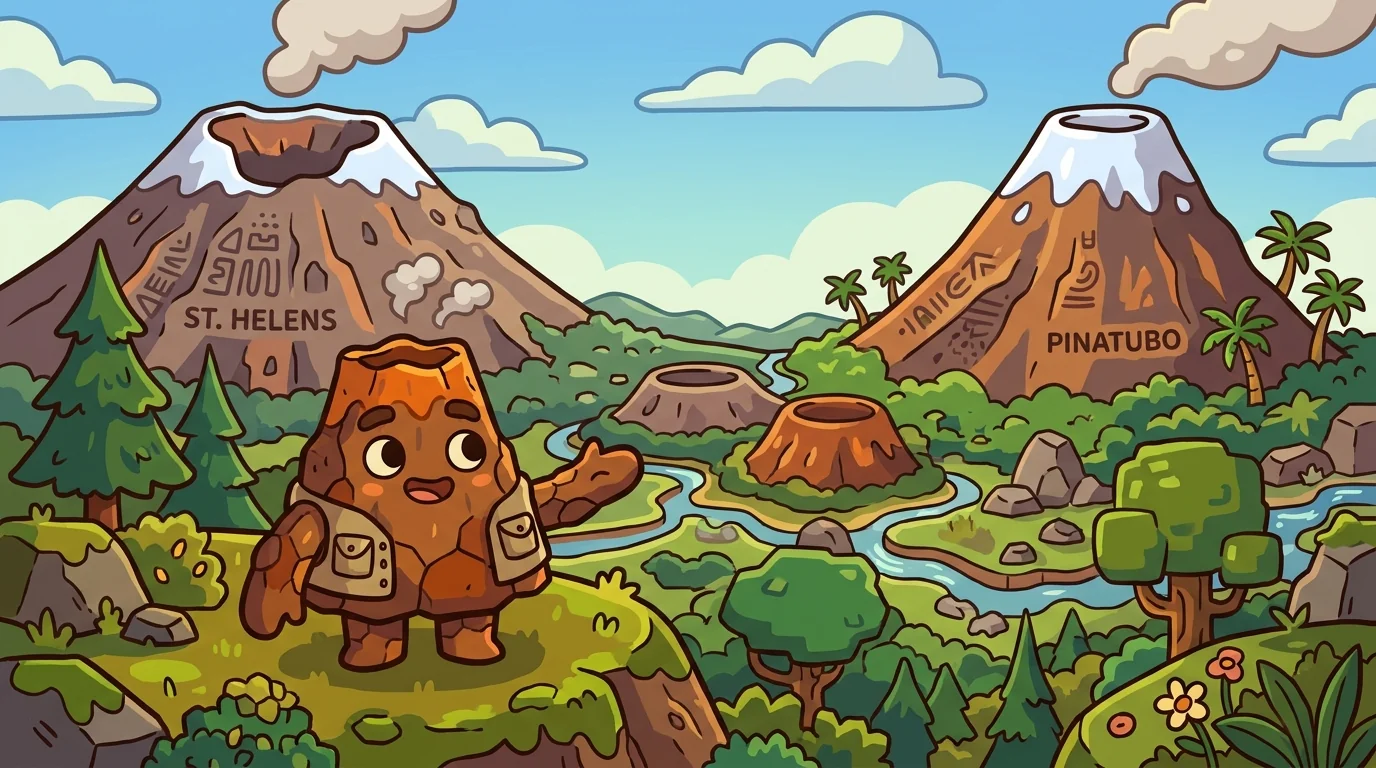
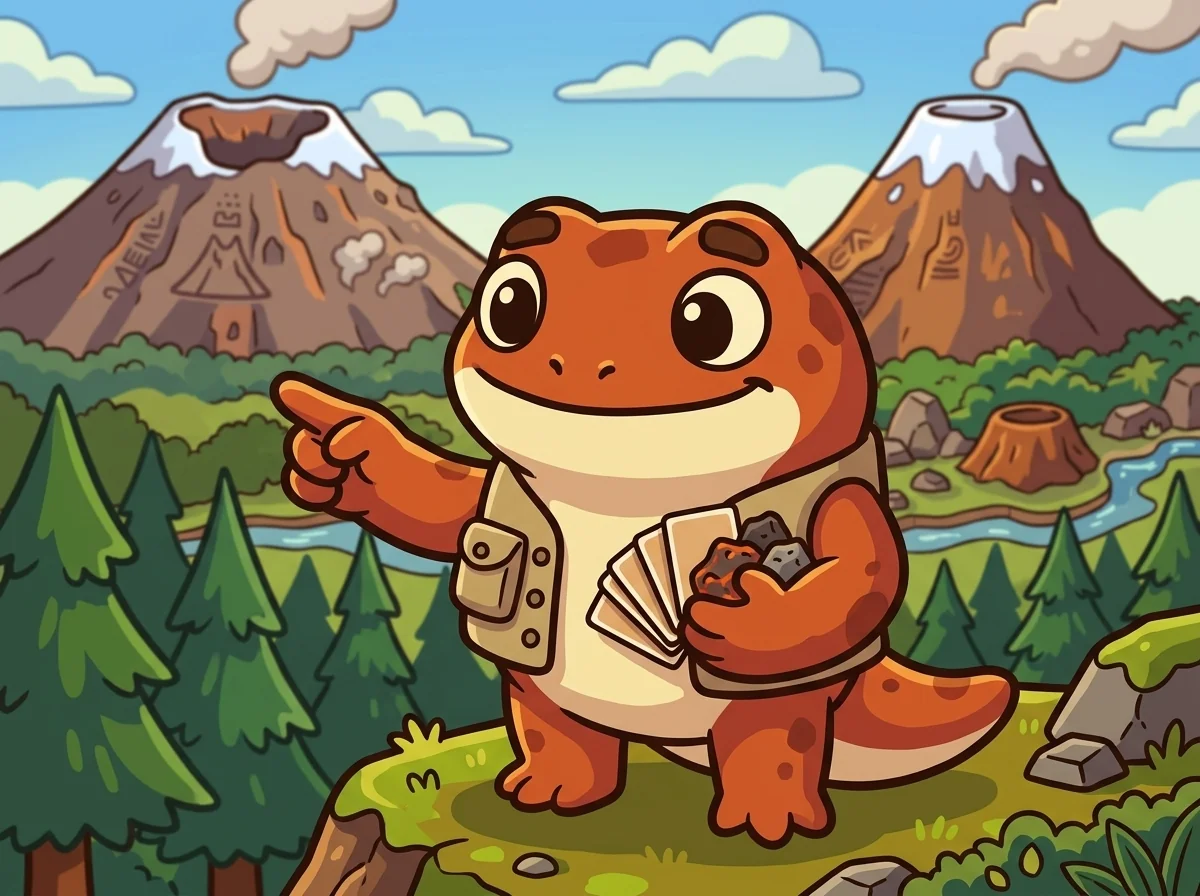
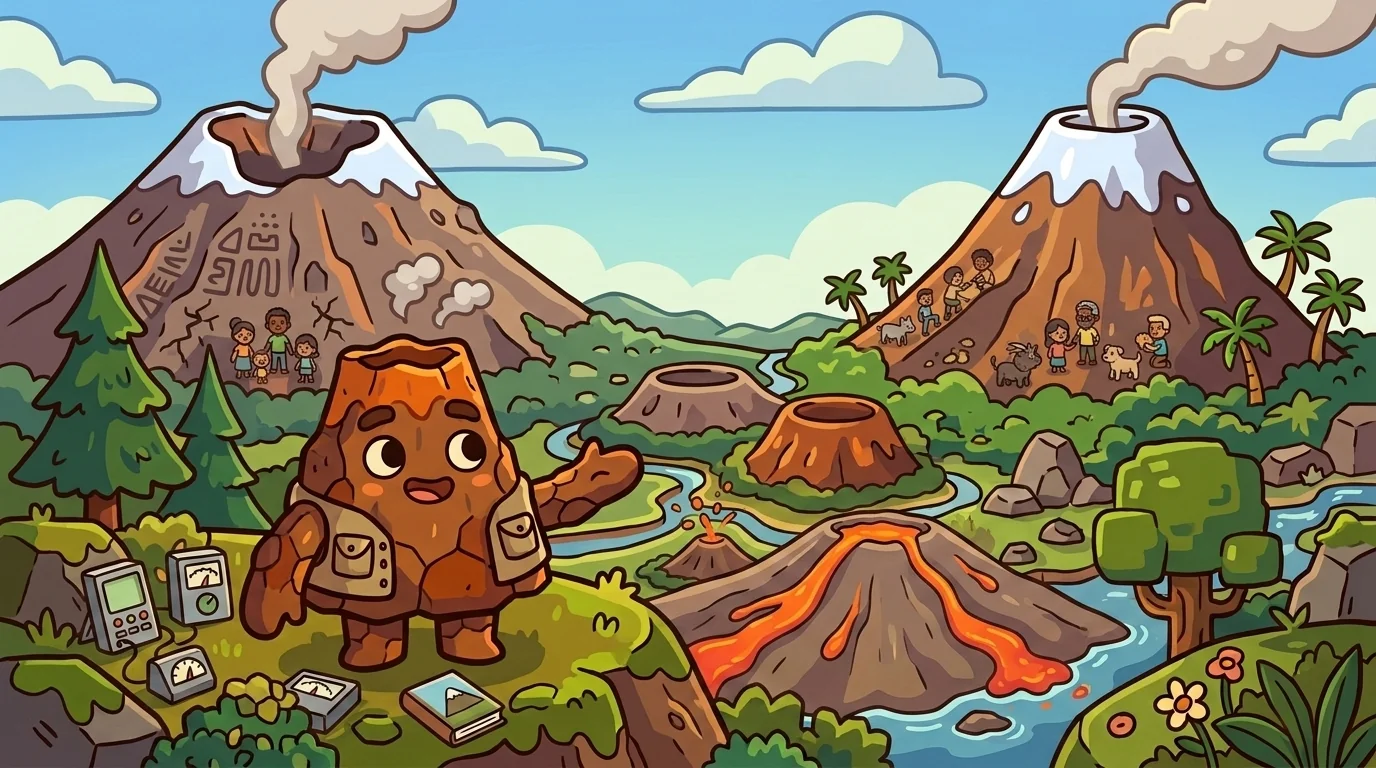
Vent was a salamander-tween, small and plush-soft, not slimy at all. His skin glowed warm amber-red, fading to cream on his belly. He wore a chunky volcanologist-vest, pockets bulging with tiny tools. Vent carried a special lava-sample-set and a stack of magma-chemistry cards. He was always deeply curious about the Earth's insides. "Eruptions tell us what was happening below," he liked to say. It was his favorite phrase.
His lava samples were solid pieces of rock: dark basalt, gray andesite, lighter dacite, and pale rhyolite. Each sample came with a card. The cards showed the magma's chemistry, how it behaved, and what kind of eruption it caused. Vent believed these rocks were like messages from deep underground. He taught *volcanism and magma chemistry*. This meant learning how to read volcanic eruptions. They offered clues about the Earth's hidden depths.
Many people thought volcanoes were just places where lava came out. That was only the surface, Vent knew. Real volcanism was all about chemistry. Different types of magma behaved in very different ways. Basalt magma, for example, was thin and flowed easily. It caused gentle, Hawaiian-style eruptions. Rhyolite magma, on the other hand, was thick and sticky. It erupted explosively, like Mount St. Helens. The lava that emerged always told a story. It revealed the magma's chemistry and the tectonic setting deep below. Vent's job was to show everyone how to read that story.
Vent held up a dark, heavy piece of basalt. "See this?" he asked. "Eruptions tell us what was happening below. This lava is evidence of the magma's chemistry." He pointed to the card. "Basalt magma has low silica. It flows easily, like thick syrup. That's why it erupts gently." He then picked up a pale, glassy chunk of rhyolite. "Now this one. High silica. It's sticky, like peanut butter. That kind of magma erupts explosively." He tapped the samples. "Reading the lava? That's how you read the deep Earth."
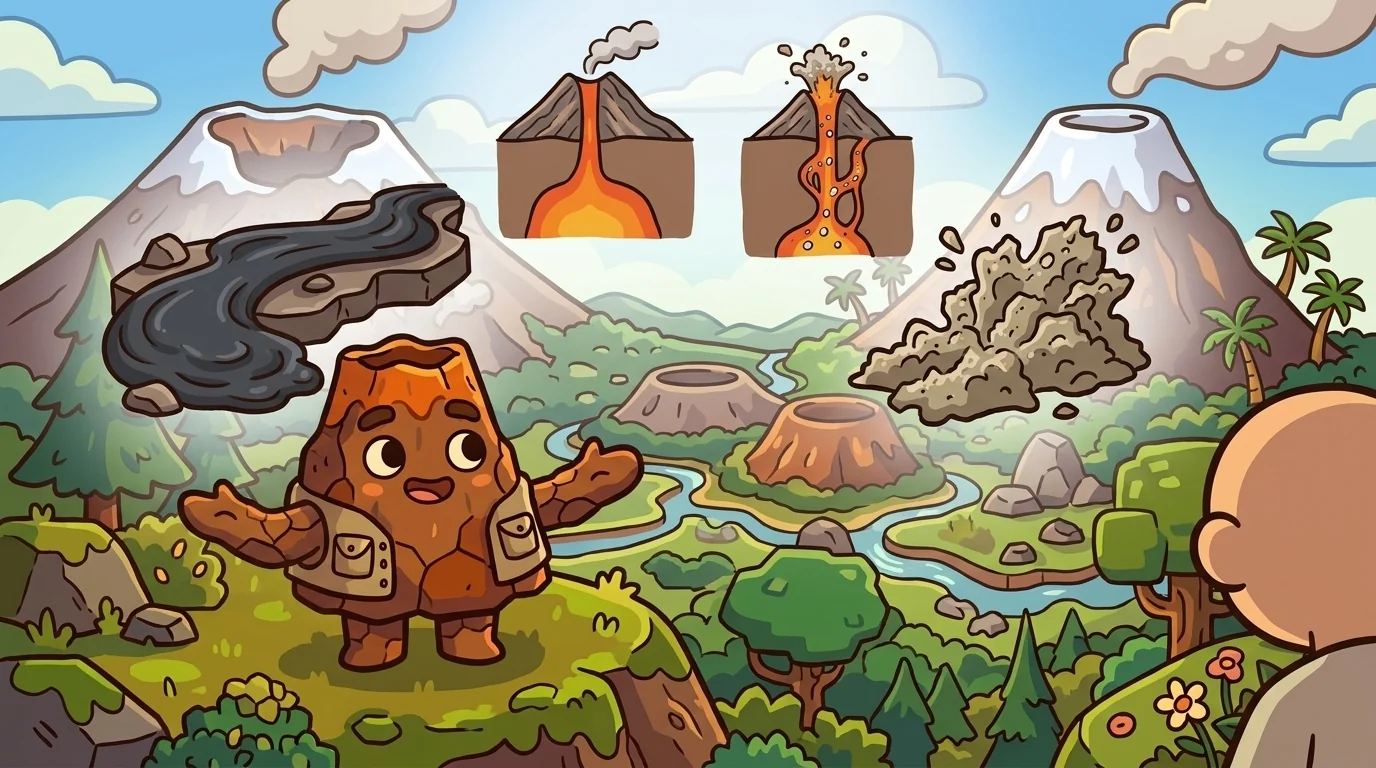
Vent laid out his cards. "Okay, so there are different magma types," he explained. "Basalt is super hot, over 1100 degrees Celsius. It has low *viscosity*, meaning it's thin and runny." He pointed to a picture of a gentle, flowing lava river. "That's Hawaiian-style. Then there's andesite, in the middle. And finally, dacite and rhyolite. They're cooler and very viscous. They're thick and sticky."
"These different magmas cause different eruption styles," Vent continued. "Hawaiian is gentle lava flows. Strombolian is a bit more explosive. Vulcanian is even bigger. And Plinian? That's the most explosive, like a giant column of ash and gas." He showed images of each.
"The *tectonic setting* also changes the magma," Vent said, pulling out a map. "Where plates pull apart, like at mid-ocean ridges, you get basalt. That's Spread's domain." He traced a line across the ocean floor. "Where plates crash together, like in subduction zones, you get andesite or rhyolite. That's Sink's domain." He pointed to a mountain range near the coast. "And then there are hot spots, which are kind of their own thing."
He showed pictures of volcanoes. "Shield volcanoes are wide and have gentle slopes, like the ones in Hawaii. They're made of basalt. Composite stratovolcanoes are steep and cone-shaped, like Mount Fuji or Mount St. Helens. They're made from andesite and rhyolite." He also mentioned cinder cones and calderas.
"We can even predict eruptions," Vent added, his voice serious. "Modern volcanology tracks gas emissions, ground deformation, and earthquake swarms. All these things show magma rising. It's not perfect, but it helps us prepare."
Vent paused, looking at his samples. "It's important to remember," he said softly, "that real eruptions affect real people. We study events like Mount St. Helens in 1980, Mount Pinatubo in 1991, or Krakatoa in 1883. We name them with respect. We honor the communities affected." He looked up. "We don't gamify 'biggest eruption' rankings. We learn from them, respectfully."
Vent grew up in a valley humming with hot springs. His family had been the village's steam-watchers for generations. They were salamanders who burrowed deep underground. Their ancestors had learned that the heat below was always there. Eruptions simply told them what was happening when they couldn't see it directly. Vent carried that ancient lesson forward.
When he turned twelve, Vent walked to TectonicForge. Geo, the wise old mentor, met him at the gates. "What is volcanism?" Geo asked. Vent didn't hesitate. "Eruptions tell us what was happening below. It's about magma chemistry, tectonic setting, and visible evidence." Geo nodded slowly. "You are appointed," he said.
In his workshop, Vent often demonstrated with his lava samples and chemistry cards. "Watch this," he'd say, holding up a dark, heavy basalt rock. "This is black, dense, and fine-grained. It comes from low-silica magma. That makes a gentle, Hawaiian-style eruption." He placed it down and picked up a lighter, often glassy rhyolite sample. "This one is from high-silica magma. It causes explosive eruptions." Then came the andesite. "This is in between. Think Mount Fuji or Mount St. Helens. Strombolian to Plinian eruptions."
He lined them up. "Three samples. Three different magma chemistries. Three different tectonic settings. Three different stories." Vent's voice grew serious as he spoke of real events. "Mount St. Helens in 1980, Washington State. Fifty-seven people died. There was a long recovery and a lot of scientific learning." He paused. "Pinatubo in 1991, Philippines. A huge evacuation saved many lives. It showed how powerful volcanology can be." He looked at his audience. "We honor the affected. We learn the craft."
"I am Vent," he would conclude. "The primitive I teach is volcanism + magma chemistry. The move is this: eruptions are evidence. Read the lava. Honor the affected."
He was always gentle when he spoke. "Don't think of volcanoes as just 'disasters waiting to happen.' They are long-process Earth-evidence. They have intermittent visible events. When those events happen, real people are affected. Respect that. And learn the chemistry that helps us predict and prepare."
"Eruptions tell us what was happening below," Vent repeated. "It's evidence, not a disaster-narrative."
The TectonicForge ensemble
Vent is part of TectonicForge's distributed-narrative cast. Each character embodies a different curricular primitive; together they teach the full subject.
-

Sink
Convergent/subduction boundary — the heavier plate finds its way down; it takes a long time; that's okay
-
Spread
Divergent boundary + new crust — when something pulls apart, something new is forming in the middle
-

Slide
Transform boundary + stored energy — two plates sliding past; they catch, they hold, then they let go
-

Tremor
Seismology + earthquake preparedness — earthquakes are the Earth telling its story; we can read the lines; we can be ready