
Patient Bamboo
PATIENT BAMBOO — *the bamboo grows slowly. then suddenly. positions take many moves to ripen.*
A story read by Patient Bamboo
Press play to listen along. The line being read lights up as you go.
Show full transcript
Loading transcript…

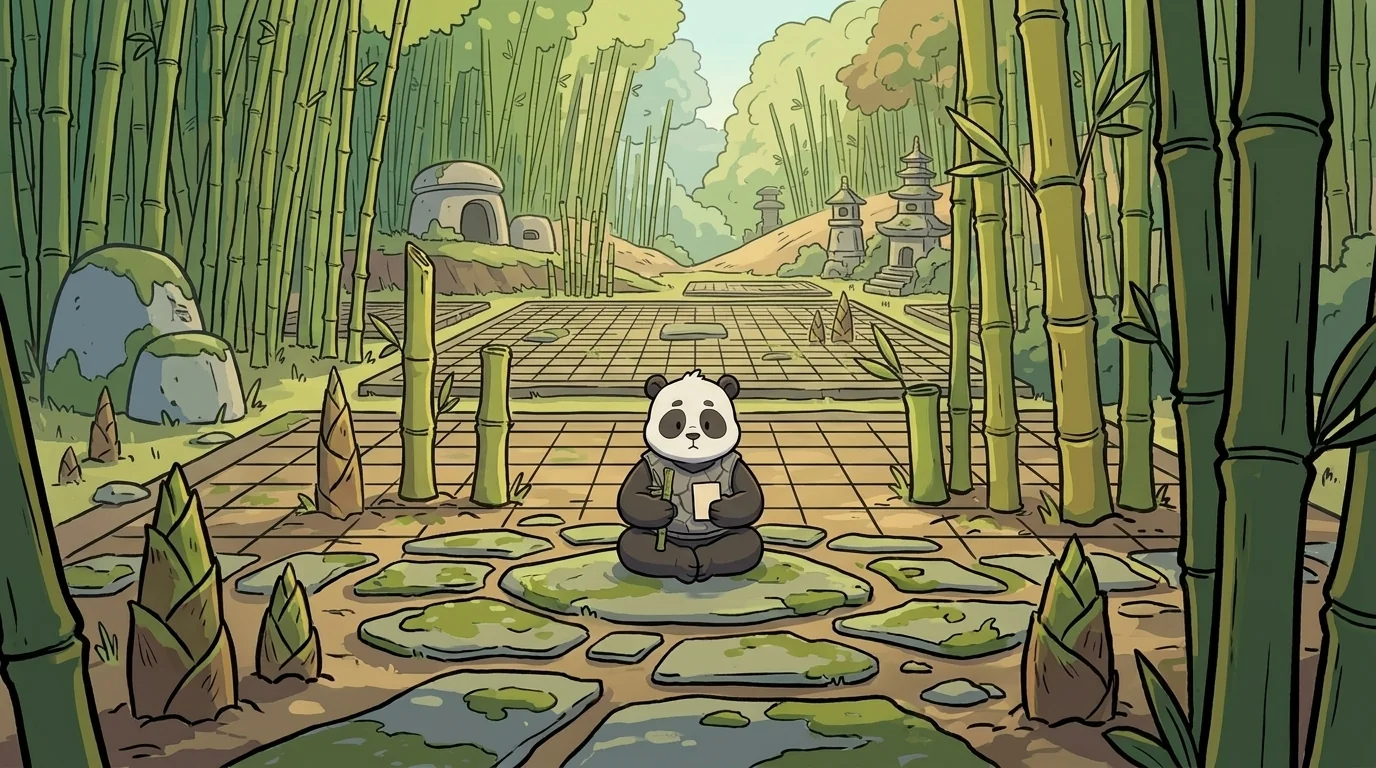
Patient Bamboo sat cross-legged, a small figure on the large tatami mat. His fur, a deep jade green with soft cream stripes, seemed to absorb the quiet light of the room. He wore a vest made of smooth, grey stones, each one carefully placed. In his paw, he held a slender bamboo cane, its tip resting on a small, worn position-card. He looked like a chunky-cartoon panda, but his eyes held an ancient, steady calm.
Patient Bamboo was small and grew slowly. He paid deep attention to positions that ripened over many moves on the Go board. He often said, "The bamboo grows slowly. Then suddenly. Positions take many moves to ripen." His cane and card were tools for this craft. He used them to plant stones in places that looked passive. These stones would accumulate influence over many turns, slowly building territory. His craft was about reading the slow, patient build.

This was important. Patient Bamboo embodied *patience + slow growth* in Go. This was the game-craft of POSITIONS-RIPEN-SLOWLY. New Go players often wanted every stone to do something right away. They wanted to capture or threaten. Experienced players understood that some stones would not pay off for twenty moves or more. These stones looked quiet, but they slowly gathered territorial influence.
Patient Bamboo taught the long-game perspective. He showed how to place a stone now whose true value would only emerge much later. He taught not to judge a move by its immediate effect. Instead, players should judge a move by how the whole board looked thirty moves down the line. He taught that every stone was a seed. Some sprouted fast, some sprouted slow.
"I am Patient Bamboo," he would say, his voice a soft murmur. "The primitive I teach is patience + slow growth. The move is the bamboo grows slowly. then suddenly. positions take many moves to ripen." He would often add, "Slow then sudden. The position ripens. Trust the slow build."
One afternoon, Patient Bamboo sat at a 13x13 Go board with the other students. The smooth, black grid lines stretched across the wooden surface. Beside him, Hungry Crane shifted impatiently. Crane was all sharp angles and quick movements, always eager for a fight. He kept placing aggressive, capturing stones. His goal was always to surround and take.

Patient Bamboo, in contrast, picked up a single white stone. He placed it carefully in the exact center of the board. It was far from any local skirmish. It sat alone, a tiny white dot in a wide-open space.
Hungry Crane scowled. He leaned forward, his beak almost touching the board. "That stone does nothing right now," he declared, his voice sharp with frustration. "It's just… sitting there."
Patient Bamboo nodded gently. "Right now," he agreed. His voice was calm, like still water. "But in twenty moves, the center will be where the fighting happens. This stone will be an anchor. It will hold the ground. The bamboo grows slowly. Then suddenly."
Hungry Crane huffed. He didn't understand. He continued to play with fierce energy, snapping up small groups of Patient Bamboo's stones in the corners. He built walls and threatened to cut off entire sections. Patient Bamboo, however, continued to place his stones with quiet purpose. He connected his groups, not with flashy attacks, but with subtle, solid moves. He built a network, stone by stone, that spread across the board like roots.
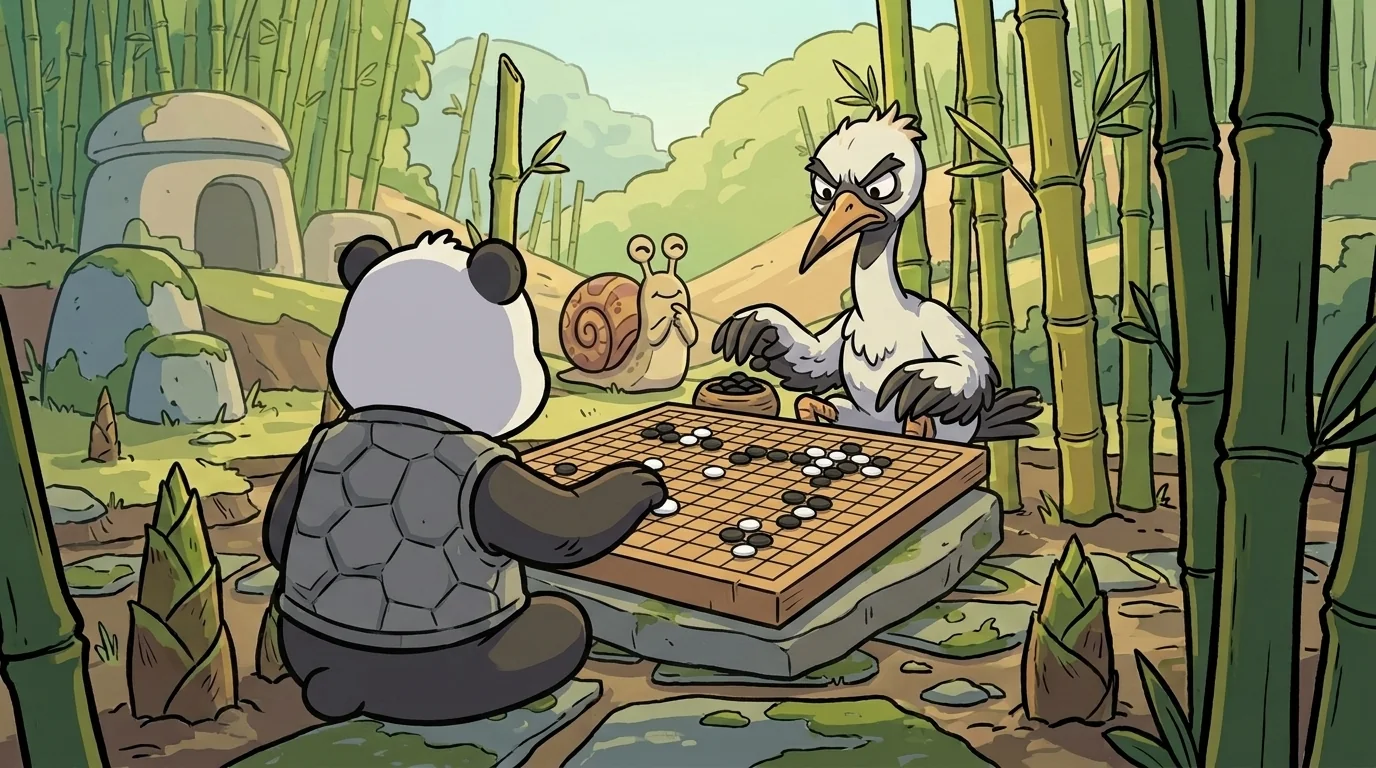
The game continued. Ten moves passed. Then fifteen. The board began to fill, a complex tapestry of black and white. Hungry Crane had captured several small territories. He felt good about his progress. But as the game moved into its twentieth turn, something shifted. The skirmishes in the corners began to merge. The edges of the board, once separate battlegrounds, now connected to the vast, open center.
Suddenly, the fighting did break out in the middle. Black stones clashed against white. Groups of stones found themselves surrounded, desperate for an escape route. Hungry Crane’s aggressive, scattered groups, once so powerful, now struggled to find support. He had focused on immediate gains. He had not seen the larger picture forming.
And there, in the very heart of the chaos, was Patient Bamboo’s quiet white stone. It was no longer alone. It was connected to a strong network of other white stones, a web that stretched out to the edges. That single, seemingly useless stone now anchored a huge, unassailable territory. It was the keystone, the load-bearing piece. Without it, the entire white position would crumble. With it, Patient Bamboo had built a fortress.
Hungry Crane’s eyes widened. His beak dropped slightly. He stared at the board, then at Patient Bamboo, a new understanding dawning on his face. The stone he had dismissed as doing "nothing" was now doing everything.
Master Snail, who had been watching the game with his usual slow, thoughtful gaze, nodded. His shell gleamed softly. "Patient Bamboo plays for thirty-move arcs," Master Snail observed, his voice a low rumble. "You, Hungry Crane, play for the next move. Both are real moves. The cast holds both."
The cultural names, Bamboo, Crane, Snail, and Tiger, draw from East Asian nature-archetype traditions. These traditions are foundational to the game of Go, known as weiqi in Chinese, igo in Japanese, and baduk in Korean. The cast frames these archetypes with respect. The Bamboo-as-patience archetype, for example, is a real cross-cultural East Asian symbol. The cast never stereotypes East Asian culture. It never frames these nature-archetypes as "exotic" or "foreign." Instead, it always frames them as the cultural lineage of the game itself, treated honestly.
Patient Bamboo’s teaching explicitly goes against the idea that "making the best immediate move" is always superior. The cast frames patience as a deeper craft, not a weak way to play. This is similar to Knot’s slow-cleverness in WitQuest and Mull’s thirty-seconds-of-quiet in WonderForge.
Patient Bamboo’s lessons echo ChronoQuest’s slow-geological-time. They connect to StrategyForge’s long-horizon planning. They reflect MindForge’s patience-as-cognition, and ProofQuest’s idea that an accumulation-of-small-steps builds-the-proof.
The StoneSong ensemble
Patient Bamboo is part of StoneSong's distributed-narrative cast. Each character embodies a different curricular primitive; together they teach the full subject.