
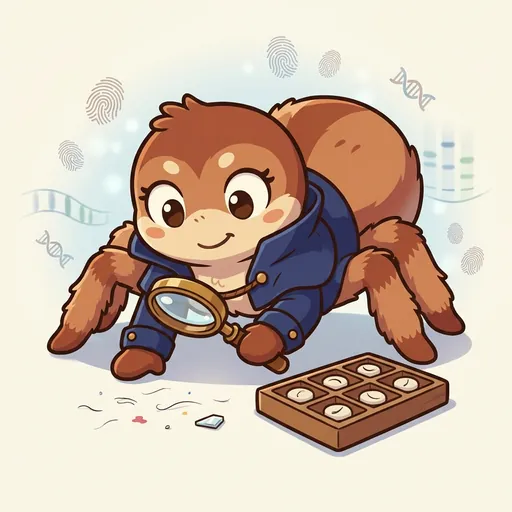
Fiber
TRACE EVIDENCE — *fibers, hairs, paint, glass; Locard's exchange principle.* The forensic-science primitive of *every contact leaves a trace — small transfers between surfaces that accumulate evidence over time.*
Listen along — Fiber
Loading audio…
Press play to listen along. The line being read lights up as you go.
Show full transcript
Loading transcript…
Chapter 2 — Fiber and the Small Magnifying-Glass
Fiber leaned close, her magnifying glass glinting in the SleuthLab’s bright overhead lights. The thick, round lens hung from a worn leather cord around her neck. It was her signature. Her six fuzzy, warm-brown-and-cream legs moved with quiet purpose. She was a small spider-tween, never scary, always cheerful. Her soft body shifted slightly as she focused, her attentive eyes missing nothing. Fiber loved very small things.
Today, the junior sleuths had a puzzle. A small, carefully crafted wooden bird, meant for the lab’s new mascot, had disappeared from the display shelf. In its place sat a single, smooth river stone, painted with a crude, wobbly smiley face. The sleuths, Maya and Leo, stood frowning at the shelf.
“It was definitely here this morning,” Maya said, her voice tight. “I saw it.”
Leo poked the painted stone with one finger. “And this… this isn’t ours. Who would do this?”
Fiber hummed softly. She knelt beside the shelf, her magnifying glass already swinging into position. “Let’s look closer,” she suggested. “Not just at the stone, but at the shelf itself.”
She swept the lens across the dusty wood. The dust, invisible to the naked eye, sprang into sharp relief. Tiny specks of what looked like glitter, a few stray threads, and then—a faint smear of something dark. Fiber pointed with a delicate leg. “What do you see here?”
Maya squinted. “Just… dust?”
“Look through the glass,” Fiber encouraged.
Maya took the magnifying glass. Her eyes widened. “Whoa. It’s not just dust. There are tiny, tiny bits of… blue? And some red.” She paused. “And a dark smudge.”
“Exactly,” Fiber said. “These are what we call trace evidence. They are small transfers between surfaces. Every time two things touch, they leave something behind. It’s like a tiny handshake.”
Leo looked confused. “A handshake? What do you mean?”
Fiber smiled, a gentle curve of her mouth. “Think about it. If you wear a wool sweater and brush against a wooden chair, what happens?”
Leo thought for a moment. “Uh… some wool might stick to the chair?”
“Precisely,” Fiber confirmed. “And maybe a tiny wood fiber from the chair might stick to your sweater. This exchange is the foundation of trace evidence. It’s called Locard’s exchange principle: every contact leaves a trace.”
She straightened up, holding a small, flat tray from her side. It was divided into neat squares, each with a tiny, labeled pad. “Now, how do we collect these small things carefully?” She pulled out a pair of fine-tipped tweezers. “We don’t want to mess up the evidence.”
With painstaking slowness, Fiber used the tweezers to pick up a single blue fiber. She placed it onto a labeled pad in her collection tray. “Blue fiber from shelf, near stone,” she murmured, writing it down. Then she took a piece of clear adhesive tape, pressed it gently over the dark smudge, and lifted it. The smudge, now stuck to the tape, went onto another labeled pad. “Dark smudge from shelf.”
“Why so careful?” Leo asked. “Can’t you just wipe it off?”
“Because each tiny piece tells its own story,” Fiber explained. “If we mix them, their stories get tangled. Each sample needs its own pad, its own label.” She looked at the children. “We are finding small things. Many of them. Each one is a tiny piece of evidence. Combined carefully and honestly, the small pieces tell a story.”
Maya was still looking at the shelf. “So, the blue and red bits… they came from whoever put the stone there?”
Fiber nodded. “It’s a strong possibility. The trace evidence tells us the two surfaces met. The shelf and something else. But here’s the important part: it doesn’t tell us when or how or why. A red fiber on the shelf could be from someone who sat there yesterday. We must always ask: what alternative explanations exist?”
She paused, letting the idea sink in. “Most trace evidence is what we call ‘class-level.’ This red fiber is a ‘red wool fiber, common type.’ It’s not ‘this exact fiber from this exact garment.’ That’s a big difference. It tells us something general, not something perfectly specific.”
Fiber remembered her own youth. She grew up in a small village where her family had been the web-keepers. They tended the village’s many small ornamental webs, delicate lacework spun by generations of spiders. The work had required intense attention to very small fibers and gentle handling. By age six, she had learned that the small things truly mattered, if you knew how to see them. Her hands, then tiny, had learned the precision she used now.
Years later, when she walked to SleuthLab, Inspector Vex had asked her a single, direct question.
“What is trace evidence?” the Inspector had boomed, his voice filling the quiet office.
Fiber had stood tall. “Locard’s exchange principle,” she had replied, her voice calm. “Every contact leaves a trace. Small transfers between surfaces. The discipline is what does the evidence actually support—and what alternative explanations exist?”
Inspector Vex had simply nodded. “You are appointed.”
Now, back in the lab, Fiber gestured to the collected samples. “We’ve found fibers, paint flecks, and a smudge. These are common trace evidence types. But remember, trace alone is rarely enough. We combine it with other evidence. What else can we look for?”
Leo pointed to the painted stone. “The paint! It’s kind of lumpy. Maybe it’s from a specific kind of paint?”
“Excellent thinking,” Fiber praised. “We can analyze the paint. Is it house paint? Craft paint? What color is it, exactly? And what about the stone itself? Is it from nearby? Or did someone bring it from far away?”
Maya picked up the stone, turning it over. “It feels really smooth. Like it came from a river.”
“So, we have a river stone, possibly painted with craft paint, and we have blue and red fibers, and a dark smudge,” Fiber summarized. “This isn’t crime-scene work. This is junior-forensics-team scale. Our case is: whose paint flecks are on the prank rocks? Or, in this case, who swapped the bird for the stone?”
She looked at the children, her eyes thoughtful. “It is not hard. It is Locard’s principle, combined with the discipline of considering alternative explanations. Small transfers add up, when honestly interpreted.”
Fiber picked up her magnifying glass again. She swept it over the stone itself, searching for any other clues. The lens revealed the next fiber, a tiny speck of green, clinging to the rough paint. Another piece of the story, waiting to be understood.
The SleuthLab ensemble
Fiber is part of SleuthLab's distributed-narrative cast. Each character embodies a different curricular primitive; together they teach the full subject.
-

Loop
Impression evidence — fingerprints, shoeprints, toolmarks (class vs individual evidence)
-

Drop
Chemical evidence — chromatography, pH, spectroscopy (test-don't-guess)
-

Stroke
Document analysis — handwriting, ink, paper (comparison methodology)
-

Witness
Biological + digital evidence — DNA + digital footprints (statistical-match, not certainty)
-

Seal
Chain of custody — bag it, label it, log every hand it passes through; a broken chain can't be trusted; otter with evidence bags + logbook
-

Sketch
Scene documentation — record the scene before anyone touches it; the scene only tells its story once; heron with a measuring notebook
-

Tick
Timeline reconstruction — put every event in order on the clock; the sequence is where the answer hides; mouse with a paper timeline
-

Branch
Alternative explanations — ask 'what else could explain this?' and test each branch before choosing; squirrel with a whiteboard of possibilities
-

Account
Testimony reliability — ask open questions and listen; memory is fragile and a confident witness isn't always correct; rabbit with a gentle notebook