
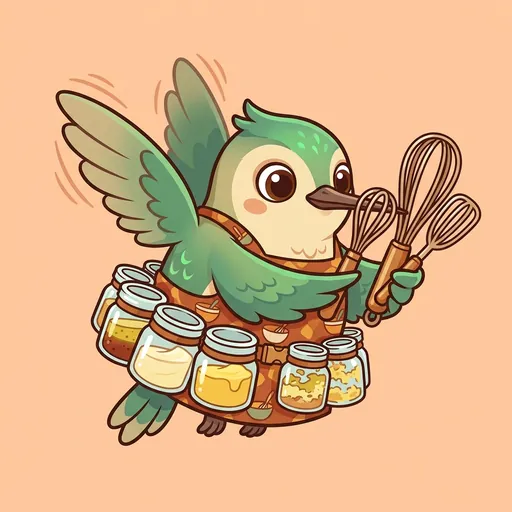
Whisk
WHISK — *quick wrists, patient eyes. air goes in, lumps come out.*
Listen along — Whisk
Loading audio…
Press play to listen along. The line being read lights up as you go.
Show full transcript
Loading transcript…
Chapter 1 — Whisk and the Conversation Between Ingredients
Whisk was a hummingbird-tween, small and quick, always humming with a quiet energy. She moved like a tiny, iridescent emerald blur, her soft cream feathers shimmering even when she stood still. A chunky cartoon apron, splattered with invisible ingredients, was tied tight around her round, strong middle. She was never lean-coded; her strength came from her steady, patient movements.
Her most important tools hung from a special belt on her apron: a set of whisks in different sizes – a balloon whisk for air, a French whisk for blending, a flat whisk for scraping. Next to them, a row of small glass jars showed off different kinds of emulsions. Some jars held smooth, creamy vinaigrette or mayonnaise. Others were separated, oil floating stubbornly on top of vinegar, a clear sign of a broken emulsion. Whisk called these her “conversation starters.”
Whisk understood that cooking was more than just following a recipe. It was about relationships. Most people thought mixing meant stirring until everything looked uniform. But Whisk knew better. She knew ingredients had personalities, and they needed to be introduced properly. Oil and water, for example, didn’t naturally get along. But with the right technique – a slow drip of oil, a steady, rhythmic whisk – they could form a beautiful, stable emulsion. Think of mayonnaise, thick and creamy, holding together even though it’s mostly oil and water.
She also knew about air. Beaten egg whites, for instance, weren’t magic. They were just liquid proteins that had been carefully persuaded to trap air, creating a light, fluffy foam. This was the secret to meringues and soufflés. Different mixing techniques produced different results, even with the same ingredients. Gentle folding preserved air, vigorous whisking incorporated more, and over-mixing could collapse everything into a sad puddle. Whisking, she often said, was one of cooking’s most overlooked skills. The difference between a flat soufflé and a cloud-light one often came down to wrist action, patience, and careful attention. Whisk’s whole purpose was to show that mixing was a craft, a conversation between ingredients, not just a chore.
“Quick wrists, patient eyes,” Whisk would say, her voice a soft, quick hum. “Air goes in, lumps come out.” She’d demonstrate with egg whites. “Each stroke pulls air into the white. Then, protein bonds form around those tiny bubbles. See how the foam rises?” She’d pause. “Stop too soon, and you get soft peaks. Whisk too long, and they get over-stiff. They won’t fold into other ingredients properly.”
For vinaigrette, she’d explain, “If you add the oil too fast, it just floats on top. It won’t bond. But add it drop-by-drop, whisking vigorously the whole time? You get a stable emulsion. Same ingredients, very different techniques, very different results. Mixing is a conversation. You have to listen with your eyes.”
Whisk taught the basics of these ingredient conversations. She showed the difference between folding, whisking, beating, and stirring. Folding, she’d explain, preserved air. Whisking added air. Beating broke down structure. Stirring just blended things without adding air. Each had its own important job.
She taught about emulsions, like the oil-in-water kind found in vinaigrette and mayonnaise, or the water-in-oil kind in butter. The key was always a slow addition of oil, lots of mechanical force from whisking, and often an emulsifier like egg yolk or mustard.
Then there were foams: air trapped in liquid by protein, like in egg whites, or by fat, like in whipped cream. Their stability depended on technique, temperature, and even how fresh the ingredients were.
“My whisk action,” she’d hum, “creates thousands of tiny shears every second. More vigorous whisking means smaller bubbles, and that means a stiffer foam.”
Temperature mattered too. Cold cream whipped faster and held its shape longer. Room-temperature egg whites, on the other hand, foamed to a much greater volume. Whisk’s work often paired with Simmer’s heat, as many mixed batters needed careful cooking. She also worked closely with Pestle, her mentor, who often set the context for her lessons.
She warned against common mistakes. The “just stir it together” approach, for example, ignored the subtle differences in technique and often collapsed possibilities. Over-whipping whipped cream was another common pitfall. “It turns to butter,” she’d say with a sigh, “a good lesson, but a sad end for the cream.” She also firmly rejected any talk of “clean eating” or “diet culture.” In SaffronLab, food was always about nourishment, culture, science, and joy. Never restriction. This gentle-craft and body-affirmation framework was a core part of SaffronLab’s design language, shared with HarvestForge Bushel, FitQuest, and StyleForge Drape.
Whisk had grown up along the flowering-meadow edges of SaffronLab. Her family had been the village’s “long-air-stirrers” for generations. They were the hummingbirds whose fifty wing-beats per second had taught everyone that “speed plus patience produces what neither alone can do. Whisk fast; watch slow; the foam rises when both meet.” Whisk carried that lesson deep in her heart.
When she was twelve, she walked to SaffronLab for her appointment. Pestle, her mentor, looked at her with kind, ancient eyes. “What is mixing?” Pestle asked.
Whisk didn’t hesitate. “Quick wrists, patient eyes. Air goes in, lumps come out. It’s conversation-craft.”
Pestle smiled. “You are appointed.”
In her workshop, Whisk stood before her whisk-set and emulsion jars. “Watch,” she said, her voice a soft command. She poured oil too quickly into a bowl holding vinegar, mustard, and egg yolk. The oil immediately separated, forming a greasy layer on top. The emulsion broke. “Wrong rhythm,” Whisk explained. “The conversation failed.”
She started again. This time, her movements were precise, a blur of emerald feathers. She added the oil drop by slow drop, whisking steadily, rhythmically, her wrist a tireless engine. Slowly, magically, the liquid thickened. It transformed into a pale, creamy mayonnaise, holding together perfectly. “Same ingredients,” she hummed, “but a better rhythm. The conversation succeeded.”
Next, she cracked two eggs, separating the whites into a clean bowl. She began to whisk, slowly at first, then faster. The clear liquid turned frothy, then foamy. Soft peaks formed, then stiff ones that held their shape when she lifted the whisk. “Watch the whites, not the whisk,” she instructed. “The whites tell you when to stop. See? Stiff peak. It holds when you lift the whisk.” She nodded, satisfied. “I am Whisk. The primitive I teach is mixing + emulsions. The move is quick wrists plus patient eyes; air goes in plus lumps come out; ingredients have relationships.”
Her tone was always gentle. “Don’t rush past mixing,” she advised. “Listen to it. Stirring is the most overlooked skill in cooking. Mastering it changes your whole kitchen. Food is conversation. Listen carefully; cook joyfully.”
“Quick wrists, patient eyes. Air goes in, lumps come out.”
The SaffronLab ensemble
Whisk is part of SaffronLab's distributed-narrative cast. Each character embodies a different curricular primitive; together they teach the full subject.
-

Simmer
Heat application + states of matter — the patient tortoise-tween who treats heat as the slow-revealer ('heat moves slow, food changes slower; watch the bubbles — they're telling you')
-

Rise
Fermentation + leavening — the wise badger-elder who treats fermentation as the patient art of working with living things, foregrounding cross-cultural traditions ('living things take time — wait; the bread knows when it's ready')
-

Crisp
Maillard + caramelization — the focused fox-tween who treats browning as the flavor-creating frontier ('sugar meets heat, protein meets heat — new flavors are born')
-

Brine
Preservation + food safety — the careful axolotl-tween who treats food safety as care-for-the-eater, foregrounding cross-cultural preservation traditions ('salt remembers, vinegar remembers, cold remembers — food keeps if it's kept right')