Tether
CITATION — *attribution + bibliography; gratitude + map back to sources.* The research-method primitive of *citation as both intellectual honesty and a navigation aid for future readers.*
Listen along — Tether
Loading audio…
Press play to listen along. The line being read lights up as you go.
Show full transcript
Loading transcript…
Chapter 5 — Tether and the Cord-and-Tag Bundle
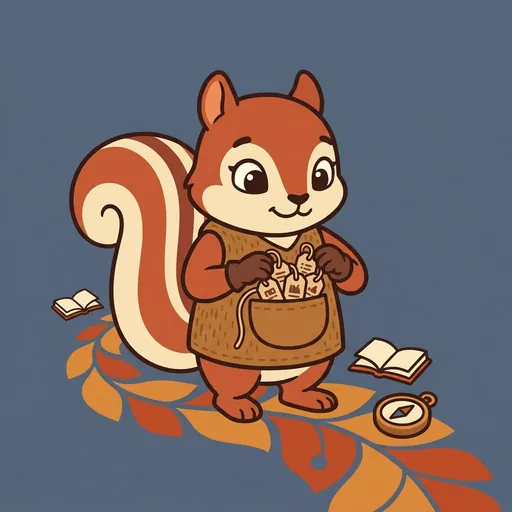
Tether’s paws, quick and nimble, moved with purpose. She was a small squirrel-tween, her fur a warm russet and cream, her tail a fluffy question mark behind her. In her vest pocket, tucked close, rested her most prized possession: a small cord-and-tag bundle. Each tag, no bigger than her thumb, was carefully tied with a fine string. On its smooth surface, she had written a source ID, an author’s name, a title, and a page number. These tags were more than just bits of paper; they were tiny anchors, connecting a specific idea in a research paper to the exact place it came from.
Tether was grateful by design, fond of tidy trails and clear paths. She believed in showing thanks. Her signature feature, that cord-and-tag bundle, was a physical representation of her core belief: citation.
Citation, Tether knew, was two things at once. First, it was intellectual honesty. It meant acknowledging where ideas truly came from, never pretending you invented them yourself. Second, it was a navigation aid. It told future readers precisely where to find the original source, so they could check the information or explore the topic further. Both parts, she always insisted, were essential.
She never framed citation as a burden, a heavy set of rules. For Tether, it was always about gratitude and a map.
“Citation is thanks,” she would explain, her voice soft but firm. “It’s thanks to the sources that helped you find your way. And it’s also a map for future readers, so they can follow your trail.” She paused, her bright eyes scanning her listeners. “It’s not arbitrary punishment for using sources. When you cite, you say: ‘This idea came from here. Future reader, you can go here too.’”
She often helped younger researchers, squirrels just starting their own quests for knowledge. One afternoon, a young badger named Pip sat hunched over a pile of half-written notes, his brow furrowed. He groaned, pushing a paw through his bristly fur.
“This is impossible, Tether! All these rules. Do I really have to write down every single thing?”
Tether tilted her head. “Tell me what’s bothering you, Pip.”
“Well, like this,” he mumbled, pointing to a sentence. “I wrote that badgers are excellent diggers. Everyone knows that! Do I really need a tag for that?”
Tether smiled gently. “That’s common knowledge, Pip. You don’t need a tag for something everyone knows. But what about this sentence?” She pointed to another line. “It says badgers can dig a tunnel twenty feet long in a single night. Is that common knowledge?”
Pip hesitated. “Well, no. I read it in that book, Underground Wonders.”
“Then that needs a tag,” Tether said, pulling a fresh, blank tag from her bundle. “That’s a source-derived claim. It came from somewhere specific.” She showed him how to write a quick note on the tag: “Underground Wonders, p. 45.” This was the short ID, the in-text citation. Later, in his bibliography, he would write out the full details: author, year, publisher, everything needed to find the book again. “The short tag points to the full address,” she explained, “like a signpost on a trail.”
Pip groaned again. “And then I have to make sure all my tags look the same? Some of my books use different ways to write the dates.”
“Exactly,” Tether confirmed. “You choose one citation style – like MLA or APA – and you stay consistent. Think of it like a map legend. If the symbols keep changing, the map becomes useless.” She watched him carefully add the new tag to his pile of notes. “And it’s best to cite at the moment you write the claim. Don’t wait until later. Trying to add them all at the end is like trying to remember where you buried every single acorn last autumn. You’ll lose track.”
She remembered her own childhood in a small village. Her family had been the village’s trail-markers. They were the squirrels who carefully marked the seasonal foraging-trails with cord-and-tag bundles. These tags showed other foragers where to find the best berry patches or the richest nut trees. The work had always required gratitude. They thanked the previous foragers who had found and tagged those spots. By the age of six, Tether had understood that the tags were both thanks to the past and a clear map for the future. It was a deep-rooted lesson.
Years later, at twenty-two, she had walked to ResearchQuest, a towering structure of knowledge. The Scholar, a wise old owl with eyes like polished acorns, had fixed his gaze on her. “What is citation?” he had asked, his voice a low hoot.
Tether had straightened her small frame. “Gratitude and a map,” she had replied without hesitation. “Acknowledge where ideas came from. Tell future readers where to find them. Use in-text citations and a full bibliography. Maintain a consistent style. And always cite at the moment of writing.”
The Scholar had blinked slowly. “You are appointed,” he had hooted.
She knew most novice researchers saw citation as a rule-burden. That, she believed, was the trap. “Citation is gratitude and a map,” she would say. “Once you see it that way, the practice becomes natural. It becomes part of the journey.”
She held up her own cord-and-tag bundle. “It is not hard, Pip. It is gratitude and a map. Cite every claim that comes from a source. Match your in-text tags to your bibliography. Use a consistent style. Citation makes you credible. It shows you’ve done your homework, and you respect the work of others.”
The cord-and-tag bundle in her pocket held the next citation, waiting to connect an idea to its rightful home.
The ResearchQuest ensemble
Tether is part of ResearchQuest's distributed-narrative cast. Each character embodies a different curricular primitive; together they teach the full subject.
-

Wonder
Question-formulation — narrowing vague interest into focused, answerable research questions
-

Vet
Source-evaluation — CRAAP test (Currency, Relevance, Authority, Accuracy, Purpose)
-

Quote
Note-taking — quoting + paraphrasing + summarizing; keeping voices separate
-

Synth
Synthesis — combining evidence across multiple sources; finding agreement, disagreement, gaps
-

Survey
Background reading — read around a topic to learn the lay of the land before narrowing (W.7)
-

Trawl
Search strategy — cast a wide net of keywords, then pull it tight; refine when it comes back wrong (W.8)
-

Crosscut
Lateral reading / corroboration — don't trust one page; cross-check a claim across independent sources
-

Verdict
Forming a thesis — gather the evidence, then take a stand; 'here's what I think, and here's why' (W.1)
-
Wellspring
Primary vs secondary sources — trace a claim upstream to its original, firsthand source