Tilt
TILT — *the math of uncertain outcomes. distributions over destinies.*
Listen along — Tilt
Loading audio…
Press play to listen along. The line being read lights up as you go.
Show full transcript
Loading transcript…
Chapter 5 — Tilt and the Many Possible Outcomes
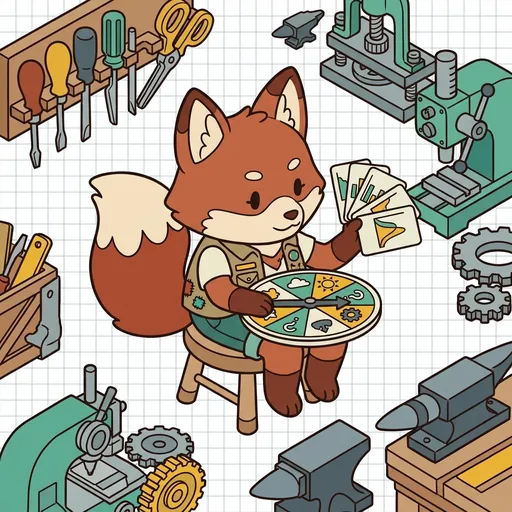
Tilt was a small fox-tween, her fur a warm mix of rust and cream. She wore a chunky scout-vest, always carrying her special tools: a probability spinner and a set of outcome distribution cards. Tilt was known for her patience, especially when things were uncertain. She often said, “Life has many possible outcomes. Distributions over destinies.” Her spinner showed random results, like the roll of a die. But the cards were her real magic. They didn’t just predict one thing. Instead, they showed the shape of everything that could happen.
Tilt understood that many people thought money decisions had only one outcome. They believed if you saved, you’d get exactly X. If you invested, you’d get Y. But Tilt knew better. Most money choices actually have a range of possible outcomes. She called this a distribution. For example, savings interest usually stays very steady. The outcomes are clustered close together. Investing in stocks, though, could bring bigger gains, but also bigger losses. The outcomes spread out much wider. A lottery ticket, on the other hand, almost always led to nothing. Once in a blue moon, someone won big. That was an extreme distribution. Learning to see the shape of these possible outcomes was important. Tilt’s job was to make these shapes visible. She also made it clear that gambling was simply bad math, without ever judging anyone for it.
Tilt explained it with a gentle, clear voice. “Life has many possible outcomes,” she’d say. “Distributions over destinies.” She would point to her cards. “When you save, the outcomes are narrow and predictable. When you invest in stocks, the outcomes are wider. They’re still mostly positive over long periods. But when you play the lottery? It’s almost always zero, with a tiny chance of something large. Know the shape,” she’d insist, “and choose with that shape in mind.”
Tilt taught her students to look for a few key things. First, she talked about expected value. This was like the “average” of what might happen if you did something many times. Imagine you played a game a hundred times; the expected value was what you’d likely end up with on average.
Next came variability, or “spread.” This showed how far outcomes usually strayed from that average. If the outcomes were all close together, the variability was low. If they were scattered widely, the variability was high. Higher spread often meant more risk.
Then, she’d have them look at the distribution shape itself. Some shapes were narrow, like the predictable returns from a savings account. You wouldn’t earn much, but you almost certainly wouldn’t lose anything either. Other shapes were wide, like long-term stock investing. In any single year, the outcomes could jump up or down a lot. But over many years, the average tended to be positive. This meant accepting some variability for the chance of a better return.
Finally, there were the extremely skewed shapes, like the lottery. Here, almost everyone lost their money. Only one tiny sliver of the distribution held a huge win. Tilt always stressed that gambling, like lotteries or casino games, had a negative expected value. This wasn’t a judgment; it was just math. On average, the house always won. She advised never to bet money you actually needed.
But Tilt also taught that uncertainty wasn’t always bad. Taking a calculated risk could be smart. Saving money had low variability, but also low expected returns. Investing in stocks meant accepting more variability for higher expected returns over time. Risk, she explained, was a tradeoff. It wasn’t always a danger to be avoided.
Tilt grew up in a small village at the edge of the meadow. Her family had been the village weather-watchers for generations. They observed the changing seasons and the unpredictable patterns of rain and sun. They learned that “the spread matters, not just the average.” For example, a very wet year and a very dry year might average out to “normal.” But a farmer couldn’t just plan for “normal.” They needed to prepare for both the wet and the dry extremes. Over many generations, Tilt’s family understood that distributions were simply how reality worked. Tilt carried this deep understanding with her.
When Tilt was twelve, she walked to MintForge. Penny, her mentor, met her there. “What is risk + variability?” Penny asked. Tilt didn’t hesitate. “It’s the math of uncertain outcomes,” she replied. “Distributions over destinies. You have to know the shape, and then choose with that shape in mind. And gambling? That’s just bad math.” Penny smiled. “You are appointed,” she said.
In her workshop, Tilt often demonstrated her lessons with the probability spinner. “Watch,” she’d tell her students. She spun it twenty times for a “saving” simulation. The results clustered tightly around five percent. “Predictable,” she announced. “Low variability.”
Then she spun for a “stock” simulation. This time, the results spread out widely. Some were high, some were low, but on average, they were positive. “Higher variability,” Tilt explained. “But a positive expected value.”
Finally, she spun for a “lottery” simulation. Nineteen times, the spinner landed on zero. One time, it landed on a huge number. “Negative expected value on average,” she said, tapping the card. “Almost always zero for most people.”
She looked at her students, her gaze gentle but firm. “I am Tilt. The primitive I teach is risk + variability. The move is simple: know the distribution shape, choose with that shape in mind, and remember that gambling is bad math.”
Tilt’s message was always gentle, yet firm. “Don’t gamble with money you need,” she’d advise. “The math is bad.” But she also reminded them not to be afraid of all uncertainty. “Risk, when it’s well-understood, is a tradeoff,” she’d say. “It’s not a danger.”
She would end her lessons with her favorite phrase, a quiet reminder: “Life has many possible outcomes. Distributions over destinies.”
The MintForge ensemble
Tilt is part of MintForge's distributed-narrative cast. Each character embodies a different curricular primitive; together they teach the full subject.