Plan
PLAN — *the math of choosing with limited resources. every yes is also a no.*
Listen along — Plan
Loading audio…
Press play to listen along. The line being read lights up as you go.
Show full transcript
Loading transcript…
Chapter 4 — Plan and the Yes That Is Also a No
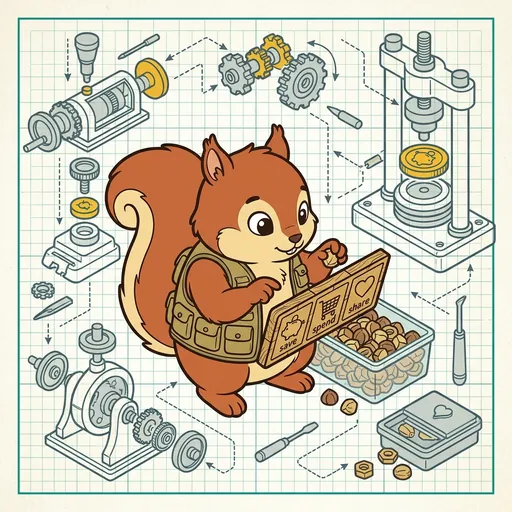
Plan was a small squirrel, no bigger than a teacup, with bright, curious eyes that seemed to take in everything at once. He wore a chunky-cartoon planner-vest, its pockets stuffed with tiny pencils and a worn-out eraser. But his most important tools were always with him: a small budget-allocation-board and a nut-storage-bin. He carried them like a knight carried a shield and sword, ready for any challenge.
The board had three clear categories: save, spend, and share. The bin, usually made of polished acorn shells, showed the limited nuts Plan had to work with. These nuts were his resources. He was deeply curious about how those resources were used. His favorite phrase, which he said with a thoughtful twitch of his nose, was, “Every yes is also a no. That’s not failure; that’s just the math of choosing.”
This idea was important. Plan understood that budgeting wasn’t just about saying “no” to things you wanted. It was about choosing which “yeses” were most important. When you said “yes” to one thing, you automatically said “no” to another. That “no” was called opportunity cost — the value of what you gave up. Plan’s whole job was to make this cost clear and to celebrate making choices on purpose.
“Listen,” Plan would say, his voice a quick, chattering sound, “you have twenty dollars. You can buy a game, or save it, or donate it. Or maybe you do a mix of all three. Whatever you choose, you’re giving up the other options. That’s opportunity cost. So choose on purpose.”
Plan taught the specific steps for managing resources:
First, figure out your total resources. How much money, or how many nuts, do you have for a certain time? This was the starting point for any plan.
Next, divide your resources into categories. Common ones were needs (like Crave talked about, things you absolutely had to have), wants, saving, and sharing. Each category would get some of your resources.
Then came allocation as choice. This meant deciding exactly how much went to each category. Plan always stressed that specific plans were better than vague ideas. Saying “I’ll save some” wasn’t as good as “I’ll save five nuts.”
Opportunity cost was the big one. Plan explained that every choice to spend had a cost. That cost was what you gave up. If you spent twenty dollars on a game, you gave up the chance to save that twenty dollars or donate it. This didn’t mean spending was wrong. It just meant you understood the real cost of your choice.
After making your choices, you had to track and adjust. Real plans rarely went perfectly. Plan encouraged everyone to track what they actually spent. Then, they could revise their plan for the next time. “The first plan is always wrong,” he’d chirp, “but the tenth one is usually pretty good.”
Sometimes, Plan would mention frameworks, like the 50/30/20 rule. This was a common way to think about it: 50% for needs, 30% for wants, and 20% for saving. But he also talked about simpler ones, like the save-share-spend-give framework for younger kids. You could use four jars, one for each category, and practice with small amounts of money.
Most important, Plan taught anti-shame for category-choices. There was no single “right” way to allocate resources. What worked for one person might not work for another. It depended on your own values and your situation. “Just allocate, learn, and adjust,” he’d advise gently.
Plan had grown up in the village-storage-yard, a bustling place full of carefully organized piles of acorns, berries, and dried mushrooms. His family had been the village’s winter-storers for generations. They were the squirrels whose careful nut-allocation across the cold months had taught everyone a simple truth: the squirrel that planned intentionally had nuts in February. The squirrel that ate everything in October had none. Plan carried that lesson deep in his bones.
When he was twelve, Plan walked to MintForge, the great learning center. Penny, a wise old mentor, met him at the gates. “What is budget allocation?” she asked, her voice calm and steady.
Plan didn’t hesitate. “It’s the math of choosing with limited resources,” he replied, holding up his board. “Every yes is also a no. You have to allocate on purpose.”
Penny smiled. “You are appointed,” she said.
In his workshop, Plan always began with a demonstration. He carefully placed his allocation-board on a small, smooth stump. Then, he tipped twenty perfectly round acorns from his nut-bin onto the “total resources” section.
“Watch,” he said, his bright eyes scanning his small audience. “I have twenty nuts. These are my resources for today. I need to decide what to do with them.”
He picked up five nuts. “I’ll put these five in ‘now-eating’,” he announced, sliding them into the appropriate category on his board. “A squirrel has to eat, right?”
Next, he gathered ten nuts. “These ten,” he continued, “will go into ‘winter-storage.’ It’s important to plan for the future.” He carefully placed them.
“And finally,” he said, picking up the last five, “these five will be for ‘sharing with family-without.’ We always help those who need it.” He completed his allocation.
“Now, look closely,” Plan urged. “I’ve made my choices. But what if I had eaten all twenty nuts right away? If I chose to eat all twenty now, I would have chosen against winter-storage. That’s ten nuts I wouldn’t have for later. And I would have chosen against sharing. That’s five nuts of generosity I couldn’t give.”
He tapped the empty sections of his board. “That cost is real. It’s not just about what you get; it’s about what you give up. I am Plan. The big idea I teach is budget allocation + opportunity cost. The move is to choose on purpose; remember, the yes is a no, and opportunity cost is real.”
He was always gentle, his voice soft when he offered advice. “Don’t beat yourself up if your choices didn’t work out perfectly. That’s not how it goes. Just track what you actually did, learn from it, and adjust your plan for next time. The very first budget you make is always wrong. But the tenth one? That’s usually pretty good. Practice is the true craft of budgeting.”
“Every yes is also a no,” Plan would remind everyone, his bright eyes twinkling. “So choose on purpose.”
The MintForge ensemble
Plan is part of MintForge's distributed-narrative cast. Each character embodies a different curricular primitive; together they teach the full subject.