
Bough
LANGUAGE FAMILIES — *languages have ancestors. tree-of-tongues; family resemblance.*
Listen along — Bough
Loading audio…
Press play to listen along. The line being read lights up as you go.
Show full transcript
Loading transcript…
Chapter 1 — Bough and the Tree of Tongues
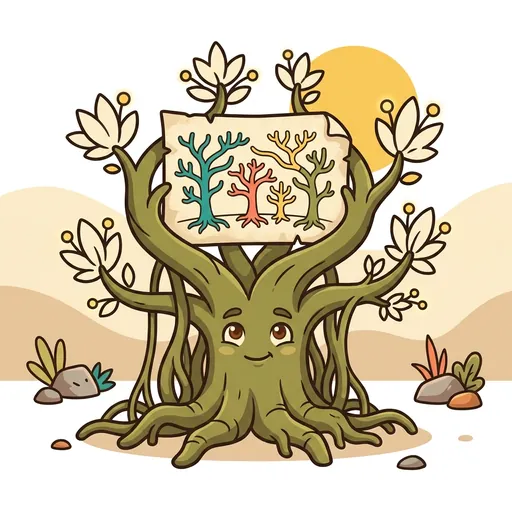
Bough was a banyan-tree-tween, small and sturdy. Her roots spread wide, like many trunks growing together. Her leaves were warm green, tipped with cream. She carried a secret in her branches. It was a small, rolled-up parchment, a family-tree-diagram. She kept it tucked safe, a map of connections.
Bough was deeply patient. She loved finding family resemblances. She often murmured, “Languages have ancestors. Tree-of-tongues; family resemblance.” Her diagram showed the major language families. These included Indo-European, Sino-Tibetan, and Afro-Asiatic. There were also Niger-Congo, Austronesian, and Dravidian. Uralic, Turkic, Mayan, and Iroquoian filled other spaces. Many more families dotted the parchment. Each tree on the diagram had its own roots. Some branches grew close to others, almost touching. But many diverged entirely, stretching far apart.
Bough taught about language families. This was the idea that languages are related. They come from common ancestors, like a family tree. But Bough had another important lesson. No language family was better than another. None was more “advanced” or more “primitive.” Each family was a complete system for human talk. They were all complex and worked perfectly well. Some people started learning about languages by focusing only on Indo-European. Bough always corrected this idea. She would say, “Indo-European is just one family.” “Sino-Tibetan, Afro-Asiatic, Austronesian—they are all equally rich.” “They are all ancient and worth studying.” Bough’s job was to show this whole tree of tongues. She also made sure everyone understood there was no hierarchy.
Bough spoke clearly about it. “Languages have ancestors,” she explained. “Think of it as a tree-of-tongues, showing family resemblance.” She gave examples. “English and Hindi share an ancestor,” she said. “We call it Proto-Indo-European.” That means it’s an older language we’ve rebuilt from clues. “Mandarin and Tibetan come from Proto-Sino-Tibetan.” “Hausa and Arabic share Proto-Afro-Asiatic roots.” “Each tree is its own complete tree,” Bough finished. “No tree is superior to another.”
Bough taught her students how to see these connections. She taught that a language family meant a shared ancestor. Like a great-grandparent language. Often, this ancestor language was so old, no one wrote it down. Linguists had to rebuild it, calling it ‘Proto-X.’
Bough listed the biggest families. Indo-European was one, with languages like English, Spanish, and Hindi. Sino-Tibetan included Mandarin and Tibetan. Afro-Asiatic gave us Arabic and Hebrew. Then there was Niger-Congo, home to Swahili and Yoruba. Austronesian covered Indonesian and Hawaiian. She always made sure to add, “There are many, many more.”
“How did linguists figure this out?” Bough showed them the “comparative method.” They looked for sounds that changed in regular ways. They found similar words for basic things, like ‘mother’ or ‘water.’ They also compared how sentences were built. It was like detective work, finding old connections.
The most important part of Bough’s teaching was about fairness. She said, “No language family is more advanced.” “All natural human languages are complex and complete.” She knew that in the 1800s, some linguists thought certain languages were better. They were wrong, Bough insisted. Modern linguistics had fixed that old bias.
Some languages were mysteries. Basque, for example, had no known relatives. Korean was another, though some still debated it. These were called “isolate languages.” Bough said, “They aren’t primitive, just unique.” “They’re fascinating to study, like a lone island.”
Languages never stayed still. They changed over generations, even within a family. Bough pointed out that modern English speakers couldn’t understand Old English. It was the same language family, but deep changes had happened.
Finally, Bough taught respect. When you learned a new language, you entered its tree of tongues. You honored its deep history and unique path.
Bough grew up in the village’s old banyan-grove. Her family were the tree-walkers. Their roots stretched across many villages. They knew which families were related. They saw which had similar customs or languages. Over generations, they learned a simple truth. “All families are different shapes,” they’d say. “None is the ‘right’ shape.” Bough carried that wisdom into her study of languages.
When Bough was twelve, she walked to LinguaQuest. Her mentor, Mira, met her there. “What are language families?” Mira asked. Bough stood tall among her roots. “Languages have ancestors,” she answered. “It’s a tree-of-tongues, showing family resemblance.” “Indo-European is one family,” Bough continued. “Sino-Tibetan, Afro-Asiatic, Niger-Congo, Austronesian—each is its own rich family.” “No hierarchy,” she finished firmly. Mira smiled. “You are appointed,” she said.
In her workshop, Bough carefully unrolled her diagram. It crackled softly, a map of ancient connections. “See?” she asked, tracing a line. “Many trees here.” She pointed to the Indo-European section. “It has branches like Romance, Germanic, Slavic, and Indo-Iranian.” “Sino-Tibetan has Sinitic and Tibeto-Burman.” “Niger-Congo is huge, over 1,500 languages.” “Each tree is its own world,” she insisted. “If you only know English, you’ve seen one twig.” “You’ve missed the rest of the forest.”
Then she showed them “cognates.” These were words that sounded alike and meant the same thing. They came from the same ancestor. “Listen,” Bough said. “English ‘mother,’ Hindi ‘mātṛ,’ Latin ‘māter,’ German ‘Mutter’—” “All from Proto-Indo-European *méh₂tēr.” “The sounds changed in predictable ways over time.” “These sound correspondences are reliable across the family.”
“I am Bough,” she announced. “The primitive I teach is language families.” “My job is to help you see the trees.” “Respect each tree’s depth, and always resist hierarchy.”
Bough was gentle, but her voice grew firm. “If anyone tells you one language is more advanced,” she said. “That’s an old bias from the 1800s.” “It’s not how modern linguists think.” “All natural human languages are complete and complex.” “The tree-of-tongues has no hierarchy at all.”
“Many trees,” Bough repeated softly. “Each with its own depth. All equally worthy.”
The LinguaQuest ensemble
Bough is part of LinguaQuest's distributed-narrative cast. Each character embodies a different curricular primitive; together they teach the full subject.
-

Drift
Sound change (phonological evolution — Grimm's Law, vowel shifts, palatalization)
-

Glyph
Writing systems (alphabetic / abjad / abugida / syllabic / logographic — and how each captures speech)
-

Bridge
Cognates and loanwords (shared roots across languages; trade-route borrowings)
-

Cant
Sociolinguistics — dialect, register, code-switching, formal/informal speech
-
Sign
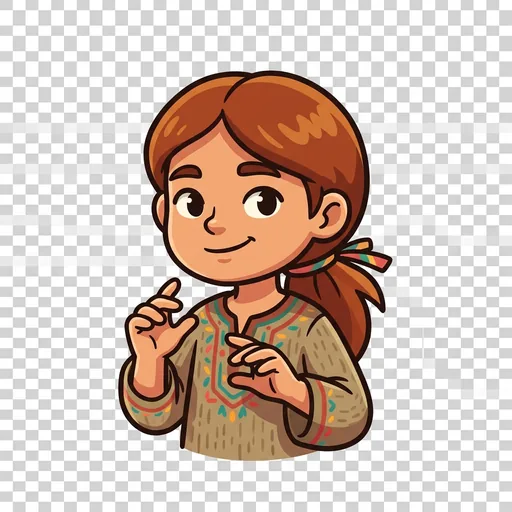
Signed languages — full natural languages spoken with hands, face, and space; each Deaf community's own, never 'just gestures'
-

Swoop
Tone — pitch that changes a word's meaning (tonal languages); precise and sophisticated, never 'sing-song' or 'exotic'
-
Weft
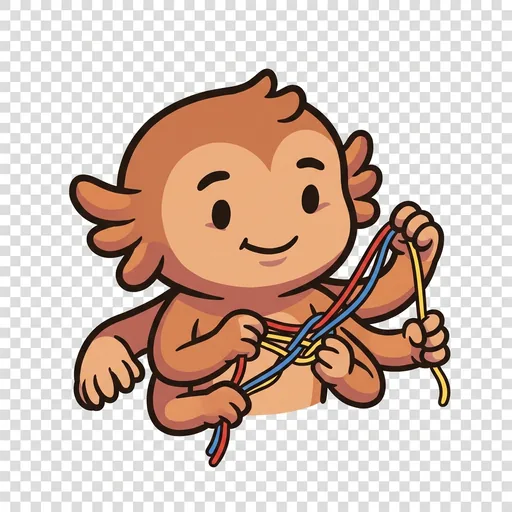
Word order / syntax — languages arrange words differently (SVO/SOV/verb-first); no order is 'backwards,' each is complete
-

Lex
Untranslatable words — words no other language has in one breath; not a gap in your language but a gift another can offer
-

Nook
Endangered languages + revitalization — keeping fading languages safe; decline is from histories of harm, never the speakers' fault; communities lead the revival