
See
SEE — *look first. talk later.*
Listen along — See
Loading audio…
Press play to listen along. The line being read lights up as you go.
Show full transcript
Loading transcript…
Chapter 1 — See and the Look-First Discipline
The Grand Laboratory’s Mechanics Lab hummed with a low, rhythmic thrum, a sound like a giant, sleeping cat. Sunlight, filtered through tall, arched windows, painted stripes across the polished concrete floor. In the center of the room, on a heavy oak workbench, a simple pendulum hung from a sturdy metal stand. A small, brass bob, no bigger than a golf ball, rested motionless at the end of a thin, nearly invisible string.
Guess, all elbows and impatient energy, practically bounced beside the workbench. His eyes, bright with curiosity, fixed on the pendulum. He was already muttering calculations under his breath, a habit See found both endearing and slightly alarming. Guess pictured graphs in his mind, lines curving, data points scattering. He loved the neatness of a solved problem.
“Alright, so the string length is, what, exactly one meter?” Guess asked, not waiting for an answer. He reached for the bob, fingers itching to set it in motion. “And the mass looks like…”
“Hold it right there, Guess.”
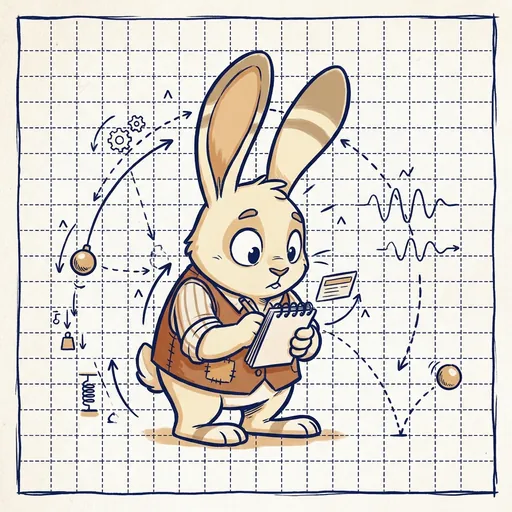
The voice was soft but firm, like a gentle hand on a shoulder. See stepped forward, a small figure with ears that seemed perpetually perked, as if listening to sounds beyond human hearing. See’s apprentice-vest, a chunky-cartoon design in soft meadow-brown stripes over warm cream, was covered in tiny, carefully stitched pockets. From one of these, See produced a small, leather-bound notebook and a slender observation-card. The card, Guess knew, was for quick notes, a temporary holding place before the permanent record.
See moved with a quiet precision, settling beside the pendulum. See’s eyes, a deep, thoughtful brown, scanned the setup, then settled on Guess. “I am See. The primitive I teach is observe.”
Guess groaned, a theatrical sound that echoed slightly in the high-ceilinged lab. “I know, I know. Look first, talk later. But I’ve done pendulums a hundred times! I already know the period is proportional to the square root of the length, and the mass doesn’t matter, and…” He trailed off, seeing the unwavering look in See’s eyes.
See held up a hand, palm open, a silent but absolute stop sign. “You know a pendulum. You know a theory. But this,” See gestured to the brass bob, “is this pendulum, right now, in this lab. The world changes. Setups are always slightly different. We observe this world, not the one in our heads.” See’s tone wasn’t scolding, just a statement of fundamental truth, like gravity.
Guess sighed, but he dropped his hand from the bob. He knew See meant business. See never let anyone skip the looking part, not even for a second. It was like a rule etched into the very air of the lab, a silent agreement everyone understood. Even when a kid had done the same experiment a dozen times, See insisted on fresh eyes, fresh data.
“So, what do we do?” Guess asked, trying to sound less exasperated than he felt. He shoved his hands into his pockets, trying to quell his restless energy.
“We watch,” See replied, already poised. “And we write what we see. Resist the urge to explain.” See handed Guess a blank observation-card. “You write too. What do you notice?”
See carefully pulled the brass bob to one side, just enough to give it a gentle, controlled start. The string tightened, then See released it. The pendulum began its rhythmic swing, a silent, graceful arc through the air. The brass bob caught the light, gleaming as it moved.
See’s gaze followed the bob, unblinking. The small notebook opened. A pen, no bigger than See’s finger, hovered over the crisp white page.
Pendulum swings back and forth. See wrote, the words appearing in a neat, compact script. The path it takes is a smooth curve. See paused, observing the peak of each swing. Maximum angle decreases over time.
Guess watched, trying to mimic See’s intense focus, but his mind kept leaping ahead. How many swings in ten seconds? Is it slowing down? He scribbled on his card: Swings left to right. Then right to left. He felt a little silly, writing such obvious things. But See had said “what you see,” not “what’s impressive.”
See continued to write. Each swing is slightly shorter than the last. The bob moves fastest at the bottom of its arc, slowest at the top. See noted the subtle shift in the pendulum’s rhythm, the almost imperceptible loss of momentum.
Thirty seconds passed. The pendulum’s swing was visibly smaller now, a more constrained dance. See made a final note. After 30 seconds, swing is visibly smaller than at start. See closed the notebook with a soft click and looked at Guess.
“What did you get?” See asked, extending a hand for Guess’s card.
Guess handed it over, a little embarrassed by his meager notes. See read them carefully. “Good. You saw the direction. You saw the motion.” See tapped the card. “Now we have data. Raw observation.”
Guess shifted his weight. “Okay. So, it slows down. Duh. Air resistance, right?” He couldn’t help but offer his explanation. It felt so obvious.
See offered a small, knowing smile. “Perhaps. But we didn’t see air resistance. We saw the swing get smaller. We saw it slow. We recorded what is. Now, with these observations, we can hypothesize. We can ask, ‘What might explain this?’ Without the looking, the hypothesis is fantasy. It’s about what we wish were true, not what is.” See’s voice held a quiet conviction, the kind that made you pause and truly consider the words.
Smithy, the lead mentor in the Mechanics Lab, had been observing from a nearby workbench, polishing a gleaming brass gear. Smithy was a tall, calm presence, with kind eyes that missed nothing. Now, Smithy nodded slowly, the gear glinting in the light.
“See is always first,” Smithy said, voice deep and resonant. “The OHEL loop starts here.” Smithy tapped a finger against the gear. “Observe. Hypothesize. Experiment. Learn. If you skip the ‘O,’ your ‘H’ is built on sand. Your ‘E’ is wasted motion. And your ‘L’ is just guessing.” Smithy’s words hung in the air, a clear, unmistakable truth.
Guess looked from Smithy to See, then back to the still-swinging pendulum. The bob was barely moving now, a tiny, almost imperceptible tremor. He hadn’t realized how much he’d missed, even in those thirty seconds. He’d been so busy trying to think about the pendulum, he hadn’t truly seen it. His own notes felt thin compared to See’s detailed record.
“So, if we want to test the period against the length,” Guess ventured, “we’d have to observe again with a different length?” He was starting to get it, the deep, patient rhythm of See’s craft.
“Exactly,” See confirmed, a hint of approval in See’s voice. “And we’d record what that pendulum does. Not what we expect it to do, but what it actually does. Every time. Fresh eyes. Fresh data.” See paused, then added, “Even if you’ve seen a thousand pendulums, this one is new. It has its own story to tell.”
See’s method wasn’t about being slow, Guess realized. It was about being right. It was about building knowledge on solid ground, brick by observed brick. It was a discipline, a quiet power. And, Guess had to admit, there was a certain satisfaction in simply watching, in letting the world reveal its secrets without trying to force them. The pendulum, now almost still, had told its story, if only he’d been patient enough to listen. He tucked his observation-card into his pocket, a small reminder of the day’s lesson.
The Labsmith ensemble
See is part of Labsmith's distributed-narrative cast. Each character embodies a different curricular primitive; together they teach the full subject.