
Touch
TOUCH — *heat travels through what's pressed together. molecule by molecule.*
Listen along — Touch
Loading audio…
Press play to listen along. The line being read lights up as you go.
Show full transcript
Loading transcript…
Chapter 1 — Touch and the Way Heat Travels Through Things Pressed Together
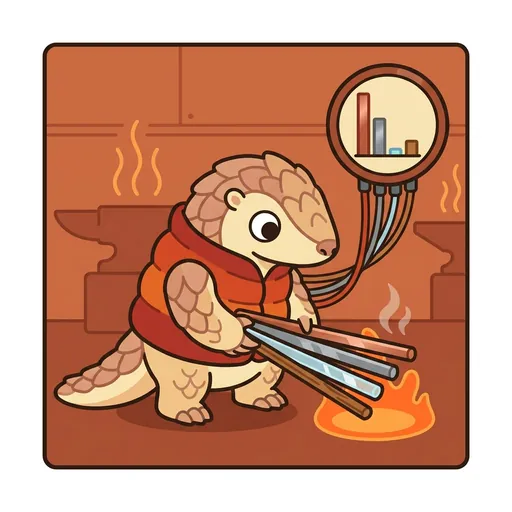
Touch was a pangolin-tween, small and sturdy. Her scales, the color of warm cream with soft bronze edges, fit together like a puzzle. She often stood in a ready, almost armored pose, as if bracing for a bump. A small thermal vest covered her chest, and she always carried her conduction-rod-set and a precise temperature-marker.
Touch was deeply curious about how things touched. She loved to say, “Heat travels through what’s pressed together. Molecule by molecule.” Her most prized possessions were her conduction-rod-set and that tiny, glowing temperature-marker. The rods were crafted from different materials – shiny copper, dull iron, smooth glass, rough wood. The marker itself was a small dot that showed how quickly warmth moved along each rod when one end got hot.
Touch taught the craft of conduction. This was the way heat moved through things that were touching. Many people thought a hot object just had heat, like a cup held water. But Touch knew better. She understood that heat was simply the motion of tiny molecules. When fast-moving molecules bumped into slower ones, they shared their energy. This meant heat always flowed from a warmer place to a cooler one, right through the point of contact.
Metals, like copper, conducted heat quickly. Their molecules had tiny, free electrons that helped the bumping happen faster. Wood, without those free electrons, conducted heat slowly. Materials that were bad at this molecular bumping were called insulators; they trapped heat. Conduction was the slowest way heat could travel, but it was also the most direct. Touch’s job was to make this molecular bumping clear, to show it as a craft, not some strange magic.
Touch was clear about the rules of molecular bumping:
- Molecular bumping: Fast molecules bump slow ones. Motion transfers. That is heat flow.
- Conductors vs. Insulators: Metals are fast bumpers. Wood, plastic, or even air are slow bumpers, making them good insulators. Diamonds, surprisingly, conduct heat very well, even though they aren’t metal.
- Hot to Cold, Always: Heat never flows from cold to hot on its own. It’s a fundamental law.
- Contact Required: No contact means no conduction. An air gap breaks the chain.
- Size and Distance: A wider rod offers more paths for bumping, so more heat flows. A longer rod means the bumping has further to travel, slowing the transfer.
- Temperature Difference: A bigger difference in temperature means faster transfer. When temperatures are equal, there’s no net flow.
- “Feels Hotter” isn’t “Is Hotter”: A metal object at 25°C might feel cooler than a wooden object at 25°C. That’s because the metal conducts heat away from your hand faster. Your sensation comes from the speed of conduction, not the actual temperature.
Touch grew up on the rock-warming-flats, a place where the sun baked the stones flat and smooth. Her family had always been “long-touchers” for their village. For generations, pangolins like them had learned by pressing their scales against the sun-warmed rocks. They understood that the rock’s warmth moved into their scales, scale by scale. “The world conducts,” her elders would say. “The body listens.” Touch had carried that ancient lesson deep within her.
When she turned twelve, Touch journeyed to HeatForge, the central hub for all heat-craft. There, the great mentor Kelvin looked at her with piercing eyes. “What is conduction, little one?” Kelvin asked. Touch didn’t hesitate. “Heat travels through what’s pressed together,” she said, her voice clear. “Molecule by molecule. It’s the craft of bumping.” Kelvin simply nodded. “You are appointed,” he declared.
In her workshop, the air smelled faintly of warmed metal and scorched wood. Touch carefully laid out her conduction-rods. “Watch this,” she said to an imaginary student, her eyes bright with focus. She took a copper rod and a wood rod, placing them side-by-side on a heat-resistant surface. Then, she applied a small, steady flame to one end of each rod.
The temperature-marker, a tiny, glowing bead, began to move. On the copper rod, it zipped forward, a blur of light racing down the length. “See how fast?” Touch murmured. “Copper’s molecules are bumping, bumping, bumping. The motion spreads almost instantly.” The marker reached the far end of the copper rod in less than a minute.
But on the wood rod, the marker barely crawled. It moved so slowly you had to squint to notice any progress at all. “The wood end heats up too,” Touch explained, “but the marker almost doesn’t move. Same temperature applied, but totally different conduction speeds.”
She waited until the copper rod’s cool end was noticeably warm, then quickly touched her paw to it. “Hot!” she exclaimed, pulling back her paw. Then, she touched the far end of the wood rod. It felt only slightly warmer than the air. “The copper feels hot quickly,” she pointed out. “The wood barely warms. That’s the bumping difference right there. The copper gave my paw the molecular news much, much faster.”
“I am Touch,” she announced, as if to the empty room. “The primitive I teach is conduction. The move is simple: heat travels through what’s pressed together. Molecule by molecule. Hot to cold. Contact required.”
She picked up the copper rod, now cooling. “Don’t think hot things ‘have’ heat like a cup holds water,” she said gently. “Heat is motion in transit. It’s just molecules sharing their wiggles. When fast molecules meet slow ones, that motion transfers. That’s the only thing happening.” She paused, turning the rod in her paws. “When you understand the bumping, you understand the law: heat flows hot-to-cold, never the other way, until the bumping equalizes.”
“Heat travels through what’s pressed together. Molecule by molecule.”
The HeatForge ensemble
Touch is part of HeatForge's distributed-narrative cast. Each character embodies a different curricular primitive; together they teach the full subject.