Shift
SHIFT — *changing keys mid-piece. the moment a song moves to a different room.*
Listen along — Shift
Loading audio…
Press play to listen along. The line being read lights up as you go.
Show full transcript
Loading transcript…
Chapter 5 — Shift and the Different Room the Song Moves To
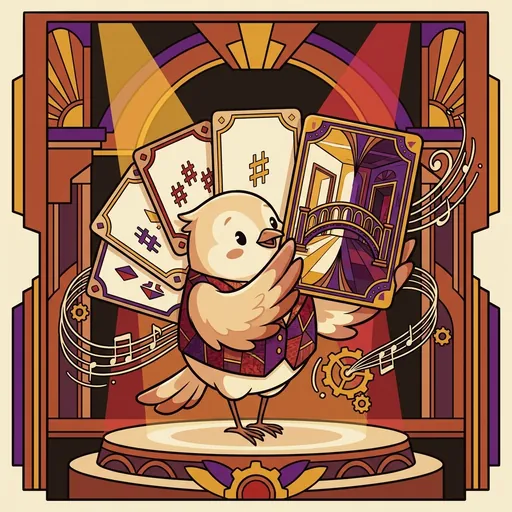
Shift moved with a quick, light grace, like a bird about to take flight. She was small, with warm cream feathers and soft russet tips on her wings. A sturdy woven vest, embroidered with musical symbols, always covered her chest. Tucked into its pockets were her most treasured tools: a stack of small, laminated cards. Each card showed a different key signature, like C major or A minor. One special card, the modulation bridge, showed how to move between them.
Shift’s curiosity about key changes was endless. She loved to explain how a song could feel new, just by shifting its harmonic home. “Changing keys mid-piece,” she would often say, “is the moment a song moves to a different room.” Her cards were always close. They showed the clear symbols of musical keys. The special bridge card helped her visualize the exact moment music pivoted from one room to another.
Shift understood that a song didn’t have to stay the same. Many new singers thought a melody had to live in just one key, from start to finish. But Shift knew better. She taught the craft of modulation, which meant changing keys right in the middle of a piece. Songwriters used this technique to create new feelings, to add energy, or just to make the music more interesting. A key change felt like the song had simply moved into a different room. The melody might be familiar, but the new harmonic context made it feel fresh and new. Shift’s work was to show everyone how this musical architecture worked.
Shift’s family had always lived along the great migration corridor. For generations, they had been the village’s long-journey-singers. Their ancestors were migrating songbirds, known for how their calls and melodies subtly changed as they traveled across different regions. They taught that the same singer in a different place would sound different. “Key is the room,” her grandmother used to say, her voice like rustling leaves. Shift carried that lesson deep in her bones. She understood that music was not just notes, but also the space those notes lived in.
When Shift turned twelve, she made the long journey to HarmonyForge. Refrain, the wise mentor, met her at the entrance. Refrain’s eyes held a quiet knowing, like deep water. “What is modulation?” Refrain asked, her voice soft but clear.
Shift didn’t hesitate. She held up her small, russet-tipped wings. “Changing keys mid-piece,” she said. “The moment a song moves to a different room. It’s architectural craft.”
Refrain smiled. “You are appointed,” she said. “You will teach the rooms.”
Shift stood in her workshop, a cozy space filled with charts and stringed instruments. Sunlight streamed through a high window, illuminating dust motes dancing in the air. A few students sat before her, their faces eager. Leo, a boy with messy hair and quick fingers, watched her carefully. He always had a hundred questions. Maya, quiet but observant, sat beside him.
“Today,” Shift began, her voice clear and gentle, “we will talk about rooms. Not rooms in a house, but rooms in a song.” She picked up a small, polished lyre. “Every song lives in a key. Think of it as its harmonic home.” She strummed a clear, bright melody. “This is C major. It feels open, sunny, a little like a wide-open field.” She held up a card marked ‘C Major’. “Each key has its own scale, its own set of chords. This is where the music starts.”
Leo nodded slowly. “So, a song just stays in its home?”
Shift smiled. “Not always. Sometimes, a song wants to visit another room. That’s modulation.” She played the C major phrase again. Then, she paused, playing a single, thoughtful chord: A minor. “This is a special chord,” she explained. “It belongs to C major, but it also belongs to G major. It’s a pivot chord.” She held up the modulation bridge card, showing how the notes connected like a secret pathway. “It’s like a doorway between two rooms that share a wall.”
She moved her fingers, and the melody continued. It still sounded bright, but with a new, slightly different energy. “Now we are in G major,” Shift announced. “We moved up a fifth. Same singer, different room. The feeling shifts, just a little.”
“It sounds… like it woke up,” Leo said, tilting his head.
“Exactly,” Shift agreed. “A bright lift. Or we could go the other way.” She played the C major phrase, then used a different pivot to move to F major. The sound settled, becoming warmer, more grounded. “That’s down a fifth. A warm settle.”
“So, you can choose the feeling?” Maya asked, her voice soft.
“You can architect the feeling,” Shift corrected. “You decide what kind of room the song needs next.”
She showed them other ways to move. “Sometimes,” she said, “you just jump to a new key. That’s direct modulation. It can be sudden, even dramatic.” She played a quick, unexpected shift that made Leo jump.
“Whoa!” he exclaimed.
“Exactly,” Shift chuckled. “No pivot, just a leap. And then there’s the ‘truck-driver modulation’.” She played the C major phrase, then, with a flourish, moved it up a half-step to D♭ major. The sound swelled, feeling bigger, more urgent, like a grand finale. “You hear this often in pop ballads, especially in the final chorus. It lifts the emotional energy, makes you feel like the song is really going somewhere.”
Leo’s eyes were wide. “So, it’s like the song gets a sudden burst of confidence?”
“Exactly,” Shift confirmed. “It’s a way to build excitement, to make the listener feel a climax approaching.” She watched Leo, seeing the gears turn in his mind. He was starting to connect the sound to the feeling, which was the whole point.
“What if you just want a different color, not a whole new room?” Maya asked.
“Ah, that’s a good question,” Shift said. “Sometimes, you just borrow chords from a parallel key. Like C major borrowing from C minor. That’s modal interchange. It adds a touch of moodiness or drama without fully changing the key.” She demonstrated, playing a familiar C major melody, then adding a surprising, darker chord that made the room feel a little shadowy, then back to bright.
Maya hummed the new, darker chord. “It’s like a shadow passed over the sun.”
“A perfect way to describe it,” Shift said. “It adds a layer of complexity, a hint of something deeper, without fully committing to a new mood.” She knew these small moments of understanding were the most rewarding part of her work. It wasn’t just about naming the techniques; it was about helping students feel the music’s architecture.
She held up her hands, her cards spread like a fan. “I am Shift. The primitive I teach is modulation. It’s about changing keys, changing rooms. Pivot chords smooth the transition. Direct modulation creates surprise. And modal interchange adds color. But always remember, modulation is architectural craft. You are building the emotional journey of the song.”
She paused, looking at each student. “Don’t think songs have to stay in one key. Modulation is a powerful tool. When a song wants a fresh feeling, modulate. When it wants to surprise, direct-modulate. You are the architect of these rooms.”
Leo picked up his own small lyre, strumming a C major chord. He looked at his key cards, then at the modulation bridge. A thoughtful hum escaped his lips. The lesson had landed.
Shift smiled. “Changing keys mid-piece. The moment a song moves to a different room.”
The HarmonyForge ensemble
Shift is part of HarmonyForge's distributed-narrative cast. Each character embodies a different curricular primitive; together they teach the full subject.
-

Triad
Chord-stacking — three tones in vertical alignment (root + third + fifth = the foundation of harmony)
-
Lean
Voice-leading — smooth stepwise motion between chord tones (the smallest possible movements between consecutive chords)
-

Pull
Tension — dissonant intervals (the leading-tone, the suspended 4th, the diminished chord) that *want* to resolve
-

Land
Resolution — the consonant arrival when tension releases (root return; cadence; the V→I gesture)