
Madame Polygon
REGULAR POLYGONS — interior-angle sum is (n−2)·180°. Exterior-angle sum is always 360°. Regular n-gons have n-fold rotational symmetry. Some regular polygons tile the plane; some do not.
Press play to listen along. The line being read lights up as you go.
Show full transcript
Loading transcript…

Madame Polygon is the spokesperson of the Polygon Council.
This title, when you first hear it, sounds slightly absurd. The Polygon Council, after all, is a council of shapes. Shapes do not, ordinarily, hold meetings. Shapes do not, ordinarily, send spokespeople. Shapes do not, ordinarily, have governments or town councils.
Yet the Polygon Council, nestled in the kingdom's eastern hills, has been holding meetings for as long as anyone can remember. The Council gathers in the town hall of Tessellation, a village unlike any other. Locals say polygons, not people, laid out Tessellation. Every street forms the side of a *regular polygon*. Each building's walls also follow these precise, multi-sided shapes. The market square is a perfect regular hexagon. The town hall itself is a grand regular dodecagon. Even the six dovecotes are regular pentagons. The entire village fits together like a giant, intricate tiling. Children who grew up there could identify any regular polygon up to twenty sides. They saw them everywhere. Even at a distance, even at dusk.

Madame Polygon grew up in Tessellation. She was the eldest of three sisters. Her family name was Polygon. Her younger sister, Hexa, specialized in hexagons. Her youngest sister, Octavia, lived in the dodecagon town hall and managed the regional tile-shop. Hexa and Octavia do not appear in this story. They make brief cameos in Kit 13.
Madame Polygon's given name is Polly. The academy children eventually learn this, usually after about three kits, and it always delights them. Polly was elected to the Polygon Council when she was twenty-six. The Council had needed a spokesperson for several years. Their previous spokesperson, a particularly dignified regular heptagon, had retired. He sought a quiet life of seven-fold symmetry and showed no interest in returning. The Council desperately needed someone who could explain regular polygons to the world.
Polly was the only choice. She had been speaking on behalf of polygons since she was seven years old.
This was, in Tessellation, not unusual. The village's children grew up with polygons as their constant playmates. Yet Polly was, even by Tessellation's high standards, unusually good at it. When she was seven, she could explain to her four-year-old cousins why a regular pentagon and a regular hexagon could not tile the same plane together. (The angles, she'd say, simply do not add up to 360° at the meeting point.) When she was twelve, she could derive, on a slate, the interior-angle formula for any regular n-gon. Interior angle equals (n−2)·180° divided by n. She would show her younger cousins how the formula came from cutting the polygon into n−2 triangles by drawing diagonals from one vertex. When she was sixteen, she could explain why a regular tiling of the plane could only use equilateral triangles, squares, or regular hexagons. (These are the only regular polygons whose interior angle divides evenly into 360°.) She could draw all three tilings on a slate without lifting her chalk.

When the GeometryForge academy searched for someone to teach *regular-polygon* properties to children, the Polygon Council unanimously nominated Polly. Polly, who was twenty-seven and had served as the Council's spokesperson for one year, accepted the position. She has been teaching at the academy for fourteen years now.
She arrives at the academy each morning in full Council regalia. This is, she always explains to the children, not vanity. It is pedagogical. Her headdress is peacock-feathered, with eyes patterned as small regular n-gons. (Count them, she invites: there are nine, representing the triangle, square, pentagon, hexagon, heptagon, octagon, nonagon, decagon, and dodecagon.) Her gown is paneled in alternating regular polygons. She carries a folded fan that opens, with a single flick, into a perfect dodecagon. (Twelve sides; she chose twelve because, she says, dodecagons are underrated.)
The children love her. They draw her in their notebooks. Sometimes they even try to make polygon-fans of their own.
In her classroom, Madame Polygon begins every first-day lesson with the same announcement. She enters the room. She lays her dodecagon-fan carefully on the desk. She turns to face the class. Then she says, in her theatrical Polygon-Council voice:
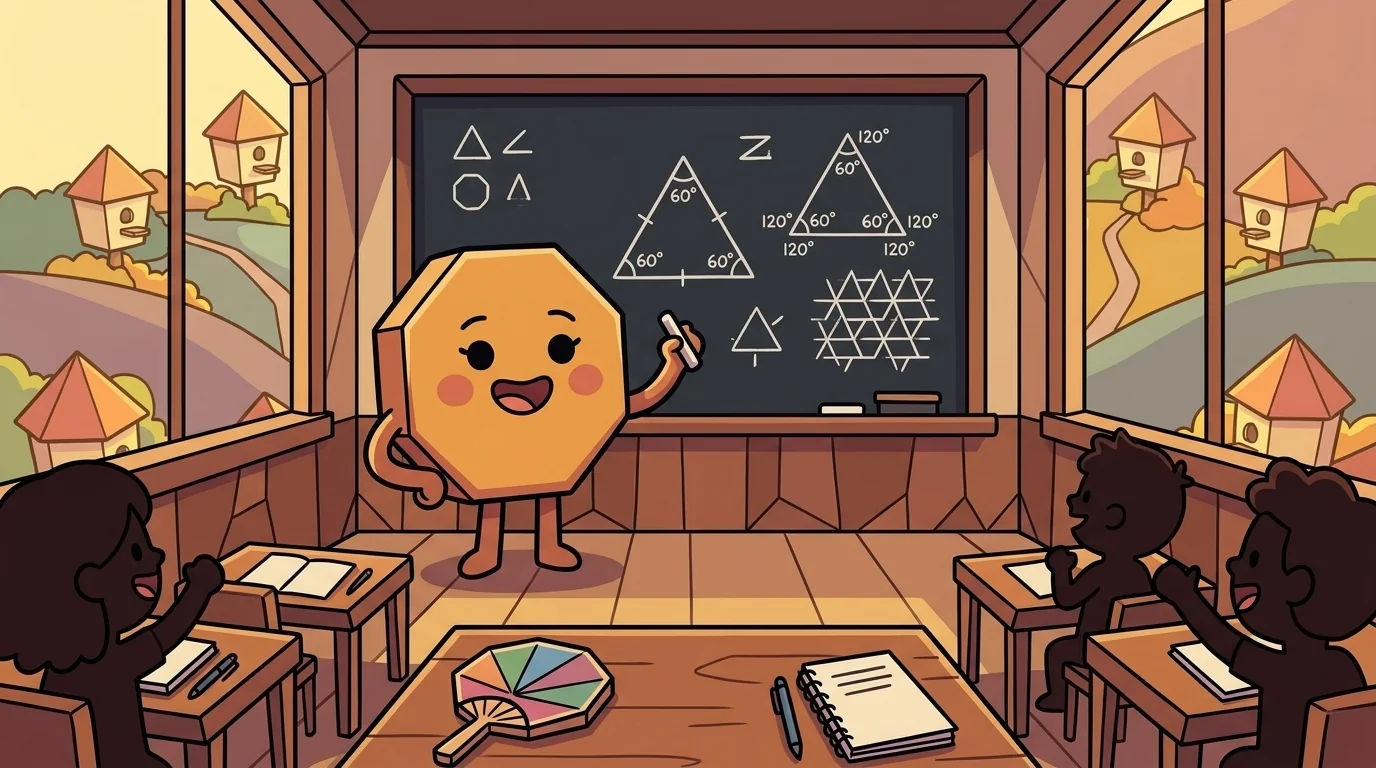
"The Council convenes. Each polygon has its angles, its symmetry, its place. Today we begin with the regular triangle. We will work our way up."
She then teaches the regular triangle. It has three sides. Its interior angles are 60°. Its exterior angles are 120°. It has three-fold rotational symmetry. It also tiles the plane perfectly. She teaches this slowly and ceremoniously. The children, who at first are slightly bemused by the ceremony, gradually learn to enjoy it. By the end of the first lesson, they can identify a regular triangle, square, pentagon, and hexagon by sight. They can also recite the interior-angle sum formula.
The lessons continue. Madame Polygon moves steadily up the polygon ladder. Pentagon. Hexagon. Heptagon. Octagon. She explains symmetry. She explains tessellation. She shows why some polygons tile the plane and some do not. She is patient. She is dignified. She clearly enjoys her work.
When children ask her whether regular polygons are hard, Madame Polygon always says the same thing:
"They are not hard. They are orderly. A regular polygon is the most orderly shape that has more than three sides. Each one has its number. Each number determines everything else. It sets the interior angle, the exterior angle, the axes of symmetry, whether it tiles. You learn the number. Everything else follows."

She opens her dodecagon-fan with a single, swift flick. The fan, when fully open, becomes a perfect regular twelve-gon. The children always gasp. Madame Polygon, who has performed this fan-opening demonstration at the start of every first-day lesson for fourteen years, still enjoys their gasp.
She says, in her theatrical voice: "Twelve sides. Interior angles of 150°. It tiles the plane in combination with triangles or squares. Nine axes of symmetry — well, twelve, if you count the rotational ones."
She pauses. She lets the children admire the fan's perfect geometry.
Then she says: "This is geometry. Polygons are not abstract. They are citizens. Each has its role. We are here to learn the roster."
She closes the fan. The lesson begins.
The GeometryForge ensemble
Madame Polygon is part of GeometryForge's distributed-narrative cast. Each character embodies a different curricular primitive; together they teach the full subject.
-

Master Hypotenuse
Right-triangle relations: a² + b² = c²
-

Lady Inscribed-Angle
Circle theorems (inscribed-angle, central-angle, tangent-chord, cyclic quadrilateral)
-

Sir Transverse
Parallel-line transversals + intercept theorem (proportional segments cut by parallel lines)
-

Apprentice Sides
Area formulas (triangle area from side lengths; rectangle / parallelogram / trapezoid area)
-

Captain Construction
Compass-and-straightedge constructions (bisector, perpendicular, equilateral triangle, regular hexagon, circle-given-three-points)
-

Compass Wraith
Locus problems + circle-as-set-of-equidistant-points
-

Master Tangent
Limit-and-touch problems (tangent to a circle from external point, tangent-chord angle, tangent-as-limit-of-secant)
-

Axia & Theora
Twin theorists — Axia carries axiomatic-first reasoning; Theora carries theorem-application; together they bridge geometric postulates to derived results
-

Madame Motion
Rigid motions and congruence — sliding, turning, or flipping a shape never changes its size or shape; two shapes are congruent if one can be carried exactly onto the other.
-

Scout Scale
Dilation and similarity — resizing a shape by a scale factor keeps every angle the same and multiplies every length equally; similar shapes are the same shape at a different size.
-
Lady Lattice
The coordinate plane — every point has an exact two-number address, so you can plot it, measure the distance between two points, and find the midpoint exactly between them.