Snip
SNIP — *mutation is natural. CRISPR makes it intentional. ethics matter.*
Listen along — Snip
Loading audio…
Press play to listen along. The line being read lights up as you go.
Show full transcript
Loading transcript…
Chapter 5 — Snip and the Tool That Edits Life Itself
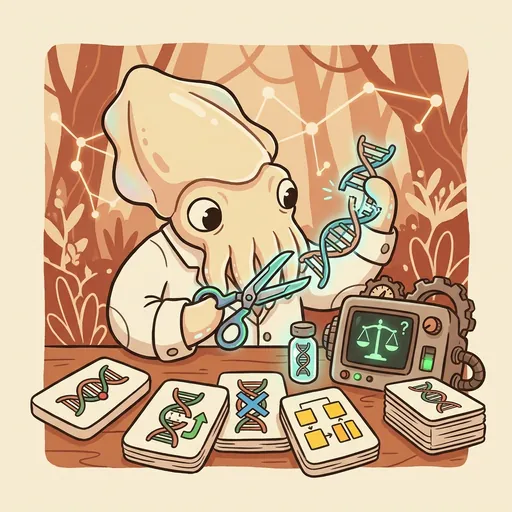
Snip hummed a quiet, off-key tune, her iridescent skin shimmering faintly under the lab lights. She was a careful-cuttlefish-tween, small and precise, her chunky-cartoon lab-tunic pristine. Her tentacles, usually busy with a dozen tasks, were now focused on one: arranging her collection of mutation cards. Each card held a drawing of an organism, a tiny change marked in red, and a brief description of what had happened.
Today, she was working on the “Natural Wonders” section. She picked up a card showing a common garden snail, but with a shell that spiraled counter-clockwise instead of the usual clockwise. Snip traced the spiral with a delicate tentacle. “A point mutation,” she murmured, almost to herself. “One tiny letter changed in the snail’s instruction book. Just one. And look.” She held the card up, admiring the unusual shell. “A whole new twist.”
A voice from the doorway made Snip jump, her skin flashing a startled lavender. “Lost in the wonders of snail genetics, Snip?”
Dr. Aris, the lead researcher for the GeneForge lab, leaned against the doorframe. Her white coat was as crisp as Snip’s, but her smile was warmer, less precise.
Snip carefully placed the snail card back in its slot. “Dr. Aris! I was just admiring this little guy. A natural mutation.” She emphasized the word, as if it were a secret. “It’s a perfect example of how change just… happens.”
Dr. Aris stepped further into the lab, her gaze sweeping over Snip’s meticulously organized workstation. “Indeed. Nature’s way of keeping things interesting. What kind of mutation is it, do you think?”
“A point mutation,” Snip said, pulling out another card. This one showed a fruit fly with slightly crumpled wings. “Like this fly. One base pair, one ‘letter’ in the DNA sequence, swapped for another. It’s like changing a single word in a very long story. Most times, it doesn’t do much. Sometimes, it changes everything.”
She pulled out a third card. “Then there are insertions – where extra letters get added. Imagine adding a whole new sentence into the middle of that story. Or deletions, where letters go missing. A missing sentence can really confuse things.” Snip paused, then grinned. “And my favorite, duplications. That’s when a whole chunk of the story gets copied and pasted, sometimes many times over. Like a chorus that just keeps repeating.”
Dr. Aris nodded, picking up a card that showed a sunflower with two heads. “So, these are all natural variations. The world would be a much duller place without them.”
“Exactly!” Snip’s skin glowed a soft, excited peach. “They’re what evolution works with. Most are silent, some are neutral, some cause problems. But they’re all just… accidents. Random.” She tapped her CRISPR-ethics-tracker, a small device clipped to her tunic. Its screen glowed with a green light. “But what if we don’t want to wait for an accident?”
Dr. Aris raised an eyebrow. “Ah, now we’re getting to the intentional part.”
Snip carefully pulled a sleek, silver tool from a padded drawer. It looked like a futuristic pair of tweezers, but much more delicate. “This is it. The CRISPR-Cas9 system.” She held it up, a reverence in her movements. “It’s a tool that lets us edit life itself. Not randomly, like nature, but with incredible precision.”
“How does it work, Snip?” Dr. Aris asked, though Snip knew she already knew the answer. It was a test.
“It’s like molecular scissors,” Snip explained, her voice dropping slightly, as if sharing a secret. “CRISPR finds a specific spot in the DNA, a target sequence. Cas9 is the enzyme that does the cutting. It snips the DNA at exactly the right place.” She demonstrated with her tentacles, making a precise cutting motion in the air. “Then, the cell tries to repair the cut. We can use that repair process to insert new DNA, delete old DNA, or even just change a single letter.”
She looked at Dr. Aris, her large, dark eyes serious. “It means we can fix a point mutation that causes a disease. Or we could give that snail a clockwise shell again. Or even make a flower grow purple instead of red, if we knew the right gene to tweak.”
Dr. Aris took the CRISPR tool from Snip, examining it. “Powerful stuff, isn’t it?”
“Terrifyingly powerful,” Snip agreed, her skin now a thoughtful, deep cream. She tapped her ethics tracker again. The green light pulsed steadily. “That’s why ethics matter. Mutation is natural. CRISPR makes it intentional. And with intention comes responsibility.”
She gestured to a small diagram on her tracker’s screen. “There are different kinds of editing. Somatic-cell therapy changes only the cells in one person’s body. Like fixing a gene in a patient’s blood cells to treat sickle cell anemia. Those changes aren’t passed down to their children.”
“And then there’s the other kind,” Dr. Aris prompted, her expression more serious now.
“Germline editing,” Snip said, her voice barely a whisper. “That means changing the genes in eggs, sperm, or embryos. Those changes would be inherited by future generations. They would become a permanent part of the human gene pool.” She shivered slightly, her skin darkening to a pale gray. “That’s where things get really complicated. What counts as ‘treatment’ versus ‘enhancement’? Who decides what’s ‘better’? And what about access equity? If only rich people can afford these treatments, what does that do to society?”
She looked down at her tracker, where a small, cautionary icon glowed red. “There was a scientist once, He Jiankui. In 2018, he used CRISPR to edit human embryos, trying to make them resistant to HIV. Those babies were born.” Snip paused, her tentacles twisting together. “It was widely condemned. He went to prison. Because even if his intentions were good, he crossed a line. A line we haven’t fully agreed on yet.”
“So, it’s not just about what we can do,” Dr. Aris said, handing the CRISPR tool back to Snip. “It’s about what we should do.”
“Exactly,” Snip said, carefully returning the tool to its drawer. She looked around the lab, at the rows of samples, the glowing screens, the endless possibilities. “The power to change life, to fix what’s broken, is incredible. But it demands careful thought. We have to consider every ripple, every consequence, before we make a single snip.”
She picked up her ethics tracker, its green light a comforting presence. “Mutation is natural. CRISPR makes it intentional. Ethics matter.” She said the words like a mantra, a quiet promise to herself and to the future. Then, with a deep breath, Snip returned to organizing her mutation cards, each one a tiny piece of a puzzle she was determined to understand, responsibly.
The GeneForge ensemble
Snip is part of GeneForge's distributed-narrative cast. Each character embodies a different curricular primitive; together they teach the full subject.