Match
MATCH — *two parents, two alleles each. Punnett square predicts offspring.*
Listen along — Match
Loading audio…
Press play to listen along. The line being read lights up as you go.
Show full transcript
Loading transcript…
Chapter 2 — Match and the Punnett Square That Predicts the Next Generation
The air in the BioLab hummed with the quiet whir of nutrient pumps and the faint scent of something green and growing. Sunlight streamed through a high window, illuminating dust motes dancing above rows of terrariums and botanical experiments. Elara, new to this section of the academy, peered into a terrarium where tiny, iridescent beetles skittered across mossy logs. She was trying to figure out which knob controlled the humidity when a small voice piped up beside her.
“Careful where you lean. The Glimmerbeast eggs are sensitive to vibration.”
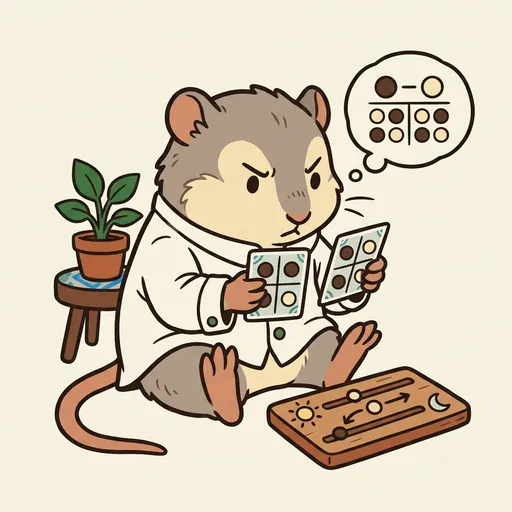
Elara jumped, nearly knocking over a beaker filled with a bubbling purple liquid. Standing next to her was a figure no taller than her elbow. It was a vole-tween with warm-cream fur and soft grey-brown markings, wearing a chunky-cartoon lab-tunic. The tunic had pockets stuffed with small, laminated cards and a miniature stylus. This was Match, known for their meticulous nature and quiet presence in the lab.
Match didn’t seem to notice Elara’s surprise. Their deep brown eyes, magnified by tiny spectacles perched on their nose, focused on diagrams taped to the terrarium glass. Match held the stylus, tapping one of the cards. It showed a grid of four squares, neatly filled with letters. This was Match’s Punnett square tracker, a constant companion.
“You’re new, aren’t you?” Match asked, not looking up. Their voice was soft but clear, every syllable carefully enunciated. “I’m Match. I teach the craft of predicting offspring.”
Elara nodded, a little intimidated by Match’s intense focus. “Elara. What exactly are you doing?”
Match finally looked at her, their expression serious, almost solemn. “I am determining the probable fur color of the next generation of Glimmerbeasts.” Match gestured to a pair of the iridescent beetles, nestled in a patch of glowing moss. One shimmered with a bright emerald green, the other a duller, earthy brown. “We need to understand how traits pass from parents to children.”
“Like, if the brown one and the green one have babies, what color will they be?” Elara asked, trying to keep up. The idea felt a bit like fortune-telling, but with science.
“Exactly,” Match said, a hint of approval in their voice. “It all comes down to allele pairing.” Match pulled out a fresh, blank Punnett card, no bigger than Elara’s thumb. “Every trait, like fur color, is controlled by genes. And for each gene, an offspring gets two copies, called alleles—one from each parent.”
Match carefully drew a square on the card, then divided it into four smaller squares with swift, precise strokes. “Let’s say the green fur allele is ‘G’ and the brown fur allele is ‘g’. Green is dominant, brown is recessive.”
Elara frowned. “Dominant? Recessive? What does that mean?”
Match patiently explained, pointing to the letters on the card. “A dominant allele, like ‘G’, will always show its trait if it’s present. So, if a Glimmerbeast has ‘GG’ or ‘Gg’, its fur will be green. The ‘g’ for brown fur only shows up if there are two ‘g’s together, like ‘gg’. That’s recessive.” Match tapped the card with the stylus. “If a Glimmerbeast has two identical alleles, like ‘GG’ or ‘gg’, we call that homozygous. If it has two different alleles, like ‘Gg’, it’s heterozygous.”
“Okay,” Elara said slowly. “So the green parent is ‘GG’?”
“Not necessarily,” Match corrected gently. “That’s where the prediction comes in. We have to consider what alleles each parent could contribute. Let’s assume our emerald green parent is heterozygous, ‘Gg’. And the earthy brown parent must be ‘gg’ because brown is recessive, and that’s the only way it can show brown fur.” Match’s explanation was clear, like a perfectly organized shelf.
Match wrote ‘G’ and ‘g’ along the top of the Punnett square, representing the alleles from the first parent. Then, ‘g’ and ‘g’ down the side, for the second parent. “Now, we combine them. Each box shows a possible pairing for an offspring.”
Match filled in the squares with practiced ease:
- Top-left: G + g = Gg (Green)
- Top-right: G + g = Gg (Green)
- Bottom-left: g + g = gg (Brown)
- Bottom-right: g + g = gg (Brown)
“See?” Match pointed with the stylus. “Two parents, two alleles each. Punnett square predicts offspring. In this case, there’s a 50% chance the offspring will have green fur, and a 50% chance they’ll have brown fur.” Match’s voice was precise, every word carefully chosen, as if each one were an allele in itself.
Elara leaned closer. “So, half green, half brown. That’s pretty neat. It’s like a little genetic roadmap.” She picked up a blank card. “Can I try one?”
Match handed her a stylus. “Of course. Imagine two Glimmerbeasts, both heterozygous for green fur. So, ‘Gg’ and ‘Gg’. What would their offspring look like?”
Elara carefully drew her own square, dividing it into four. She wrote ‘G’ and ‘g’ on the top, and ‘G’ and ‘g’ on the side. Then she filled in the boxes: ‘GG’, ‘Gg’, ‘Gg’, ‘gg’.
“So, three green and one brown?” she asked, looking up. “Seventy-five percent green, twenty-five percent brown?”
Match nodded, a rare, small smile touching their lips. “Exactly. You’ve grasped the fundamental tool.” Match carefully filed Elara’s card next to their own. “But real inheritance can be much more complex. Sometimes, traits are influenced by many genes, not just one. That’s polygenic inheritance. Or sometimes, neither allele is fully dominant, leading to a blend, which we call incomplete dominance. Or both traits show up equally, codominance.”
Match paused, looking at the Glimmerbeasts, their gaze distant. “For example, some Glimmerbeasts have a faint, shimmering pattern on their fur. That pattern isn’t just ‘on’ or ‘off.’ It’s a gradient, from barely there to intensely bright. That suggests multiple genes are at work, making the prediction much harder than a simple four-square Punnett.” Match sighed, a tiny puff of air. “The Punnett square is a powerful start, but the world is rarely so neat.”
Elara thought about it. The idea of predicting something so fundamental, like what a new creature would look like, was powerful. But Match’s quick addition about the “real complexity” made her realize it wasn’t always as simple as a clear-cut answer. Genetics, it seemed, was a clever puzzle with many layers, always hinting at more beneath the surface. Match, with their careful pairings and precise predictions, seemed perfectly suited to unraveling them, even the messy parts.
“So, you’re always trying to figure out what comes next?” Elara asked.
Match nodded, returning to their observations of the terrarium. “It’s about understanding the patterns of life. And knowing when the patterns are just the beginning of the story.” Match adjusted their spectacles, a tiny, dedicated guardian of genetic secrets.
The GeneForge ensemble
Match is part of GeneForge's distributed-narrative cast. Each character embodies a different curricular primitive; together they teach the full subject.