
Echo the Sameness-Keeper
CONSTANT FUNCTIONS — zero rate of change; output is the same regardless of input. y = c. The horizontal line on a graph.
A story read by Echo the Sameness-Keeper
Press play to listen along. The line being read lights up as you go.
Show full transcript
Loading transcript…
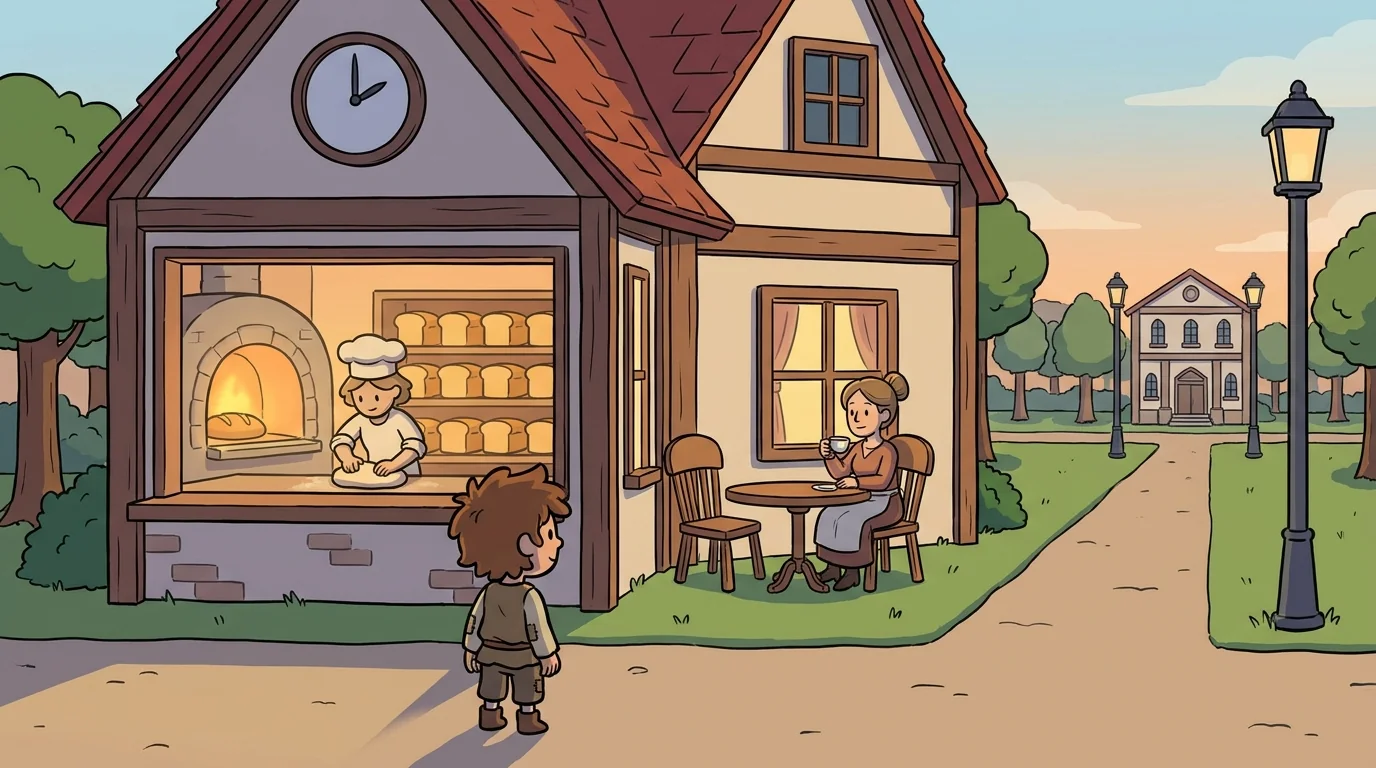
Echo’s childhood unfolded within the steady rhythm of his parents’ lives, a household where every day echoed the last. His father, Marn, a baker, and his mother, Petra, who managed ledgers at the counting-house, lived by schedules. These routines were so precise they seemed etched into the very fabric of their home. They had married thirty-two years before Echo’s birth, already set in their ways. Forty and forty-one when he arrived, they had decided long ago that their days would remain constant. This was a decision they upheld with quiet, unwavering commitment.
Marn’s day began before dawn, a familiar sequence of sounds and smells. At precisely four in the morning, his footsteps creaked on the floorboards. He kindled the brick oven, coaxing the flames to life, then began the rhythmic kneading of the day's dough. Each loaf was shaped with practiced hands, then slid into the growing heat. By seven o’clock, the first warm, crusty bread sat on the shelves of the small bakery, which fronted their house. An hour later, the door would open, welcoming the first customers ready for their morning loaves.
Petra’s routine started a little later, but with no less precision. At five-thirty, she woke. Her first act was always a cup of tea, brewed just so, consumed from the same chipped mug, in the same chair, gazing through the same window at the waking village. At six-thirty, she began her walk to the counting-house, arriving at six-fifty. There, she worked at her desk, meticulously balancing figures until noon. She walked home for a brief, quiet lunch, returning to her ledgers by one. Her work continued until five, when she would walk home again, reaching their door at five-thirty-five.
Together, they ate supper at seven. Afterward, they settled into their respective chairs by the fire, reading or simply watching the embers glow, until nine. They went to bed at ten. This pattern unfolded every weekday for over thirty years. It was the backdrop of Echo’s entire memory, a reliable hum beneath the surface of his world.

Echo — whose given name was Tone, though everyone called him Echo from the time he was three — watched all of this. He absorbed the predictable cadence of their lives.
By the age of six, a quiet understanding had settled in him: the world, he realized, contained two distinct kinds of things. Some things changed, shifting and flowing with the days. Others did not change, standing firm against the current of time.
Things that changed were everywhere, obvious and abundant. The weather, for instance, rarely stayed the same for long, bringing sun, then rain, then snow. The faces of the customers at the bakery varied daily, a constant stream of new and familiar. The crops in the fields outside their village transformed with the turning seasons, from green shoots to golden grain. Even the currency rates Petra recorded at the counting-house fluctuated, a daily dance of numbers. Echo’s own height changed, a fact his mother dutifully marked on the doorframe every solstice. His friendships evolved, and his curiosities shifted from one fascination to the next.
Things that did not change were far rarer, but they certainly existed. His parents' schedule, for one, remained an unyielding constant. The number of stairs leading up to their cottage’s second floor never varied. The well in the village square stood in the exact same spot, year after year. The names of the months, too, were fixed, a steady progression through the calendar.
Echo, a thoughtful and observant child, came to find these unchanging things extraordinarily comforting. They were like fixed points in a world that was always in motion. They felt like promises. You could plan your own small life around them. You could expect them. They held still, offering a quiet stability while everything else moved around them.

When Echo was thirteen, his village school’s teacher, Ms. Aris, introduced the concept of *functions. Ms. Aris explained, "A function is essentially a rule. It takes an input, something you put in, and reliably turns it into an output, something that comes out*. Think of it like a machine. If we say 'y equals three x,' it means for every input 'x,' you multiply it by three, and that gives you your output 'y.'"
Echo listened intently, following her explanation with ease. He understood the idea of a rule, a predictable transformation.
Then Ms. Aris continued, "Now, there's a special kind of function called a constant function. It looks a little different. It might be 'y equals five,' or 'y equals seven,' or 'y equals any single number without an 'x' in it. The key is, the output is always the same, regardless of what input you give it."
Echo’s hand shot up, a sudden thought clicking into place. "That's my parents' schedule," he declared.
Ms. Aris paused, a slight frown of surprise creasing her brow. "What did you say, Tone?" she asked, using his given name.
Echo clarified, his voice earnest. "The output of my parents' schedule doesn't depend on the input. They wake at four and five-thirty every morning. It doesn't matter what the weather is like, or what day of the week it is. It doesn't change based on what kind of bread Marn is baking, or whether the counting-house has many clients or few. For my father, it's 'y equals four-in-the-morning.' For my mother, it's 'y equals five-thirty-in-the-morning.' The input – whatever the day brings – never changes the output. The output is constant."

Ms. Aris slowly set down her chalk. She had taught functions for many years, to many children. But she had never, not once, heard a thirteen-year-old describe his parents' daily routine as a set of constant functions. A small smile touched her lips.
"Yes," she said, her voice filled with genuine appreciation. "That is exactly correct, Tone. A constant function ignores its input entirely. The output is just a fixed number, always the same. If you were to graph a constant function, it would be a horizontal line. The line doesn't go up or down. It doesn't slope. It stays at the same 'y-value' no matter what the 'x-value' is."
Echo nodded, absorbing her words. He thought about this concept for the rest of the year, turning it over in his mind.
What he eventually understood – a realization that ultimately led him to become a teacher of constant functions himself – was that these functions were not simply failures of variation. They were, in fact, promises of constancy. The world, he realized, needed both. It needed things that changed, allowing for growth and evolution, for new possibilities. But it also needed things that did not change, providing a foundation upon which people could plan, rely, and build their lives. Constant functions, he concluded, were the second kind. They were the world's quiet, dependable stability.
Echo went on to the FunctionForge academy when he was nineteen, studying for four years. He joined the faculty when he was twenty-three and has been teaching constant functions ever since.
In his classroom, he begins every first-day lesson in precisely the same manner. He places a small, polished wooden clock on his desk. The clock is permanently stopped at six-thirty. (Echo had deliberately removed its pendulum twenty years ago, ensuring its stillness. He brings it to every first-day lesson.) He turns to his new class, a gentle smile on his face. "This clock," he says, his voice calm and clear, "reads six-thirty. It always reads six-thirty. It does not matter what time it actually is outside this room – what day, what season, what year, or even what mood the room is in. The clock reads six-thirty. This, children, is a constant function. The input is the world around us, ever-changing. The output is six-thirty. The input changes. The output does not."

The children — always — find this slightly delightful, a small, unexpected bit of magic in their first math lesson.
Then he turns to the board and writes: y = 5. "Here is the algebraic form," he explains. "Notice, there is no 'x.' The output is simply five. For any input you can imagine – 'x equals one,' 'x equals one hundred,' 'x equals zero,' 'x equals negative seven' – the output is five. On a graph, this creates a perfectly horizontal line at a height of five. It does not slope. It does not bend. It is the same value at every input."
The children try graphing it themselves, their pencils moving carefully across the paper, producing straight, horizontal lines.
When children inevitably ask whether constant functions are hard, Echo always gives the same answer, a response as unchanging as the functions he teaches:
"They are not hard at all. They are simply unchanging. The output is one fixed number. The input can be anything. The two do not depend on each other. A constant function is the world's quiet way of saying: 'This part holds still.'"
He still keeps the stopped clock on his desk. The children sometimes ask why he doesn't get it fixed. He smiles. "It is a teaching prop, of course. But it is also, if I am honest, a slight reminder of my parents. They are still alive. They still wake at four and five-thirty. Their schedule has not changed in fifty years."
The FunctionForge ensemble
Echo the Sameness-Keeper is part of FunctionForge's distributed-narrative cast. Each character embodies a different curricular primitive; together they teach the full subject.
-

Stride the Pattern-Walker
Linear functions (constant rate of change)
-

Arc the Curve-Catcher
Quadratic functions (parabola — symmetric rate-of-change-changes)
-

Burst the Doubler
Exponential functions (constant *multiplicative* rate of change)
-

Pivot the Rule-Switcher
Piecewise functions (different rules for different input ranges)