
Undo
INVERSE OPERATIONS — every operation has an undo. Addition undoes subtraction. Multiplication undoes division. Squaring undoes square-root.
Press play to listen along. The line being read lights up as you go.
Show full transcript
Loading transcript…
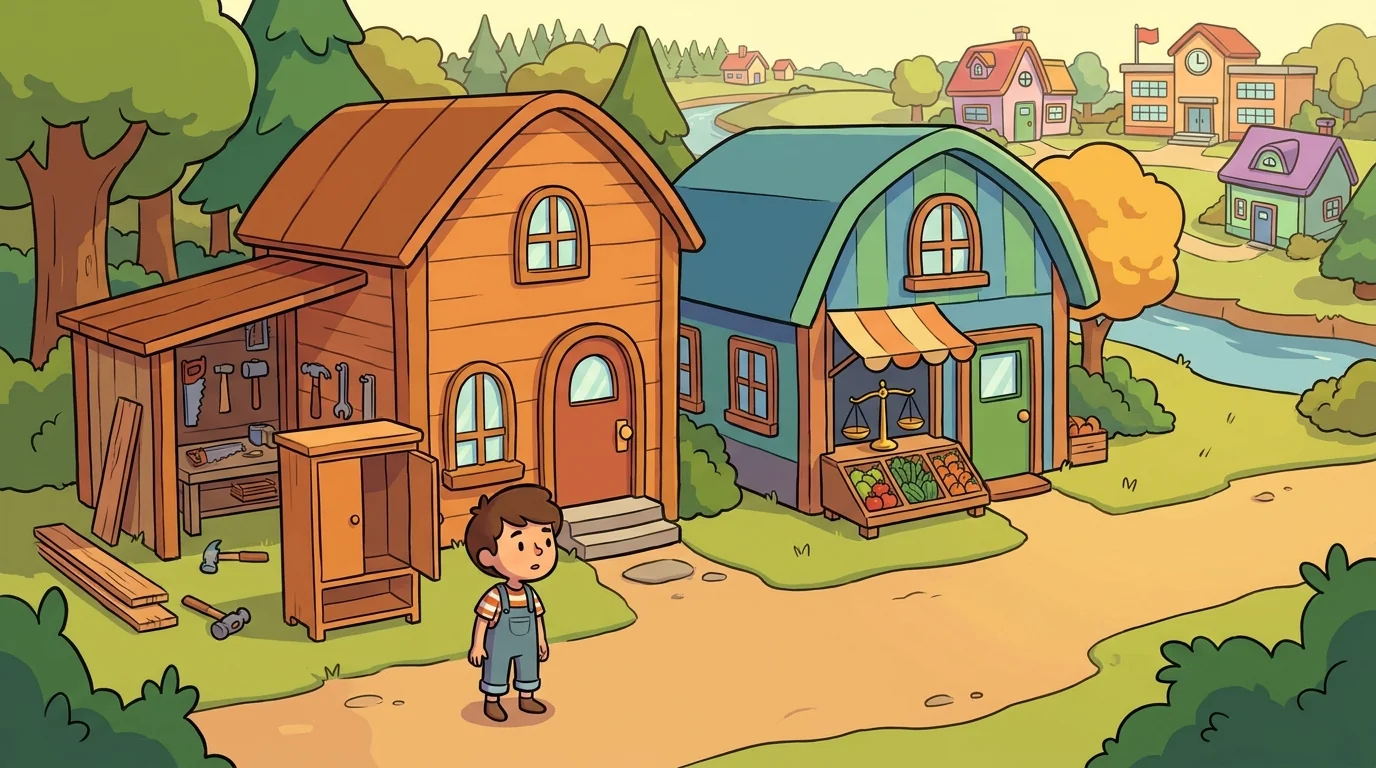
Undo lived right next door to Lever in the quiet town of Pivot. They had known each other since their toddler days, practically sharing a sandbox and every scraped knee. They walked to school together, then home again, their footsteps echoing a shared rhythm. In the way that only the closest childhood friends can, they sometimes felt like two halves of the same person, even as they grew into very different kinds of teachers.
Lever, as you know, spent his childhood watching the brass scales at his family's market. Undo, however, grew up watching her older brother build cabinets.
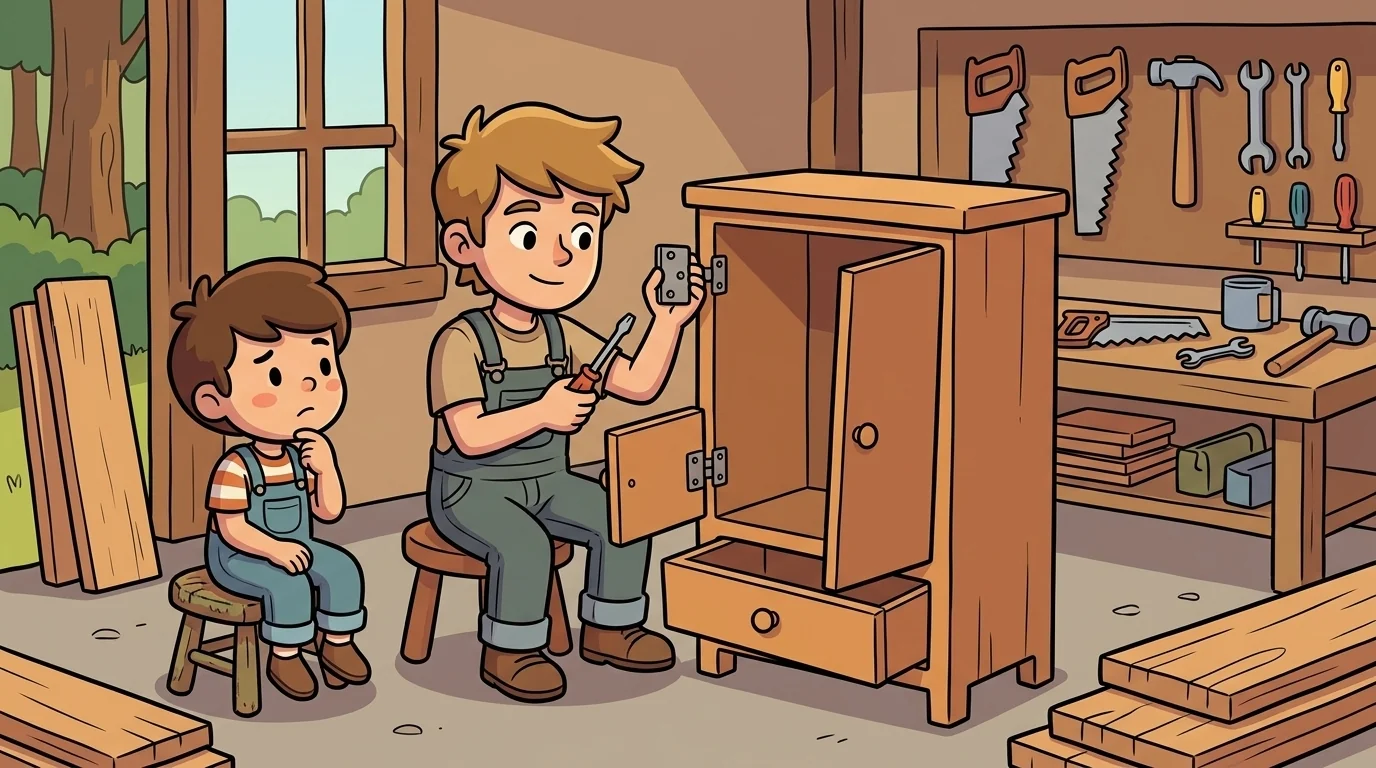
This is the story of how those quiet hours in a workshop shaped the teacher she would become.
Undo's brother, Joist, was a carpenter. He was nine years older, a towering figure who smelled of sawdust and lemon oil. From the time Undo was small, she claimed a worn wooden stool in Joist's workshop. She would sit there for hours, watching him work. He crafted chairs, sturdy tables, elegant shelves, and solid doors. Yet, his true passion, the things he built with the most care, were cabinets. Cabinets with smooth-gliding drawers. Cabinets with polished brass hinges. Cabinets whose doors swung open cleanly, latched securely, and stayed shut until you wanted them to move.
Joist's cabinets were more than just functional; they were works of art. Customers traveled from three towns over, sometimes more, just to commission a piece. The local carpenters' guild, a notoriously gruff bunch, once told Undo's mother that Joist was "unusually patient." Undo understood what they meant.
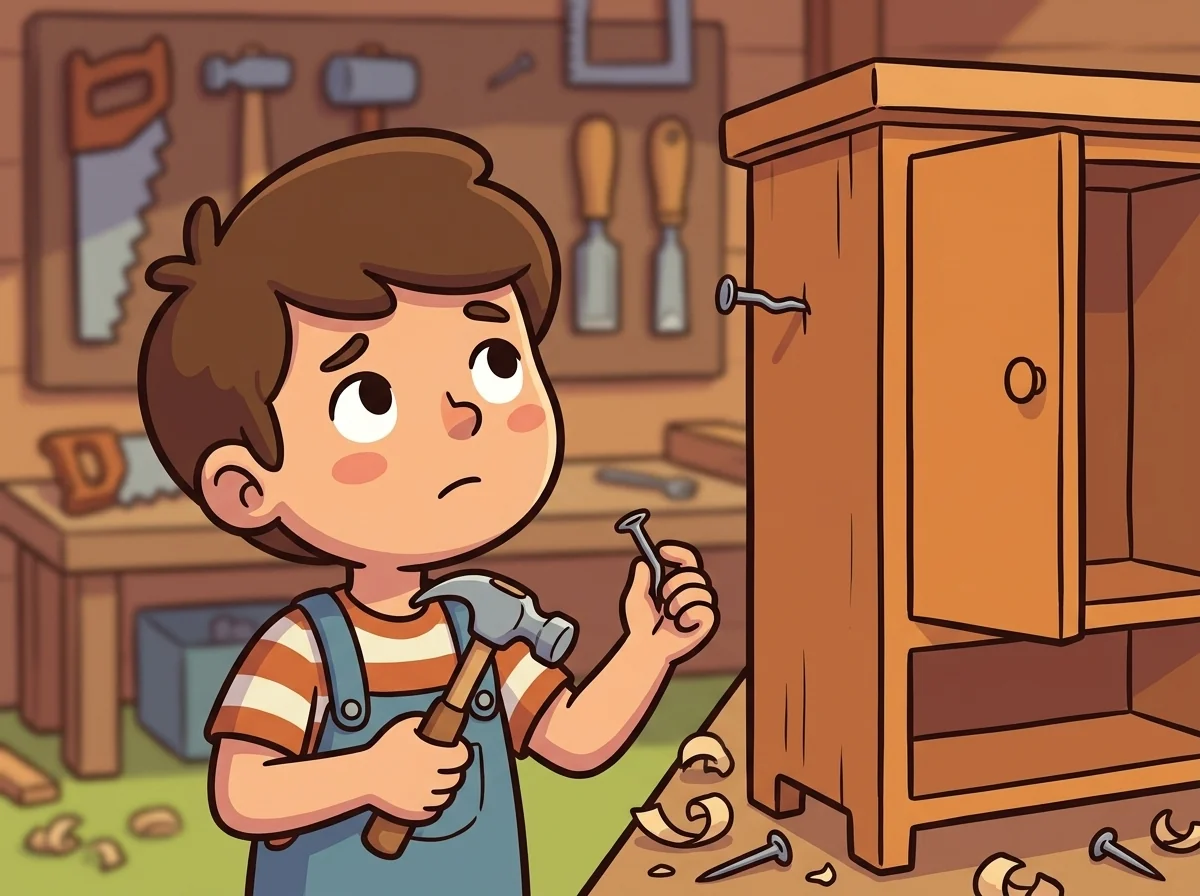
From her perch on the stool, Undo noticed Joist's peculiar ritual. It was something no other carpenter she'd ever watched seemed to do. After weeks of careful work, after a cabinet stood perfect and gleaming, Joist would unbuild it. Not completely, not destructively, but methodically. He would pull out each precisely fitted drawer, then slide it back in. He would unscrew every hinge, then carefully screw it back into place. He tested each joint, pulling it in the exact opposite direction it was designed to hold. He would, in essence, undo nearly every step of his own meticulous work. Only then would he reassemble it, piece by careful piece.
One afternoon, when Undo was seven, she finally asked him, "Why do you do that?" Joist paused, wiping sawdust from his brow. "I do not trust a joint I have not undone," he replied simply.
Undo thought about his words for the rest of the day, and for many days after. The full meaning didn't click into place all at once. It was a slow understanding, unfolding over years of watching Joist work. She began to see that every action involved in building a cabinet had a precise opposite. Nailing a board meant pulling the nail to take it apart. Gluing a joint meant separating it with a thin, patient blade. Screwing in a hinge was reversed by unscrewing the hinge. For every single step, there was an action that exactly reversed it. Joist didn't just know how to build; he insisted on knowing how to unbuild, too.
Much later, when she was older, Undo realized this careful philosophy had a name: the *principle of inverse operations. It was the same idea, she discovered, that powered algebra. If you added five to one side of an equation, the operation that exactly reversed it was subtracting five. If you multiplied one side by three, the operation that undid it was dividing by three. If you squared a number, the operation that reversed it (for positive numbers, anyway) was taking the square root. Every single step, she understood, had an undo*. If you didn't know the undo, you couldn't truly trust the original step.
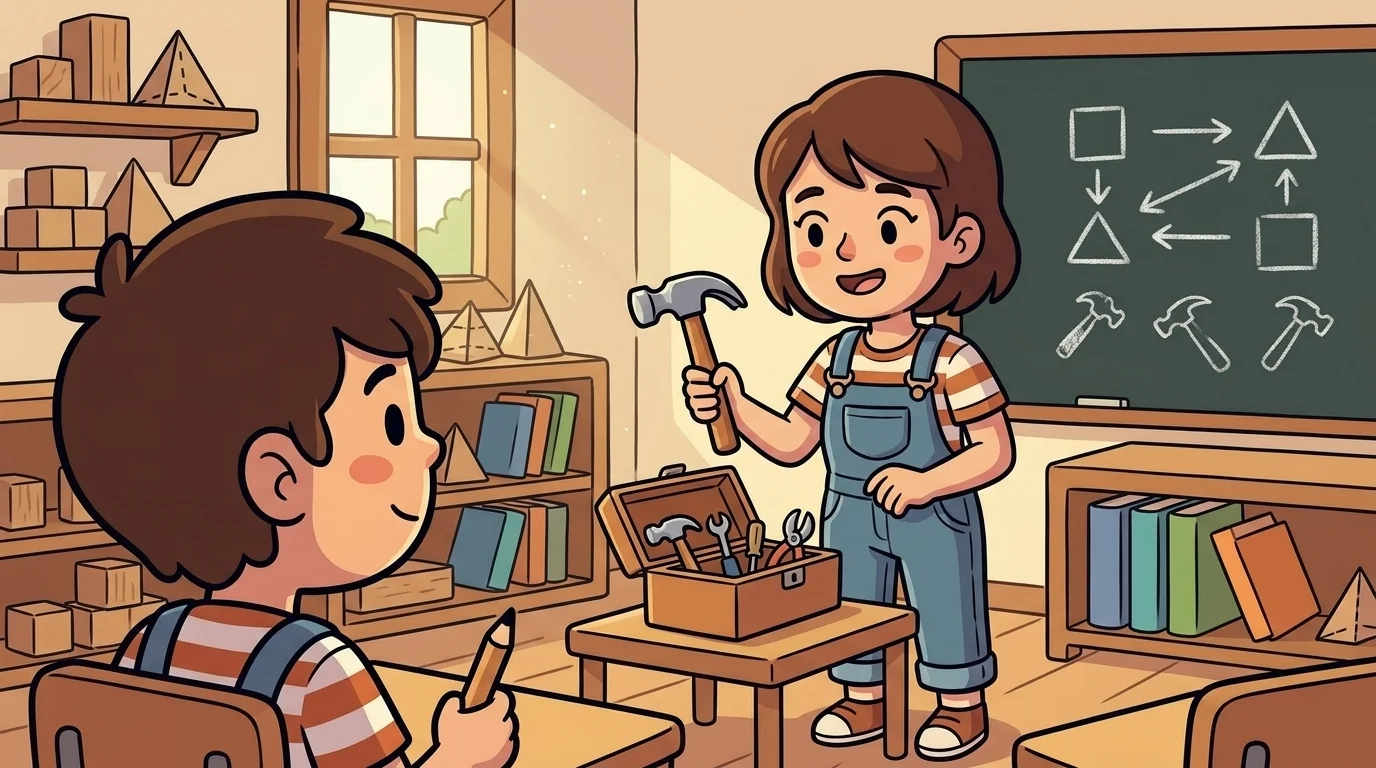
Undo arrived at the EquationQuest academy at nineteen, a little older than most new teachers. She carried a small, well-worn toolbox, a gift from Joist. Inside were six different implements, each designed to reverse a specific carpentry action. The academy master, a stern woman with sharp eyes, watched Undo for a few minutes during her orientation. Then she simply nodded. "You will be teaching inverse operations," the master said. "Welcome."
Undo has been teaching at EquationQuest ever since. She still keeps that small toolbox in her classroom, a quiet reminder of Joist's wisdom. It's her favorite demonstration. She'll hold up a hammer, its head gleaming. "This," she'll tell her students, "puts a nail in." Then she'll flip it around, showing the clawed end. "And this," she says, "takes a nail out. They are the same tool. They are the same idea, just moving in two different directions."
The children always remember this. Little hammers, some with nails, some with claws, appear in their notebooks for weeks.
Every year, when her students reach Kit 8, Undo tells a particular story. It's a true one, from Joist's workshop. Once, he built a magnificent corner cabinet for a customer. It was a true showpiece, all gleaming wood and precise angles. A few days after delivery, a frantic letter arrived. The customer claimed the cabinet's main door would not open. Joist was briefly, utterly panicked. He couldn't understand. He had tested that door a hundred times, opening and closing it, checking the hinges. He drove straight to the customer's house, his stomach tight with worry. There, in the corner of the room, sat his beautiful cabinet.
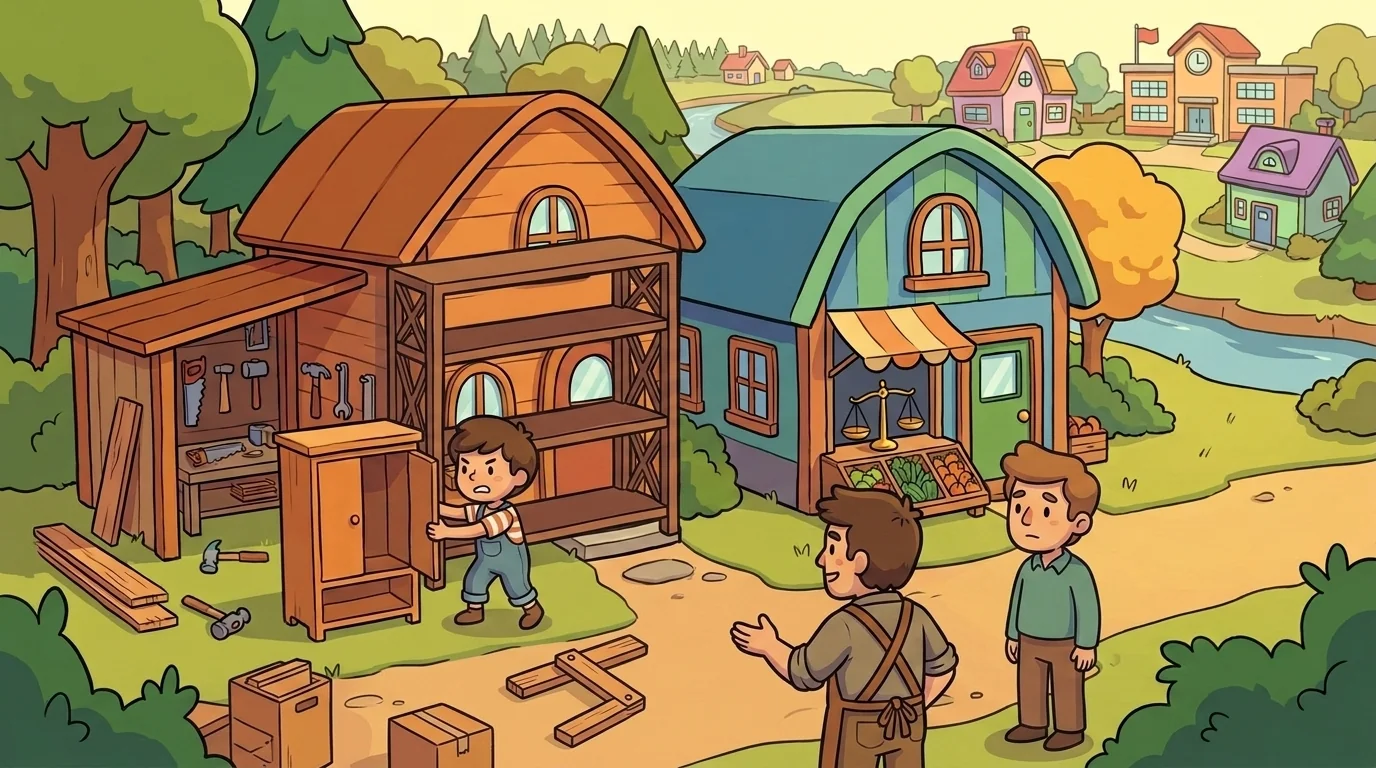
The customer had placed it snugly into a corner. The cabinet door, designed to swing wide to the left, now faced a wall only four inches away. It could only open a tiny crack, barely a quarter of the way. Joist saw it immediately.
The cabinet itself was perfect. The room was the problem. Joist simply suggested moving the entire cabinet six inches to the right. The customer, a little sheepish, did exactly that. The door then swung open cleanly, silently.
Undo uses this story every year in Kit 8. It helps her explain a crucial idea: sometimes the equation itself is fine, but the situation around it is wrong. You have to step back, she tells her students, and check that the "room around the equation" makes sense. You need to verify that the variable can actually take the values you are letting it take. Mathematicians, she explains, call this checking the domain**. Undo, however, still calls it "moving the cabinet six inches to the right."
Twice a year, Undo still travels home to Pivot. She helps Joist with whatever cabinet he's building, just like when she was small. She still tests every joint. And she still does not trust a joint she has not undone.
The EquationQuest ensemble
Undo is part of EquationQuest's distributed-narrative cast. Each character embodies a different curricular primitive; together they teach the full subject.