
Lever
BALANCING — the foundational principle that an equation is a balance, and whatever you do to one side you must do to the other.
Press play to listen along. The line being read lights up as you go.
Show full transcript
Loading transcript…
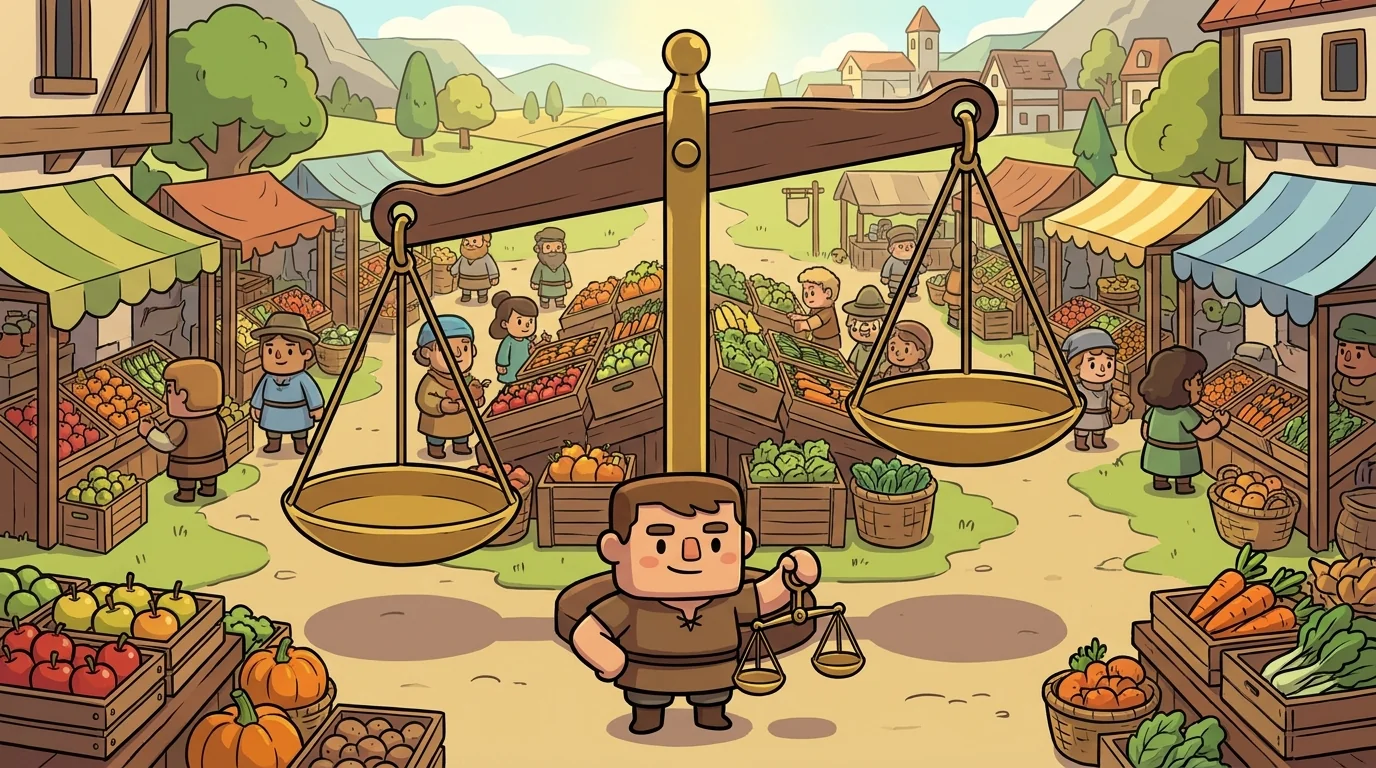
*Lever was a compact man, built with the sturdy squareness of a shipping crate. He carried a small set of brass scales with him nearly everywhere he went. The scales weren’t strictly necessary for his work, as he often admitted, but he liked the solid weight of them in his hands. They reminded him of an essential truth. They reminded him why he started.*
His story began in a town called Pivot, set squarely in the kingdom’s central plain. The name came from a type of mechanical joint, a fact the townspeople had, over many generations, stopped finding clever. Lever’s family didn’t work the forges or the mills that lined the river. They ran the market, a sprawling collection of twenty-three stalls famous for one thing above all else: its honesty. And that honesty began at the front gate, with the weighing scales.
The market scales were enormous. Two flat brass pans, each the size of a ceremonial platter, hung from a thick wooden beam that balanced on a single brass pin. The beam itself was four feet long, weathered by sun and rain. The entire assembly weighed as much as a small pony, and it was the most respected object in Pivot. It was the final word.
Lever grew up in the shadow of those scales. By his own careful count, he spent roughly ten thousand hours of his childhood watching people weigh their goods. He watched farmers heap apples onto one pan and the market clerks stack brass weights on the other. He watched until he was eleven, and by then he had seen something that most of the adults had long since stopped noticing.

He had noticed the scales were honest.
You could not cheat them. You could not persuade them, or bully them, or make them say something untrue by hoping very hard. If a farmer’s cart held two pounds of potatoes, it took exactly two pounds of brass to balance the beam. Not an ounce more, not an ounce less. The scales did not argue or negotiate. They simply stated the truth. For young Lever, this was the most fascinating thing in the world.
For his eleventh birthday, his grandmother gave him his own set of scales. They were a beautiful, palm-sized version of the market’s giant, carved from dark wood with delicate tin pans. Lever took them everywhere. He weighed his shoes, his lunch, and his cat, who was not a willing participant. He weighed feathers and stones and coins, keeping a meticulous record in a small notebook. He thought of himself as a detective of unseen truths, an investigator of honest numbers.
One sun-baked afternoon in late spring, when Lever was twelve, an event at the market changed the course of his life.
A farmer rattled up to the gate, his cart piled high with shining red apples. He was a man with a face like a dried plum, and he was already frowning. “Two hundred and forty pounds,” he announced, slapping a dusty ledger book he carried. “Weighed it myself on my own scale before I left the orchard.”
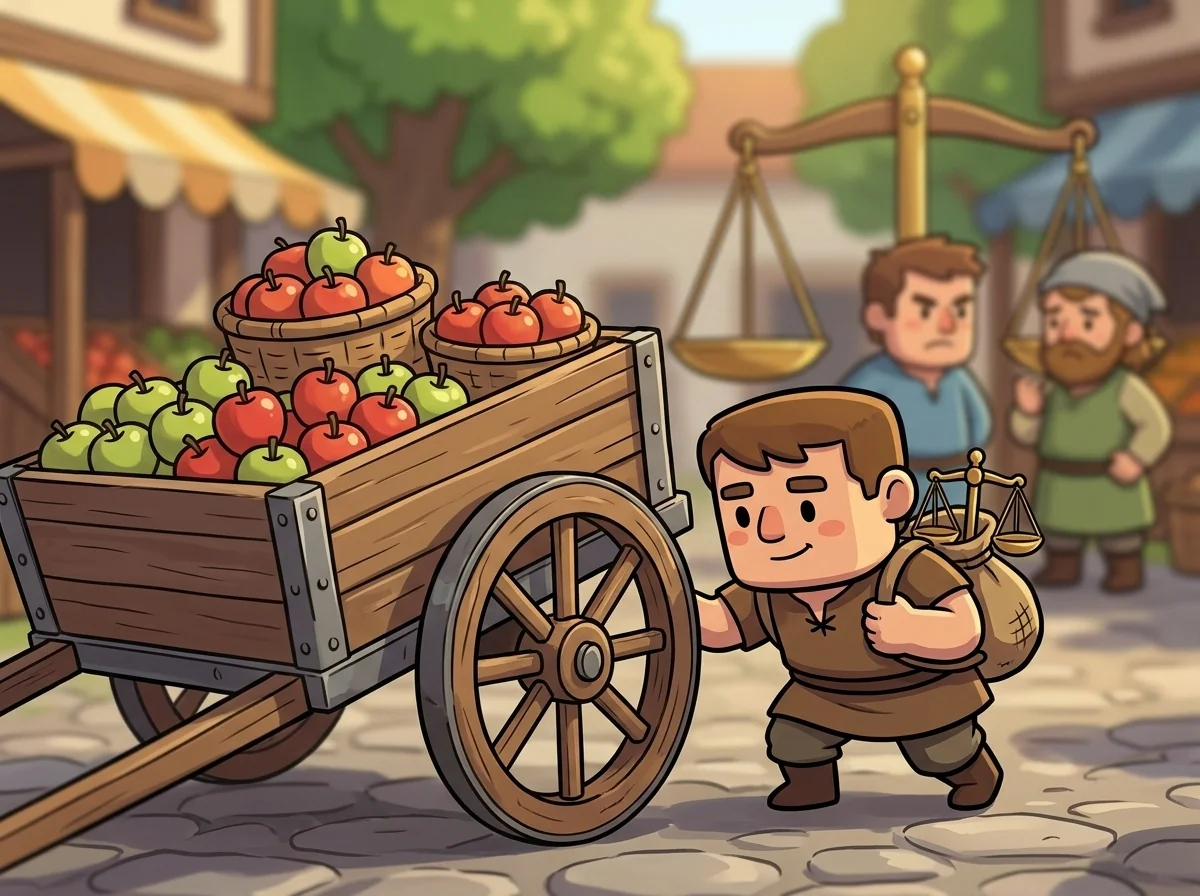
The market clerk, a teenager named Finn, chalked the number on his slate and gestured the farmer forward. The cart’s wheels groaned as they settled onto the massive brass platform of the market scale. The long wooden beam tipped, swayed for a moment, and finally came to rest. Finn squinted at the markers.
“Two hundred and fifty,” he declared.
The farmer’s frown deepened. “What? No. It’s two-forty. Your scale is off.”
“Scale’s never off,” Finn said, a little defensively. He had heard this complaint a hundred times. “It’s two-fifty.”
“That’s ten pounds of apples I’m being cheated out of!” the farmer grumbled, his voice rising.
Lever, perched on a nearby crate of cabbages, said nothing. He just watched. He saw the farmer’s face darken with suspicion. He saw Finn’s flush of confusion. And he saw the scales, steady and certain. The scales weren’t wrong. They never were.
So, if the scales were right, and the farmer was also sure he was right, then something else had to be happening. Lever’s eyes left the arguing men and traced the dusty lines of the apple cart. He slid off his crate and walked over, his own small scales clinking softly in his pocket. He didn’t look at the apples. He looked at the cart itself. He circled it slowly, his gaze running along the wooden frame. Then he knelt down and peered underneath.
And there it was.
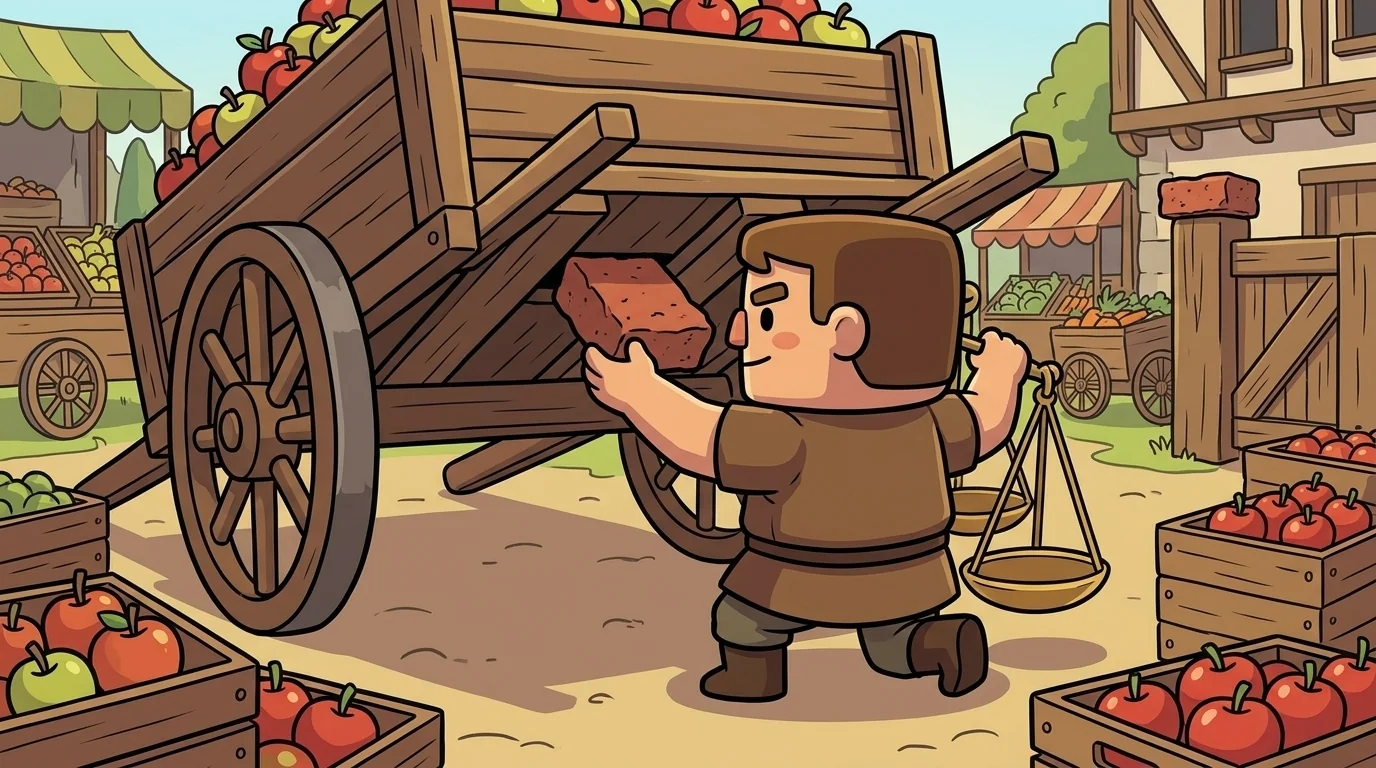
Wedged between two of the thick wooden slats on the cart’s underside was a dusty red brick. Some kid on the road from the orchard must have jammed it in there as a prank. It was a heavy, solid thing, out of place and unseen.
Lever reached under and worked it free. It was heavier than he expected. He stood up, holding the brick in both hands. He didn’t say a word. He just walked over to the clerk’s smaller counter-scale, placed the brick on one pan, and began stacking one-pound weights on the other.
One. Two. Three. All the way to ten. The pans balanced perfectly.
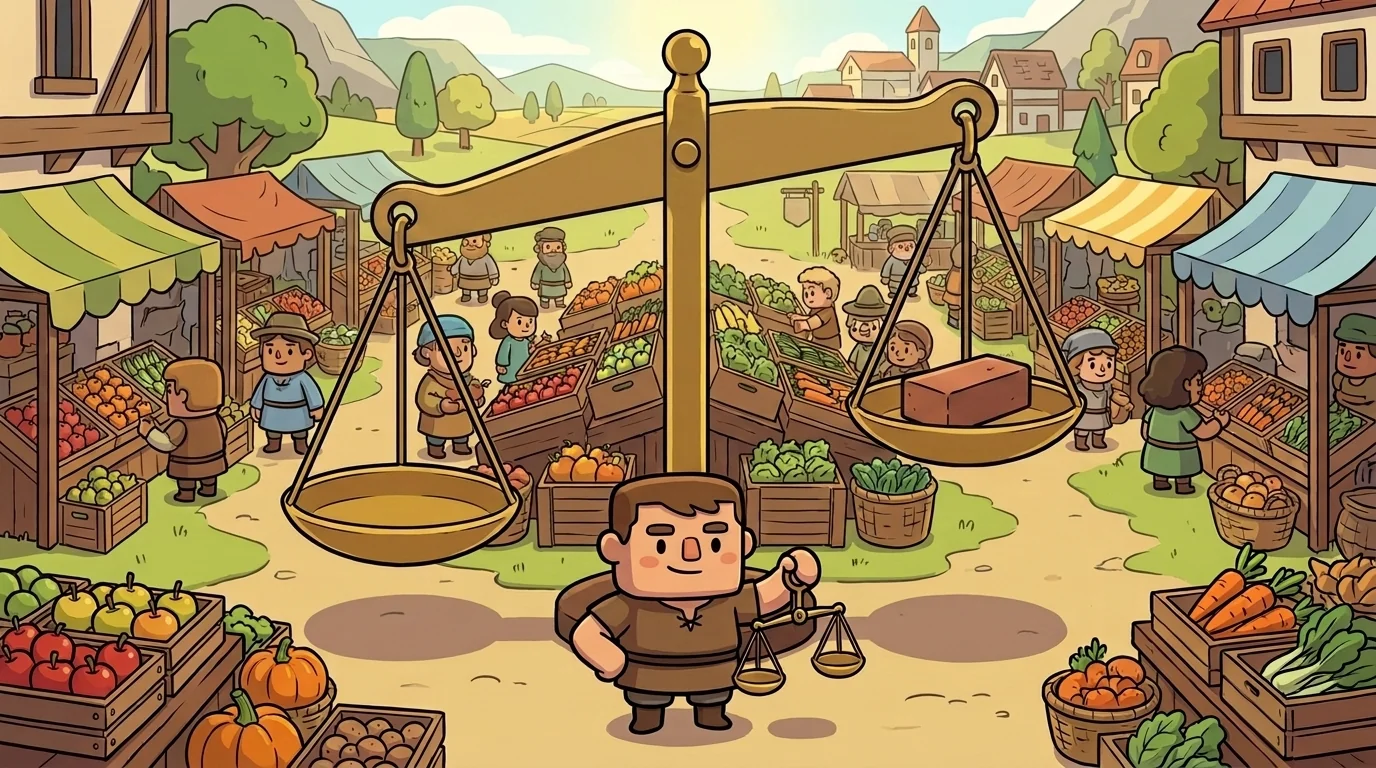
He turned and showed the ten-pound brick to the farmer and the clerk. A moment of silence passed. Then the clerk, Finn, let out a short laugh of understanding. The farmer stared at the brick, then at his cart, and then he laughed too, a deep, rumbling sound.
The scales had been right. The farmer’s scale had been right, too. The brick was the difference. Both sides paid for the apples by weight, minus ten pounds for the stowaway. Everyone went home happy. The brick was placed on the gatepost as a friendly warning to future drivers, and it sat there for years.
That was the day Lever understood his life’s work. The scale had told the truth, even when it seemed wrong. It couldn’t have known the brick was there, but it felt its weight all the same. Because the scale did not negotiate, the brick had to be found. You couldn’t just decide the cart weighed less. To find the true weight of the apples, you had to remove the brick from the cart, and you had to remove its weight from the total.
You had to do the same thing to both sides of the problem. It was a rule as simple and unbending as the beam of the scale itself.
Years later, when the EquationQuest academy invited Lever to teach this principle, he brought the small wooden scales his grandmother had given him. He still uses them in his classroom. The brick story is the first one he tells. On a shelf behind his desk sits a dusty, chipped, ten-pound piece of clay with a small label that reads: “The equation is a balance.”
He still goes home to Pivot once a year to help with the harvest weighings. He still listens to the scales. And he still does not negotiate.
The EquationQuest ensemble
Lever is part of EquationQuest's distributed-narrative cast. Each character embodies a different curricular primitive; together they teach the full subject.