Shape
SHAPE — *what family of object? typology + comparative craft.*
Listen along — Shape
Loading audio…
Press play to listen along. The line being read lights up as you go.
Show full transcript
Loading transcript…
Chapter 2 — Shape and the Family Resemblance of Things People Made
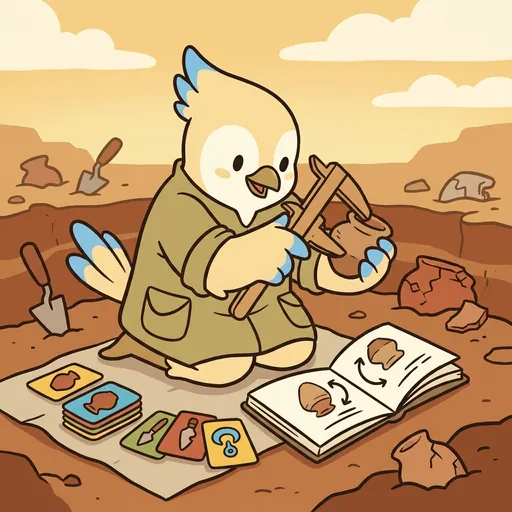
The small jay-tween, Shape, sat hunched over a pottery sherd, her cream-colored feathers tipped with soft blue. Her bright, curious eyes, sharp as a hawk’s, were fixed on the broken piece of clay. Around her in the workshop, shelves overflowed with reference books and display cases held carefully labeled artifacts. Shape’s signature tools lay spread on her workbench: a set of precise brass calipers, a stack of typology cards, and a well-used comparative sketch-pad.
Shape was always attentive, always comparing. She believed that every object, no matter how small or broken, had a story to tell. But you couldn’t just guess that story. You had to ask the right question. Not “What is it?” but “What family of object does it belong to?”
She picked up the sherd, turning it gently in her small, three-fingered hand. “This,” she said, her voice soft but clear, “is where the craft begins. Typology and comparative craft.”
Most people, when they found something old, wanted a quick answer. They wanted a single word: pot, tool, bead. But for Shape, that was just the start. She knew that artifacts, like living things, belonged to families. Pottery, for example, had different types, each with its own characteristic rim profiles, decoration patterns, and even the kind of clay and how it was fired. Stone tools had specific flaking patterns, edges, and wear marks from how they were used. Beads varied by material, the way they were drilled, and their shape.
This process of grouping artifacts by their shared characteristics—their “family resemblance”—was called artifact typology. It was the archaeology craft of understanding what family of object this is. Typology helped place artifacts within a craft tradition, a specific time period, and a particular region. A piece of pottery that looked like other Mississippian-style sherds, sharing a certain rim shape and the same kind of crushed shell mixed into its clay, wasn’t just a sherd. It was a clue. It spoke of an entire craft tradition, a likely period, and even cultural connections between different groups of people.
Shape picked up her calipers. “The way we work is simple,” she explained, her voice even. “Measure. Sketch. Compare. Then we ask what that family membership tells us.”
She held the sherd steady and carefully measured its thickness. Then she measured the curve of its rim, noting the exact angle. “This helps us understand its form,” she said, making a quick, precise sketch on her pad. “Was it a bowl? A jar? A plate?”
Next, she examined the surface for any decoration, drawing the faint lines and patterns she found. She scraped a tiny bit of the clay from a broken edge, looking closely at the tiny flecks within. “This is the temper,” she explained, “the material mixed into the clay before it’s fired. It could be sand, crushed shell, or even plant fibers. Different groups used different tempers.” This detail, she knew, was a crucial clue to its origin.
With her measurements and sketches complete, Shape turned to her typology cards. These cards organized artifacts by family: pottery types, tool types, ornament types. She flipped through the pottery section, comparing her sketch to the detailed drawings and descriptions. She also consulted the large, worn reference catalogs on her shelves, filled with published types from across the region and different time periods.
“Ah,” she murmured, her eyes lighting up. “This rim profile, this temper, this decoration… it matches a known type.” She pointed to a card. “This sherd belongs to the Late Woodland tradition, specifically a type of storage jar common in the river valleys during that period.”
She leaned back, a quiet satisfaction on her face. “Now, the sherd tells more of its story. It tells us when it was made, whose craft tradition it came from, how it was made, and even why it was used.” She gestured to the shelves of books. “Typology isn’t something one person invents. It’s built across generations of archaeologists. I just joined the long conversation.”
Shape looked up, her gaze gentle and attentive. “Don’t snap-identify,” she advised. “That’s the anti-pattern. The comparison is the work. Compare slowly; join the long conversation. That’s what typology is all about.”
She tapped the sherd gently. “What family of object? Typology and comparative craft.”
The DigQuest ensemble
Shape is part of DigQuest's distributed-narrative cast. Each character embodies a different curricular primitive; together they teach the full subject.
-

Layer
Stratigraphic context — where in the layered earth? (vertical chronology, context integrity)
-

Past
Dating techniques — when by which method? (dates as ranges with confidence intervals)
-
Keep
Cultural-context inference — keep-what-people-said, not invent-what-they-must-have-meant
-
Ask
Community-partnership ethics — whose story is this and who gets to tell it? (NAGPRA + UNDRIP-grounded, descendant-community partnership)