
Trench
HADAL ZONE — *deepest trenches. extreme pressure. and still — life. ancient time. ancient adaptation.*
Press play to listen along. The line being read lights up as you go.
Show full transcript
Loading transcript…

The first thing you noticed about Trench was her stillness. She moved with a slow, deliberate grace, like a cloud of mist drifting through water. Her body, a soft translucent pink-cream, seemed to glow faintly in the dim light of her workshop. She was small, even for a snailfish, and her movements were always calm. On her back, she carried a small, rolled-up chart. It was her *time-depth-chart*, a diagram that showed how ocean depth connected to the vast stretches of geological time. She often said, "The deepest places are also the oldest. These adaptations took millions of years."

Trench taught about the *hadal zone. This was the deepest part of the ocean, a world of narrow, elongated trenches plunging from 6,000 to 11,000 meters down. These deep gashes in the seafloor formed when one oceanic plate slid beneath another, a process called subduction*. The Mariana Trench, the deepest known, reached nearly 11,000 meters. Down there, the pressure was immense, more than 1,000 atmospheres. Imagine a ton of weight pressing on every square centimeter of your body. Most people thought nothing could live in such a place. They were wrong. Snailfish swam happily at 8,000 meters. Tiny amphipods scuttled across the trench floor. Strange, ancient species thrived in isolated pockets of these deep, dark valleys.
It wasn't just about survival; it was about persistence. The hadal zone was a refuge, a place where life had found a way to survive for millions of years. These creatures were living fossils, direct descendants of lineages that had thrived in deeper seas eons ago. While the surface waters changed, the deep ocean remained a stable, unchanging sanctuary. Trench called it the ocean's living archive, a place where evolution had paused, content with its ancient masterpieces. Trench's job was to show everyone the wonder of this extreme, ancient world.

Trench spoke with a quiet, steady voice. "The deepest places are also the oldest," she would say. "Extreme pressure. Total darkness. And still—life. Ancient time. Ancient adaptation. My zone is where evolutionary patience meets physical extremity. The species here have been here, mostly unchanged, for many millions of years."
Trench herself had grown up in the deep, deep trenches. Her family had lived there for what felt like forever. They were a lineage of snailfish whose ancestors had looked much the same for millions of years. Generations of her family had passed down a single, vital lesson: "The deepest places change the slowest. Time runs differently here." Trench carried that truth inside her, a quiet strength.

When Trench was thirteen, she made the long journey to DepthQuest. Marlin, the wise old mentor, met her at the entrance. "What is the hadal zone?" Marlin asked, his voice echoing in the vast chamber. Trench took a deep breath. "The deepest trenches," she began. "Six thousand to eleven thousand meters down. Extreme pressure. Total darkness. And still—life. Ancient time. Ancient adaptation. My ancestors have been in roughly this body-shape for millions of years. Deep-sea stability preserves ancient lineages." Marlin simply nodded. "You are appointed," he said. And Trench, the small snailfish, had found her place.
In her workshop, Trench unrolled her time-depth-chart. It was a beautiful, intricate diagram. One side showed the layers of the ocean, from the sunlit surface down to the crushing depths. The other side showed geological time, stretching back hundreds of millions of years. "See?" she said, tracing a line with a delicate fin. "The surface ocean changes rapidly with climate. The twilight and midnight zones change slower. The abyssal zone is slower still. But the hadal zone? It's glacially slow. The deepest trenches barely change over millions of years." She paused, letting the thought settle. "So, creatures here haven't needed to change much either. That's why some of my neighbors look 'ancient'—they are."
She then showed footage from a 2017 expedition to the Mariana Trench. On a large screen, a snailfish drifted into view. Its body was translucent, almost ghostly, and small. It moved with an unhurried calm, its tiny eyes seemingly unfocused in the perpetual darkness. "This snailfish was discovered at 8,178 meters," Trench explained. "The deepest known fish. It survives where land animals couldn't last a second." She pointed out its soft, cartilaginous skeleton and the lack of a swim bladder. "These are key adaptations," she said. "No rigid bones to be crushed. No gas-filled bladder to explode under the pressure. Just specialized membranes and proteins that work perfectly down there. And they have a very slow metabolism," she added, "meaning they use energy slowly, like a deep-sea battery that lasts for ages." She also showed images of amphipods, small crustaceans scuttling across the trench floor, breaking down "marine snow"—the constant shower of organic particles from above—and the occasional carcass. "They're the clean-up crew," she added with a hint of dry humor. "Efficient and ancient. Some of their lineages are very, very old." It made you think about time differently. What did 'new' even mean when some creatures had been perfectly adapted for millions of years?
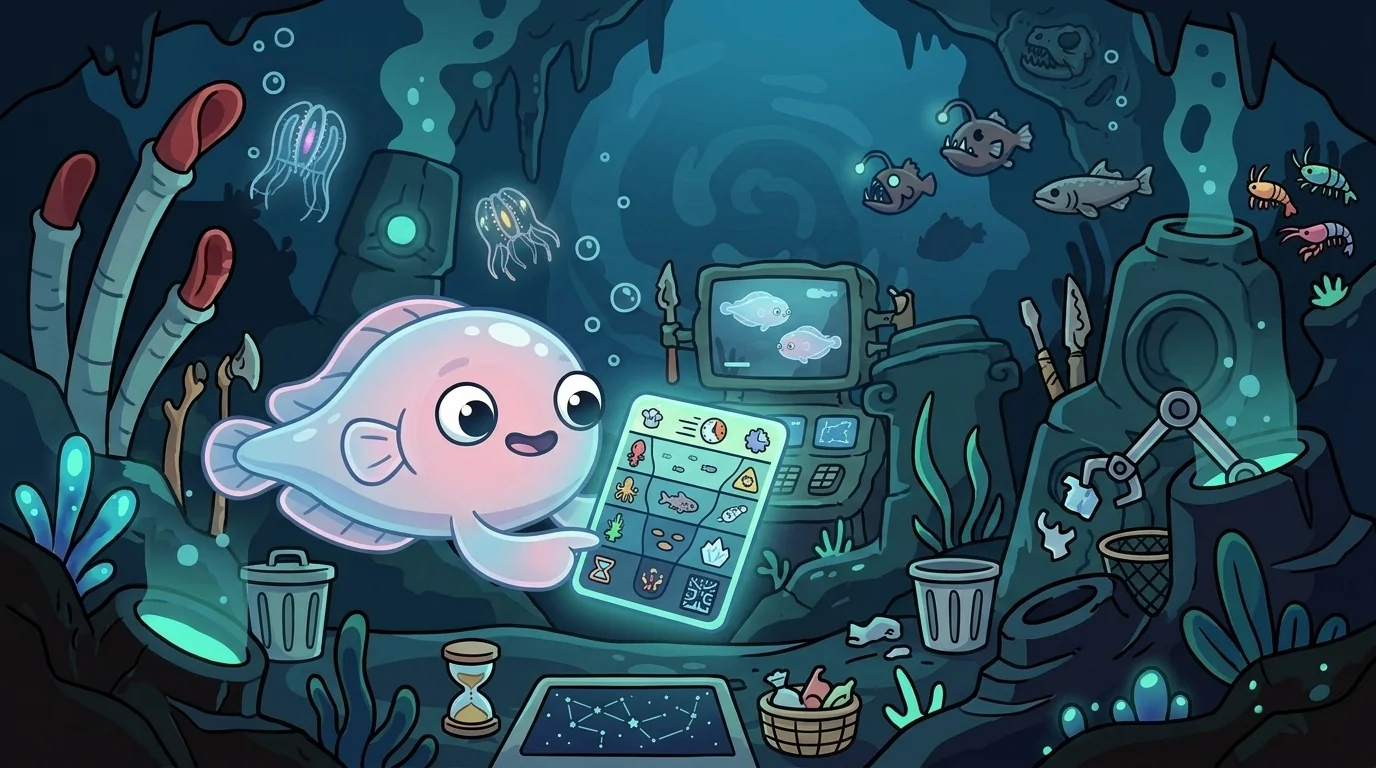
"I am Trench," she stated, her voice clear. "The primitive I teach is the *hadal zone + deep-time adaptation*. My message is simple: deep places are old places. Stability preserves the ancient."
Then, her expression turned serious. "Even the deepest trench has been touched by plastic," she admitted, her voice softer now. A hush fell over the workshop. "That's sobering, yes. But it's also motivating. Cleanup work is happening at multiple ocean scales. We need awareness, not despair. My zone is recoverable too."
She finished by looking around at her students. "Wonder at the depth," she urged them. "Wonder at the time. Both are vast. Both hold marvels."
The DepthQuest ensemble
Trench is part of DepthQuest's distributed-narrative cast. Each character embodies a different curricular primitive; together they teach the full subject.