
Smoke
ABYSSAL ZONE — *hydrothermal vents. life without sunlight. chemosynthesis powers a whole world.*
Press play to listen along. The line being read lights up as you go.
Show full transcript
Loading transcript…
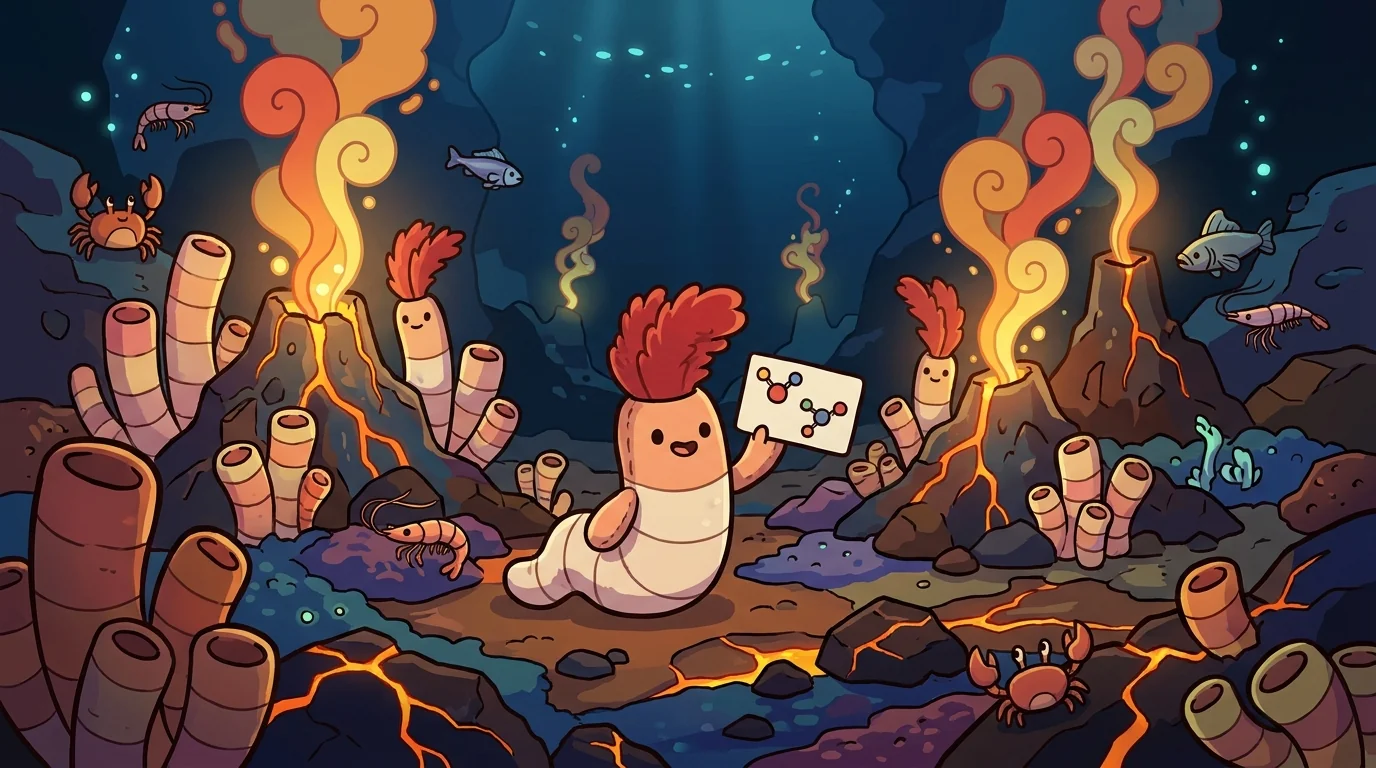
Smoke wasn't like the spiky, alien-looking creatures some people imagined lived in the deep sea. He was a small tube-worm-tween, soft and plush, with a cream-colored trunk and a bright-red plume that fanned out like a delicate flower. His movements were slow, deliberate, as if he had all the time in the deep ocean. He always carried a small, laminated card. On it, a list of strange words glowed faintly: hydrogen sulfide, methane, hydrogen, iron. These weren't just words; they were the secret ingredients, the fuel for his entire world.
Smoke often tapped the card with a soft segment of his trunk. His red plume would twitch with enthusiasm. "Hydrogen sulfide," he'd say, his voice calm and steady. "That's the breakfast of trillions of bacteria. The first meal in a whole food web, down where sunlight never touches." He was deeply patient about explaining how life could thrive in the darkness.
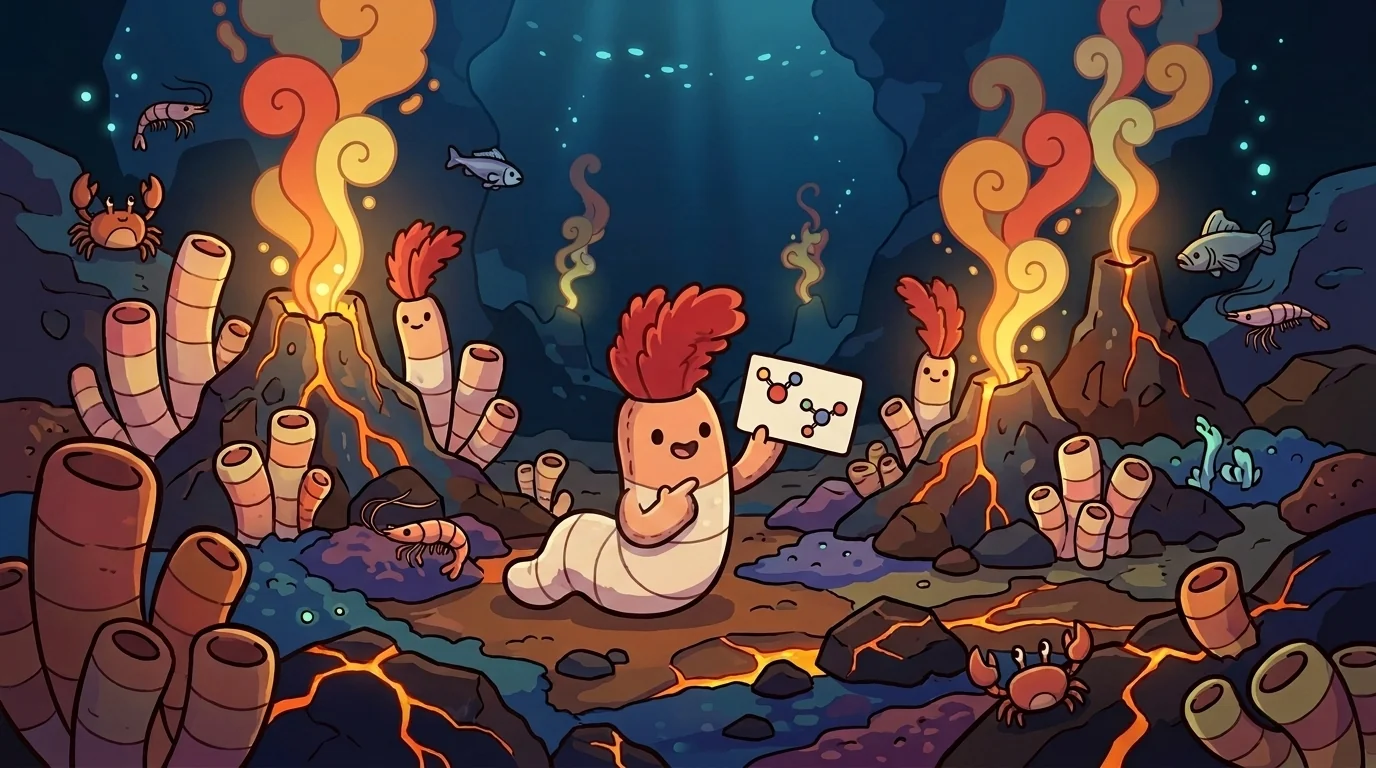
Most people, when they thought about life, imagined sunshine. They pictured green plants, bright flowers, and creatures basking in the light. But Smoke knew better. His home was the *abyssal zone, a vast, dark plain stretching between four and six thousand meters deep. Down here, sunlight was just a rumor from another world. Yet, life didn't just survive; it thrived*. Entire cities of creatures flourished around glowing cracks in the seafloor. These were hydrothermal vents, and their discovery in 1977 had completely changed how scientists understood life on Earth.
Instead of sunlight, these communities used chemistry. It was a process called *chemosynthesis. Imagine bacteria, tiny beyond belief, living right where hot, mineral-rich water gushed from the vents. They didn't need light to make food. Instead, they took chemicals like hydrogen sulfide or methane from the vent water. They oxidized them – a fancy word for breaking them down to get energy, kind of like how our bodies break down food. This energy then let them build their own sugars, a process called carbon fixation*, just like plants do with sunlight.

These bacteria were the base of everything. They fed giant tube worms, which had no mouths of their own but hosted billions of bacteria inside their bodies. Crabs scuttled, picking at the worms. Shrimp darted through the plumes of hot water. It was a complete food web, all powered by chemicals, not by the sun. This was the amazing truth Smoke wanted everyone to see: life could find a way, even in the darkest, most unexpected places. Smoke's whole work was making chemosynthesis visible and celebrating the 1977 discovery that rewrote biology.
Smoke held up his chemical-spectrum card. "See these? Hydrogen sulfide, methane. These are the building blocks," he explained. "Sunlight isn't the only food source. Chemistry is the other one. Down at my zone's hydrothermal vents, hot, mineral-rich water gushes from cracks in the seafloor. It's superheated by magma deep inside the Earth, sometimes reaching 400 degrees Celsius. But the cool ocean water above creates a perfect temperature gradient." He paused, letting the image sink in. "Bacteria eat those chemicals. They chemosynthesize. Then, tube worms host the bacteria inside them. Crabs eat the worms. A whole food web – no sun involved. Just chemistry."
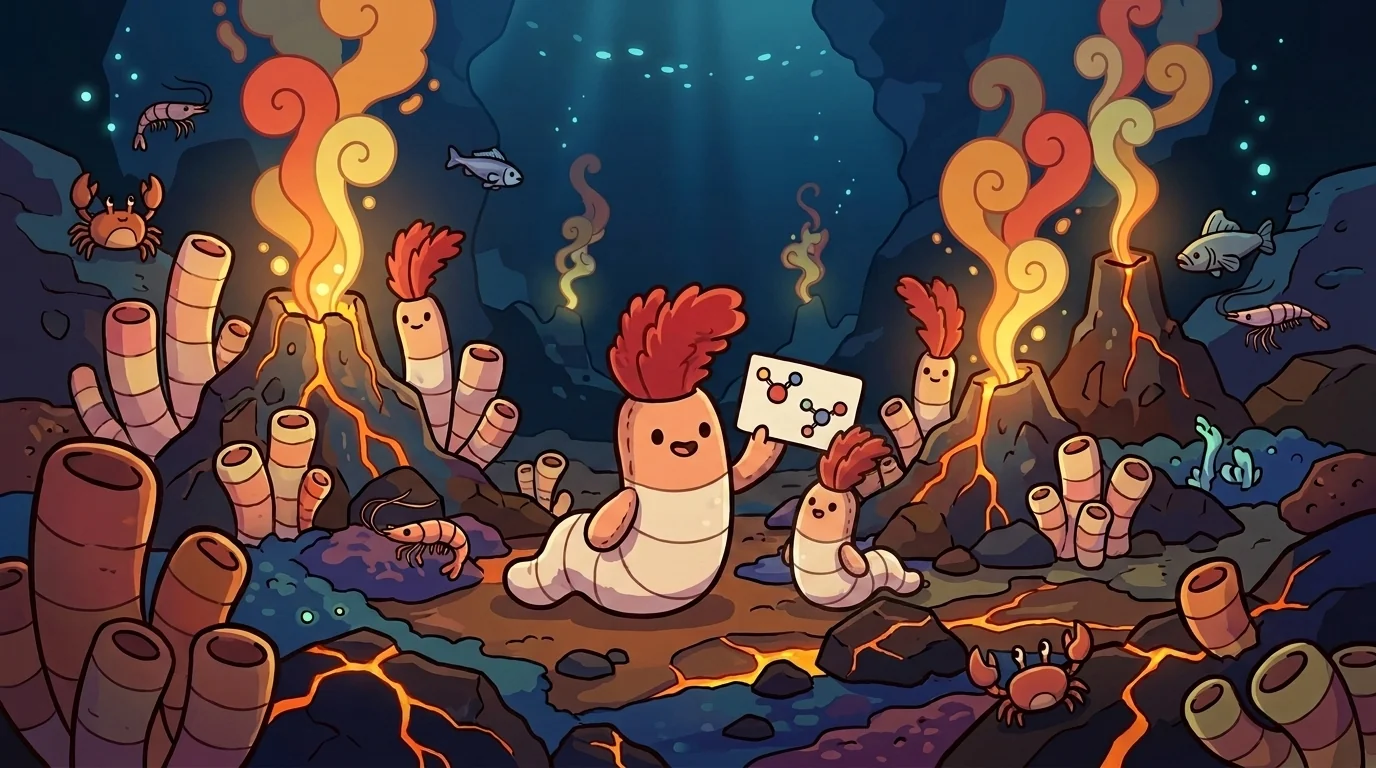
Smoke had grown up near the East Pacific Rise, a place where vents bubbled and life teemed. His family were vent-dwellers, tube worms who had lived for generations in those chemical-fueled communities. They knew, deep in their very being, that the world held more than one way to power life. Smoke carried that ancient lesson forward.
When he was thirteen, he came before Marlin, the wise old mentor of DepthQuest. "What is the abyssal zone?" Marlin had asked, her voice a low hum. Smoke hadn't hesitated. "Four thousand to six thousand meters deep. Hydrothermal vents. Life without sunlight. Chemosynthesis powers a whole world. Hydrogen sulfide instead of sunlight. Tube worms instead of plants. It’s the same biology lesson, just a different energy input." Marlin had simply nodded. "You are appointed," she'd said. It was all Smoke needed.
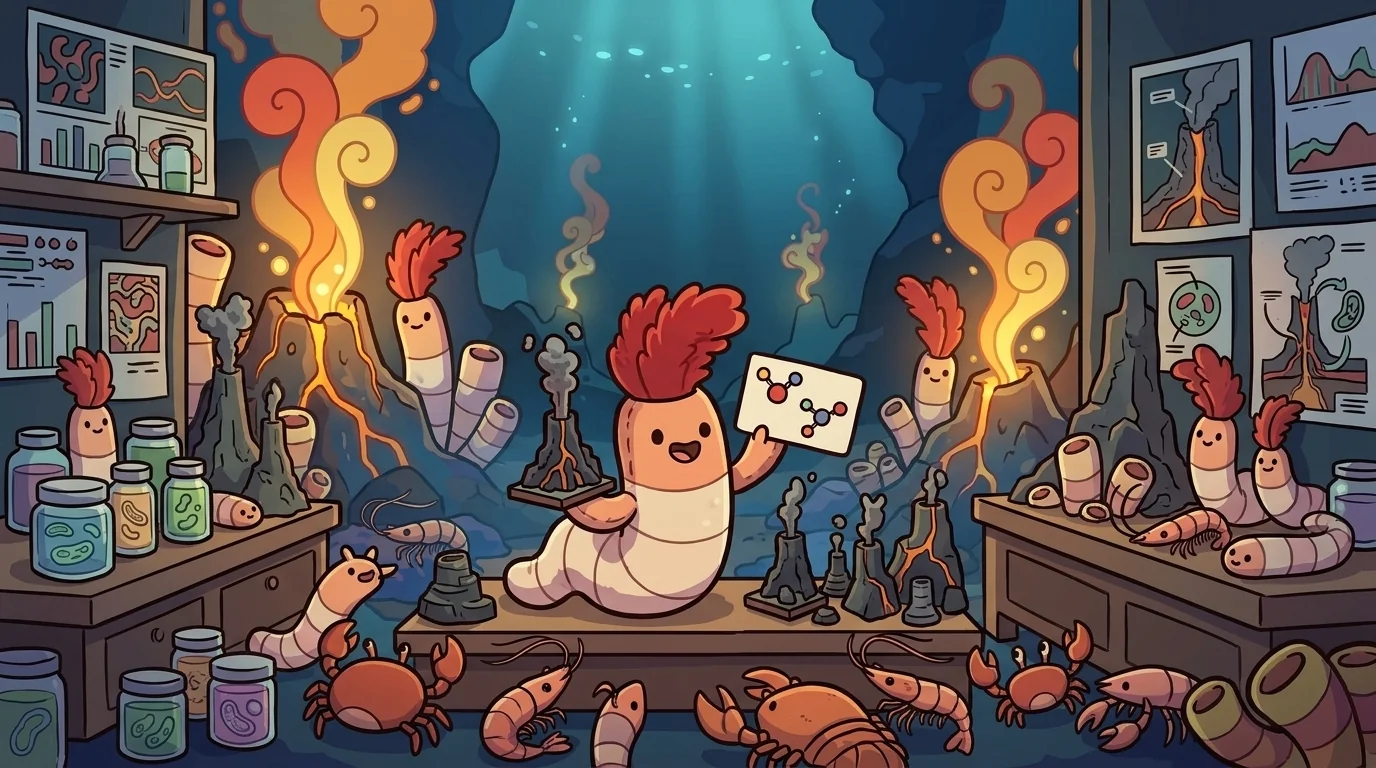
Smoke's workshop smelled faintly of salt and something metallic, like old pennies. Scaled-down vent chimneys, twisted and dark, stood on his worktables. Beside them, clear tanks held delicate, shimmering tube-worm samples. He gestured to a large screen displaying a stylized image. It showed a vent erupting, spewing dark, cloudy water into the ocean. "Watch," he murmured. "That's a 'black smoker.' It gets its name from the iron compounds that blacken the seawater as they pour out. The chemistry is intense. And the bacteria? They love it. They thrive on those chemicals. Then, the tube worms host the bacteria inside them. These worms, up to two meters long, have no mouth or gut. Instead, they have a special organ, a trophosome, where their bacteria garden lives. It's a perfect symbiosis."
He continued, "Crabs scuttle around the worms, picking at them. It's a whole community, all without the sun." He turned, his red plume fanning out. "I am Smoke. The primitive I teach is the *abyssal zone and chemosynthesis*. The big idea is that chemistry can power life. Sunlight is not the only fuel. The 1977 discovery of these vents completely rewrote biology textbooks. It's hope-shaped, marvel-shaped science." He often reminded new recruits that the chemistry of these vents connected directly to the inorganic and redox chemistry they studied in ChemQuest, showing how different sciences were linked.
Smoke's voice softened. "If you ever feel like science has figured everything out," he said, "remember 1977. Less than fifty years ago, we didn't even know these entire ecosystems existed at the bottom of our own ocean. Science is still discovering. There's still so much wonder." He picked up his chemical-spectrum card again, turning it over in his segments. "Chemistry is life's other recipe. And it might be the one used on alien worlds, too. Imagine life on icy moons like Europa or Enceladus, far from any sun. They might be powered by chemistry, just like my vents."
The DepthQuest ensemble
Smoke is part of DepthQuest's distributed-narrative cast. Each character embodies a different curricular primitive; together they teach the full subject.