
Drift
TWILIGHT ZONE — *200–1000m. light fades to almost-nothing. life makes its own light.*
Press play to listen along. The line being read lights up as you go.
Show full transcript
Loading transcript…
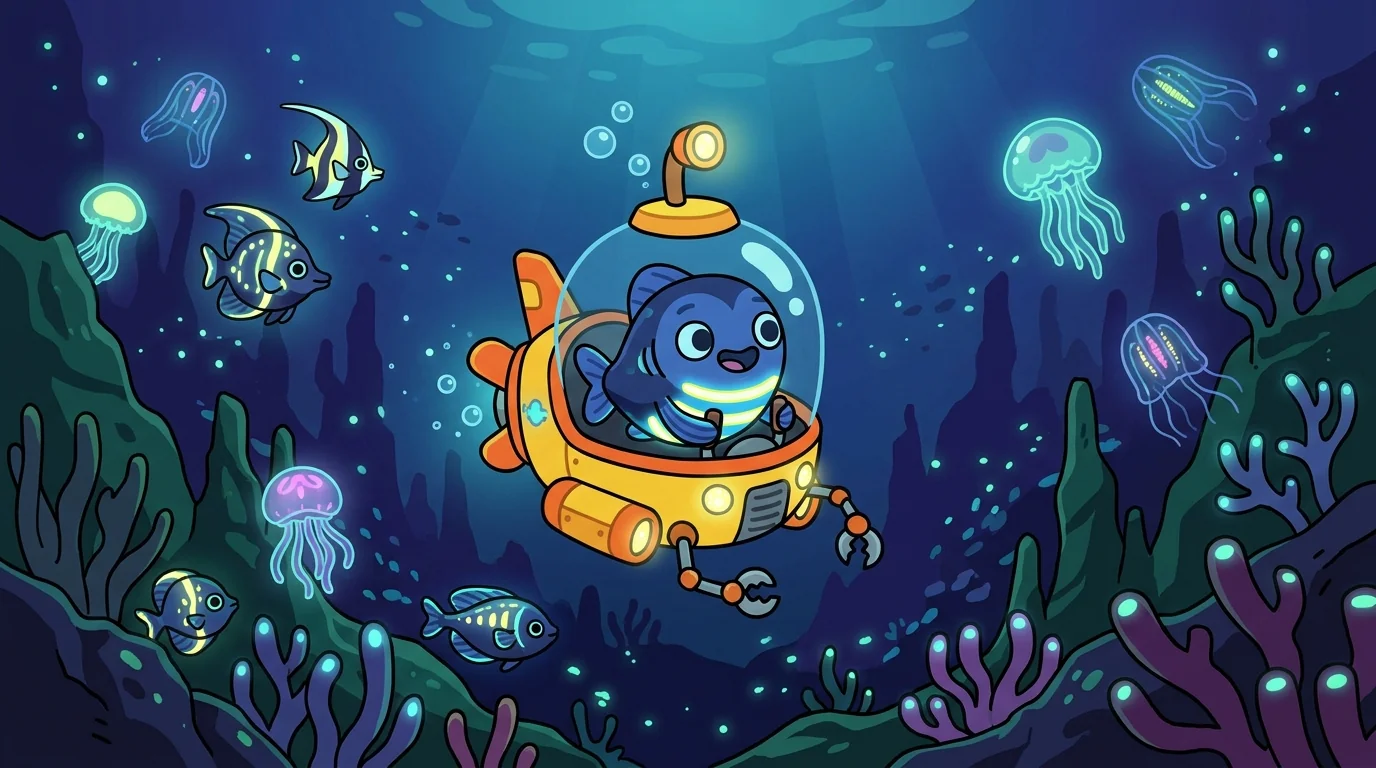
Drift was a lanternfish-tween, small and quick. His body shimmered with chunky, iridescent belly-stripes, a deep cobalt blue. Glowing spots dotted his sides and belly, like tiny, living stars. Beside him zipped his ROV, a remote-operated vehicle. It was a miniature submarine, sleek and silent, and he piloted it himself to find creatures in the deepest parts of their zone.
Drift was always curious. He especially loved exploring the twilight zone, the ocean layer where sunlight faded to almost nothing. "Down here, the light comes from us," he liked to say, his voice a soft hum. Those glowing belly spots were his signature feature. They were called photophores, and they made a natural light he could dim or brighten with a thought. His little ROV also let him survey deeper than his own safe zone, past the last hint of sunlight.
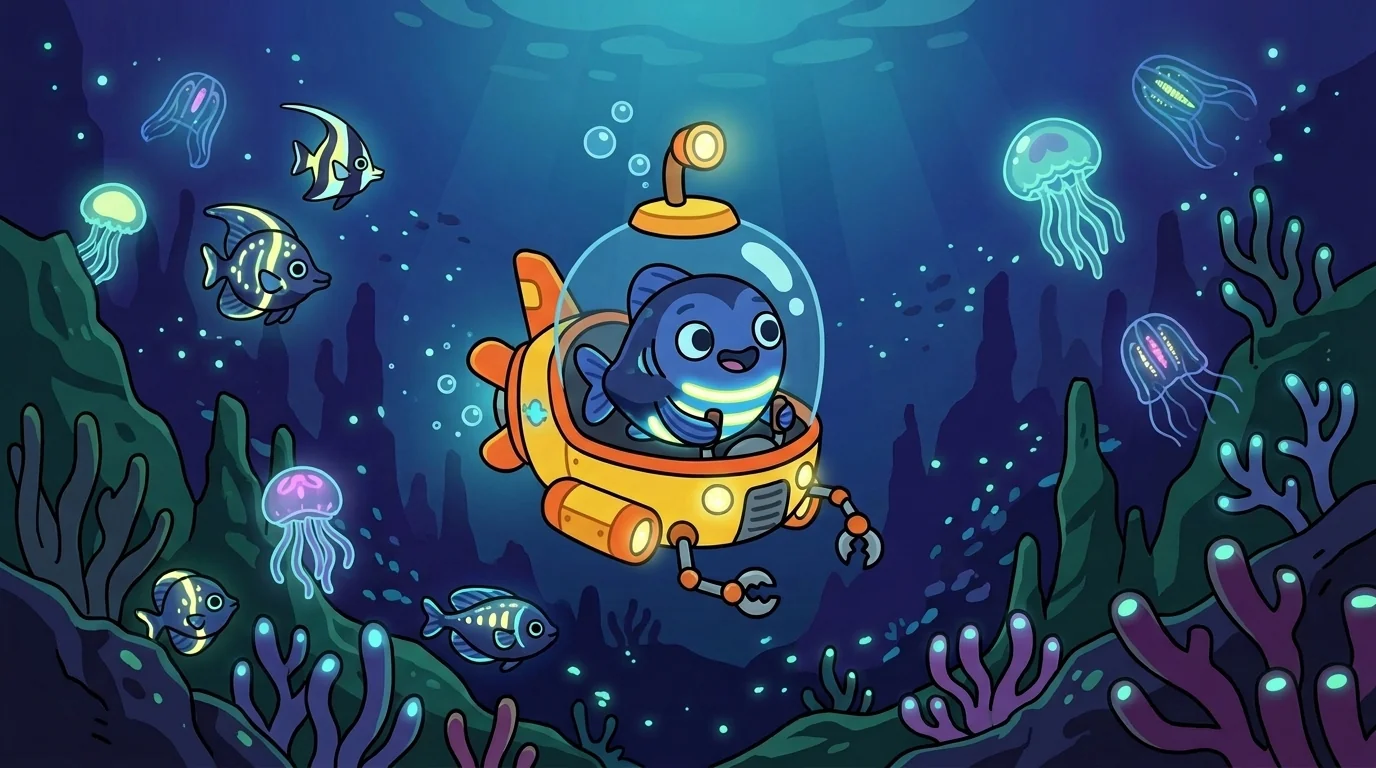
The *twilight zone* was his world. It stretched from 200 meters down to a thousand meters, a vast, dim ocean layer. Here, the sun’s light grew weaker and weaker. By the time you reached a thousand meters, only a billionth of the surface light remained. It wasn't completely dark, not like the pitch-black abyss, but it was too dim for plants to grow or for photosynthesis to happen. Yet, this dim world was teeming with life.
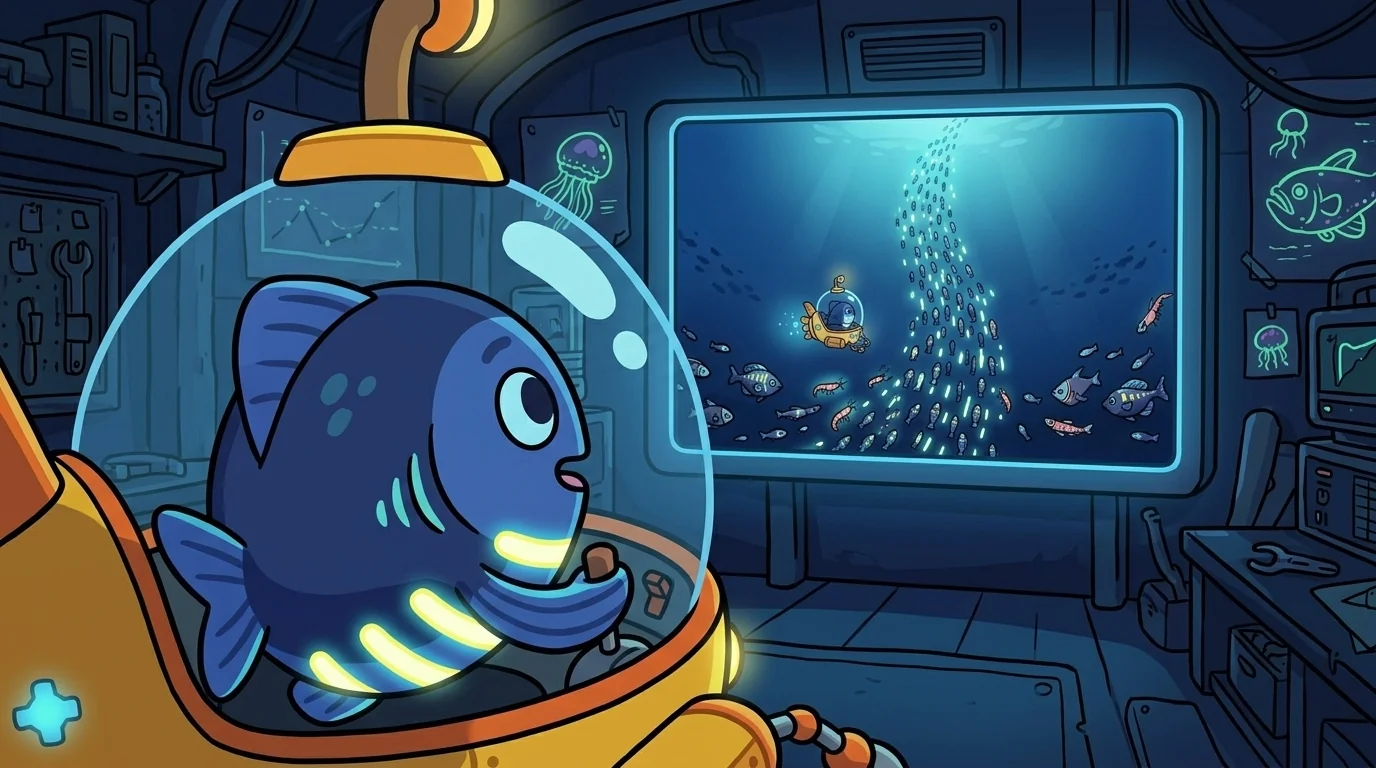
Drift aimed his ROV’s camera. On the screen, a hatchetfish drifted by, its body thin and silvery, almost transparent. Its eyes were enormous, like dark marbles, designed to catch every stray photon of light. Other creatures appeared: some had bodies so clear you could see right through them. Many were red, which looked like black in the deep blue light, making them almost invisible to predators. But the most amazing thing, Drift thought, was the light they made themselves.
"Bioluminescence," Drift murmured, watching a small squid flash. "It's chemistry, not magic." He tapped a control on his console, and his own belly spots pulsed softly. "Our bodies make light through a chemical reaction. We have special compounds, like luciferin, and an enzyme called luciferase. When they mix, poof! Light." He paused, thinking. "It's cold light, too. No heat wasted, just pure glow."

He guided the ROV deeper, past a school of tiny krill. "See them?" he asked the empty space around him. "They’re part of the biggest show on Earth." Every night, as dusk settled on the surface, something incredible happened in the twilight zone. Vast numbers of fish, squid, and krill began to rise. They swam upward, hundreds of meters, toward the surface waters.
"It's called the diel vertical migration," Drift explained, watching the ROV footage. Thousands of lanternfish, their photophores blinking like tiny signals, joined the upward journey. Hatchetfish and swarms of krill followed. "They go up to feed in the rich surface waters, where there's plenty of food. Then, before dawn breaks, they swim all the way back down." He zoomed in on a group of migrating lanternfish. "It’s the largest animal migration on the planet, by sheer biomass. Every single day."
He loved showing this footage. Most people imagined the deep ocean as a scary, empty place. But Drift knew better. His family had been light-keepers for generations, lanternfish whose photophores helped synchronize the schools' nightly rise. They understood that "the daily rise and fall is the rhythm of the ocean's middle layer." Drift had carried that lesson forward.
He remembered walking into DepthQuest when he was twelve. Marlin, the big, wise mentor, had asked him a simple question. "Drift," Marlin had rumbled, "what is the twilight zone?"
Drift had stood tall, his own photophores glowing with excitement. "It's 200 to 1000 meters down. Sunlight fades to almost nothing. Life makes its own light there. Bioluminescence — chemistry, not magic. And every night, my whole zone migrates UP to feed, then back DOWN by morning. The largest daily migration on Earth."
Marlin had simply nodded. "You are appointed."
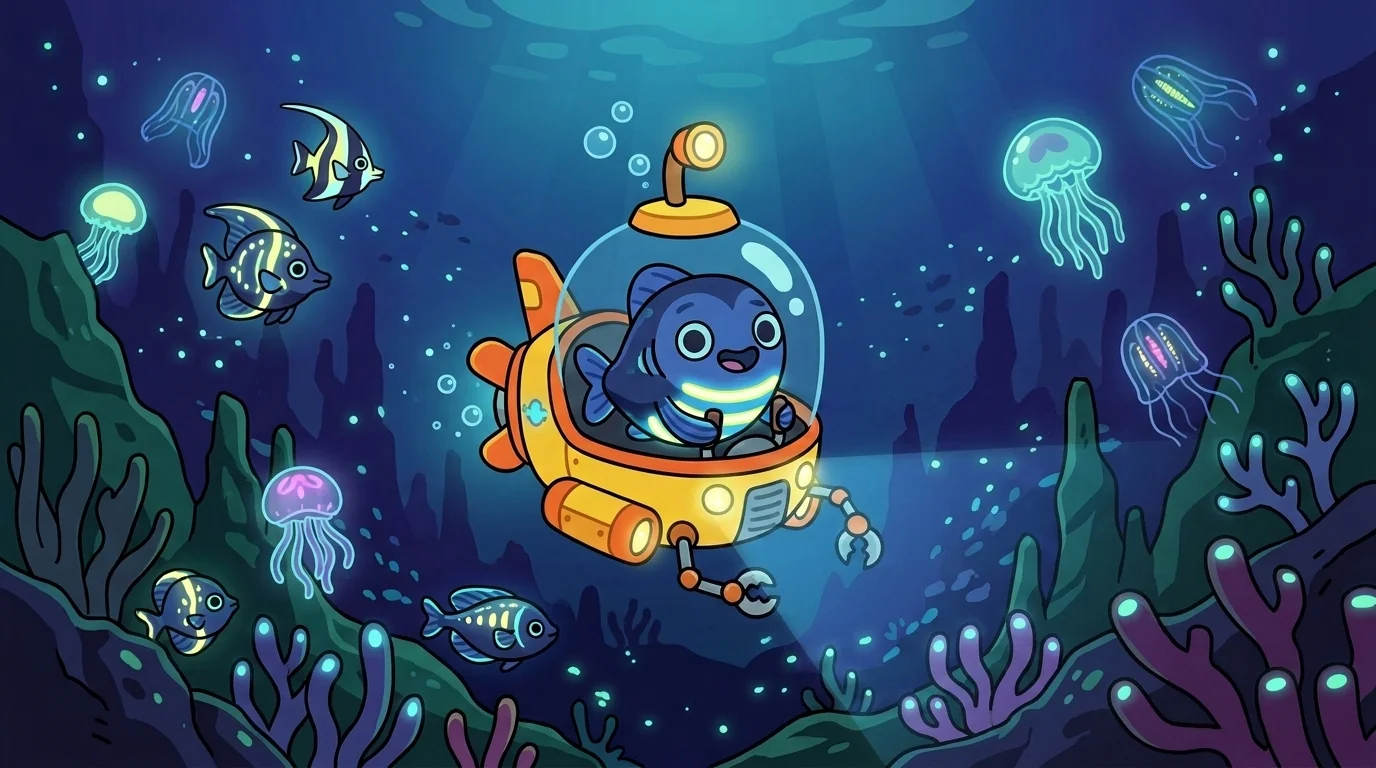
Now, in his workshop, Drift demonstrated his belly-photophores. He dimmed them until they were barely visible. Then he brightened them, a soft, steady glow. He made them pulse, a quick, rhythmic flash. "Different patterns mean different things," he explained. "Mate-finding, predator-confusing, prey-attracting. Each species has its own signature pattern, like a secret code."
He pulled up more footage from the ROV. Thousands of lanternfish, hatchetfish, and krill streamed through the water column at dusk. Their tiny lights glittered in the dimness. "Every night," Drift said softly. "Every species. Every ocean. The biggest movement on Earth, hidden in the dark." He looked at the screen, a small smile on his face. "I am Drift. The primitive I teach is the *twilight zone*. The move is wonder, not fear. The dark middle of the ocean is alive with daily migration and self-generated light. Marvel-stuff."
He often heard people call the deep ocean "creepy." He always shook his head. "Don't be scared of the deep ocean," he would say gently. "It's not 'creepy.' It's a chemistry-driven light show with a daily rhythm. The fear comes from stories that don't know how rich it truly is."
He believed wonder was the only right response. "Marvel at the bioluminescence," he urged. "Picture the migration. Imagine the chemistry. It’s all happening, right now, just below the surface."
The DepthQuest ensemble
Drift is part of DepthQuest's distributed-narrative cast. Each character embodies a different curricular primitive; together they teach the full subject.