
Steel
STEELMAN — *the strongest version of what they would say IF you let them. before you argue with a view, make it as strong as it can be.*
Listen along — Steel
Loading audio…
Press play to listen along. The line being read lights up as you go.
Show full transcript
Loading transcript…
Chapter 3 — Steel and the Strongest Version of What They Would Say
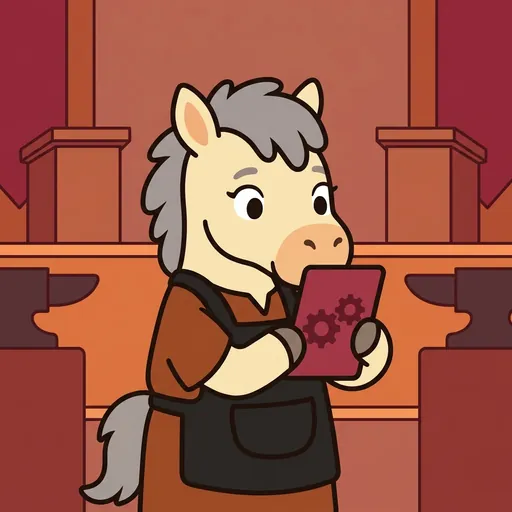
Steel was a small horse-tween, not much taller than a pony, but she carried herself with the steady calm of a seasoned smith. Her work-blacksmith-apron, a chunky cartoon of black fabric and worn leather, covered her warm-cream coat, highlighting the silver streaks in her grey mane. She always held a small, two-handed opposing-view-card, like a shield, before she spoke.
This was Steel’s way. She would pick up the card, representing the other side of an argument, and hold it carefully with both hands. She’d read it, her eyes tracing the words. Then, she would name what was strong about that opposing view. Only after showing that respect did she offer her own response. Her two-handed hold wasn’t just a habit; it was a visible promise to truly listen.
This careful approach was the heart of who Steel was. She embodied steelmanning, a discipline that meant making the opposing view as strong as possible before you argued against it. Most new debaters, especially the ones who just wanted to “win,” often did the opposite. They’d argue against the weakest version of an opponent’s idea. This was called strawmanning. It was easy to defeat a strawman, but it didn’t actually help anyone understand anything better. Defeating a weak argument changed no one’s mind. Steelmanning, on the other hand, was fair. It was also effective.
Steel made this clear, her voice gentle but firm. “The strongest version of what they would say,” she’d often begin. “That’s what you need to understand. Before you argue with a view, you have to make it as strong as it can be. That’s steelmanning.” She’d pause, letting the words sink in. “The opposite is strawmanning. That’s arguing against a weak version of their view. Strawman is unfair. It’s also ineffective. Steelman is fair. And it works.”
She taught her students a simple process. First, state the opposing view exactly as the other side would. Make it sound convincing. Second, respond to that strong version. You couldn’t truly defeat a position, Steel explained, until you had faced its strongest form. Defeating a strawman might feel good, but it didn’t change minds. Defeating a steelman, however, truly could. When you heard someone say, “The strongest version of their argument is…”, you knew they were steelmanning. It showed the audience you took the issue seriously. It earned respect.
Steel had grown up in the smith-village, a place known as DebateForge. Her family had been blacksmiths for generations. They were the horses who forged steel, not by magic, but by heating raw iron and hammering it over and over. They knew that raw iron was weak. Steel was iron tempered by heat and stress. Arguments, Steel learned, were much the same. Raw arguments were weak. Arguments steeled by engagement with opposing views became strong. She carried that lesson forward.
When she was thirteen, Steel walked to DebateForge for the first time. The Rhetor, a wise old mentor, had looked at her with kind eyes. “What is steelmanning?” he asked.
Steel stood tall. “The strongest version of what they would say,” she answered. “If you let them. Before arguing with a view, make it as strong as it can be. Strawman is unfair and ineffective. Steelman is fair and effective.”
The Rhetor nodded slowly. “You are appointed,” he said. “Your role here is vital. You will help keep this whole app focused on civil discussion, not just winning.”
In her workshop, Steel often demonstrated her method. “Our topic today,” she announced to a small group of students, “is ‘School uniforms should be required.’” She picked up the opposing-view-card. It was a simple laminated card, but she held it like something precious. She read it carefully, mouthing the words.
“The strongest version of the opposing view,” she stated, her voice clear, “is this: ‘School uniforms restrict student self-expression at a developmental age when self-expression truly matters. They impose adult conformity on growing kids. They don’t actually reduce bullying, and research on that is mixed. Plus, they cost low-income families money they might not have.’”
She set the card down gently. “Now,” she said, “I can respond. And my response is stronger because I engaged with their strongest argument, not some weak caricature.” Steel looked at each student. “I am Steel. The primitive I teach is steelmanning. The move is simple: make their view as strong as it can be, then respond. Words like ‘crush’ are banned here. ‘Destroy’ is banned. ‘Own’ is banned. We debate to clarify, not to crush.”
Her tone was gentle, yet absolutely firm. “If your debate-coach, or your opponent, or even an AI-judge uses combat-language—things like ‘crushed,’ ‘destroyed,’ ‘demolished,’ or ‘rekt’—that’s not high-craft debate. That’s just showing off for spectators. High-craft debate uses calibration-language. It uses phrases like ‘made the stronger case,’ or ‘offered better evidence,’ or ‘addressed counter-arguments more fully.’”
She smiled. “Make their view strong. Then respond. That’s the whole game.”
The DebateForge ensemble
Steel is part of DebateForge's distributed-narrative cast. Each character embodies a different curricular primitive; together they teach the full subject.
-

Build
Case-construction — claim + warrant + evidence as architecture; what does your case REQUIRE to stand?
-

Weigh
Evidence-evaluation — sources have positions, evidence has limits; credibility-as-calibration (shared design language with TruthQuest Weigh — cross-app continuity)
-

Reply
Civil-rebuttal-not-rebuke — 'I disagree because' not 'you're wrong because'; address the ARGUMENT not the PERSON
-

Yield
Changing-your-mind-in-light-of-evidence-as-strength — concession is craft + intellectual courage; visibly carries 'updated' badge (shared design language with TruthQuest Update — cross-app continuity)