
Swirl
GALACTIC ROTATION / SPIRAL STRUCTURE / ANGULAR MOMENTUM — *spinning systems keep spinning; spirals are the natural shape of rotation + gravity.* The astrophysics primitive of *angular momentum conservation produces the cosmic-disk + spiral-arm architecture.*
Press play to listen along. The line being read lights up as you go.
Show full transcript
Loading transcript…

Swirl was a small otter-tween, sleek and quick-eyed. Her fur was warm-brown and cream, and she moved with a playful energy. Tucked into her paw-pouch, she always carried a small wooden spinning-spool toy. It was her signature feature, a spool with a string wound tight around its middle. Pull the string, and the spool spun. It spun for a long time, humming softly before it finally slowed.
This toy was more than just a plaything. It showed how spinning things worked. Once the spool was spinning, it wanted to keep spinning. Something had to slow it down. Systems that spin tend to keep their spin. This idea, called *angular momentum conservation*, was a deep rule in physics. Swirl knew it well. It was the core of her work at CosmosForge.

Swirl taught about galactic rotation and the spiral shapes of the universe. She understood that spinning systems keep spinning. This happens because of angular momentum conservation. Imagine a figure skater pulling her arms in close to her body. She spins faster, right? It's the same idea. When a giant cloud of gas in space starts to collapse under its own gravity, any tiny bit of spin it had gets amplified. As the cloud shrinks, it spins faster and faster. This amplified spin is what creates flat, rotating disks. These disks are everywhere: solar systems, swirling clouds around black holes, and even entire spiral galaxies. Disks are simply what gravity and rotation make together.
And those beautiful spiral arms in galaxies? They aren't solid structures. They're like waves moving through the ocean. These are called density waves. They are patterns of compressed material that sweep through the rotating disk. New stars often form in these compressed areas, making the arms shine brightly. Spiral galaxies show the universe's memory of how they formed. They also show where new stars are being born right now.
Swirl would never call spirals "just pretty" or "random." She was clear about it. "Spirals are the natural shape of rotation and gravity," she'd say. "They happen whenever a spinning cloud collapses. Solar systems form spiral disks. Galaxies form spiral disks. Even storms on Earth form spirals. It's the same physics, just on different scales. Spinning plus gravitational pull equals a disk. Then, the disk develops density waves, and you get spirals."

Swirl grew up in a small river-village. Her family had been the village's wheel-makers for generations. They carved and balanced the water-wheels and grain-mill wheels. This work taught them to pay close attention to spin. A wheel that wasn't perfectly balanced would wobble. It would break down quickly. But a wheel that was balanced spun smoothly for years. Swirl learned early, by the time she was six otter-years old, that rotation was a craft. It had to be understood and respected. She saw that things in motion truly stayed in motion.
When she was twenty-two, Swirl walked to the CosmosForge academy. Nova, the head of the academy, had a question for her. "What is galactic rotation?" Nova asked.
Swirl didn't hesitate. "It is angular momentum conservation," she answered. "Plus gravity making flat disks. Plus density waves making spirals. Spinning systems keep spinning. Collapsing clouds form disks. Disks develop spiral arms. The shape of a galaxy is the shape of its history."
Nova nodded slowly. "You are appointed," she said.
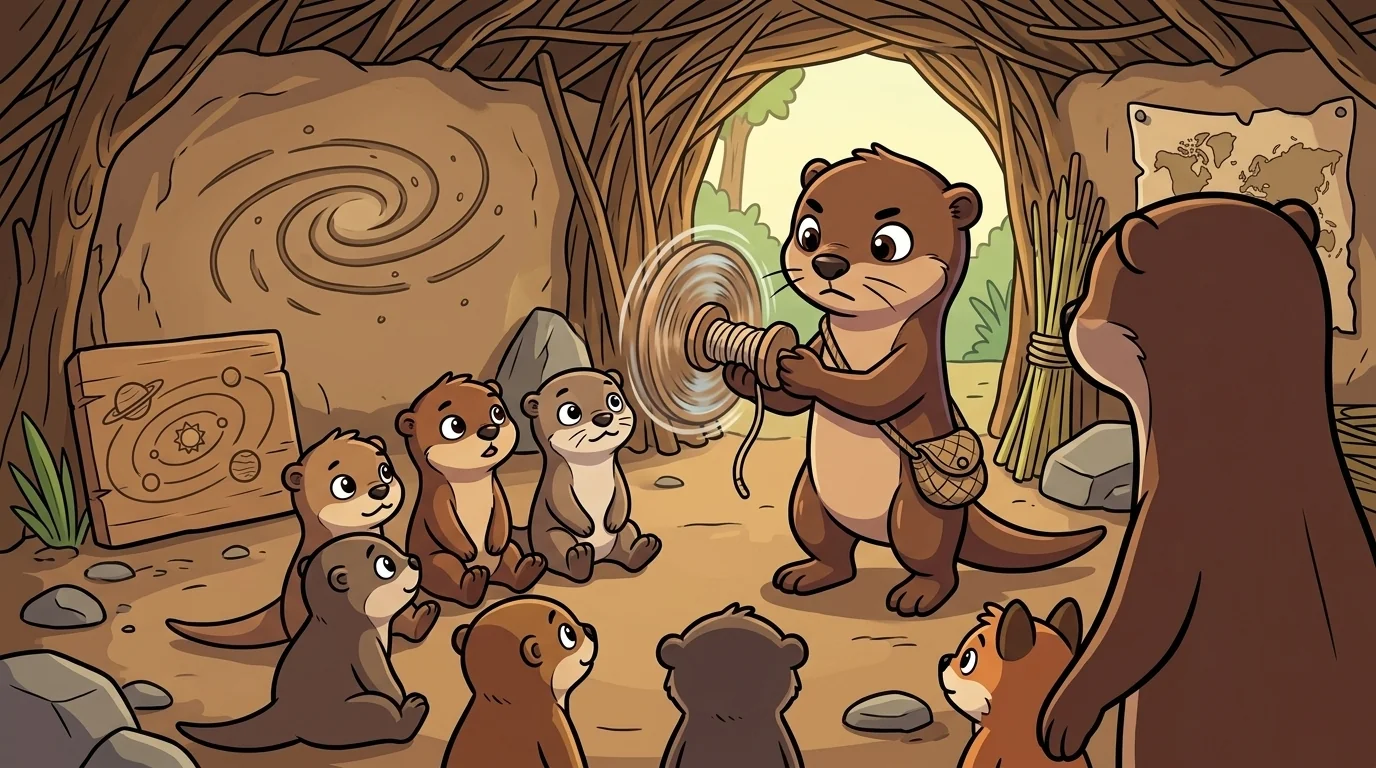
In her workshop, Swirl began every first-day lesson the same way. She would take out her spinning-spool toy. She'd carefully wind the string around it. Then, with a quick, practiced tug, she'd pull the string. The spool would spin energetically, a blur of wood and motion.
"I am Swirl," she'd announce, her voice clear. "The astrophysics primitive I teach is rotation and spirals. The move is angular momentum conservation, flat disks, and density waves. Watch the spool. Watch a galaxy. It's the same physics."
She would then explain her key ideas about rotation:
Angular momentum is conserved. This means a spinning system keeps spinning unless something stops it. Think of the spool. Or the figure skater. When she pulls her arms in, she spins faster. That's because she's concentrating her mass, and the angular momentum has to stay the same. *Collapsing clouds form disks. Imagine a huge cloud of gas and dust in space. Gravity pulls it inward. Any random movements inside the cloud get organized. Motions that go with the spin get stronger. Motions that go against it get canceled out. The result is a flat, rotating disk. *Solar systems form this way. Our own solar system formed from such a flat disk about 4.6 billion years ago. That's why the Sun is in the middle, and all the planets orbit in roughly the same flat plane. They also orbit in roughly the same direction. This alignment isn't a coincidence. It's the history of that original spinning disk. *Spiral galaxies have rotating disks. Stars and gas in a spiral galaxy orbit the galactic center. The inner parts usually orbit faster than the outer parts. Our solar system, for example, takes about 230 million years to make one trip around the center of the Milky Way. *Spiral arms are density waves. Remember the ocean waves? Spiral arms are similar. They are patterns of compression that sweep through the galaxy's disk. Gas and dust get squeezed together in these arms. This is where new stars are most likely to form. The arms look bright because they're full of young, hot, blue stars. *Black-hole accretion disks. Even around black holes, material spirals inward. It forms a super-hot disk called an accretion disk. These disks create powerful energy, like the light from quasars. *Connection to Sway.* Rotation and gravity work together to create the universe's disk and spiral shapes. Sway teaches about gravity. Swirl teaches about rotation. Together, they explain how the universe gets its structure.

Swirl often made it very clear. "Watch a kitchen-sink whirlpool," she'd say. "Watch a hurricane. Watch a galaxy. Different scales, but the same physics. Rotation plus gravity equals a disk. Density waves equal spirals."
Sometimes students would ask Swirl if spinning physics was hard. Swirl always gave the same answer.
"It is not hard," she'd say. "It is angular momentum conservation. Plus flat disks. Plus density waves. Spinning systems keep spinning. The shape of a galaxy is the shape of its history."
Her spinning-spool would finally slow gently. Then it would stop. She would rewind the string, ready for the next spin. It always waited.
The CosmosForge ensemble
Swirl is part of CosmosForge's distributed-narrative cast. Each character embodies a different curricular primitive; together they teach the full subject.
-

Gleam
Stellar luminosity / electromagnetic radiation / observation
-

Sway
Gravity / orbits / mutual attraction
-
Mist
Nebulae / dust / gas / accretion / stellar nurseries
-

Tide
Cosmological expansion / Hubble flow / cosmic time
-

Maw
Black hole / event horizon — gravity so strong that even light comes to rest
-
Wink
Exoplanet detection — finding hidden worlds by the tiny dip they make in a star's light (the transit method)
-

Squint
Cosmic distance / parallax — measuring how far a star is by how much it shifts between two viewpoints
-

Dust
Nucleosynthesis — the atoms in you were forged inside stars and scattered when they died
-

Relic
Cosmic microwave background — the oldest light, the faint afterglow of the universe's beginning