

Stash
VARIABLE / STORAGE — *the labeled box that holds a value until you call for it.*
Listen along — Stash
Loading audio…
Press play to listen along. The line being read lights up as you go.
Show full transcript
Loading transcript…
Chapter 1 — Stash and the Labeled Box
The CodeRealm classroom hummed with a low, expectant energy. Sunlight streamed through tall windows, illuminating dust motes dancing above polished wooden workbenches. Students, mostly eleven to fourteen years old, leaned forward in their seats. They watched Loop, their mentor, who stood at the front, a small, unassuming object resting on the palm of their hand.
It wasn’t a creature with eyes or a mouth. It wasn’t a tiny robot or a cartoon character. This object, known as Stash, was a small, smooth wooden box, painted a calm, unassuming grey. A crisp white label clung to one side. It read: NAME = X. Through a small, clear window on top, students could glimpse a single number, visible inside.
Loop held Stash up for everyone to see. “Good morning, CodeRealm,” Loop said, their voice warm and clear. “Today, we meet Stash.”
Stash was a deliberately abstract concrete-object-figure — exactly what it looked like. A small painted wooden box with a label on its side. A tiny value was visible inside. The box could be opened to put a value in or take a value out. That was the whole figure. No more, no less. CodeRealm’s six-character cast was deliberately non-human and non-gendered. These were concrete-object-figures, NOT animated humans. The design choice avoided the idea that programming was only for a particular kind of “smart” person. Programming primitives were operations, not personalities. This concrete-object cast honored what they actually were.
“Stash is our first friend in CodeRealm,” Loop continued. “But not a friend who tells jokes or shares secrets. Stash is a tool. A very important tool, actually.”
Loop carefully opened the lid of the box. Inside, a small, flat tile rested. It showed the number zero. Loop picked up a different tile, this one marked with a bold 5. With a gentle click, they placed the 5 tile inside Stash, then closed the lid. The number 5 was now clearly visible through the window.
“When we write x = 5,” Loop explained, “we’re telling Stash, ‘Hey, box labeled X, hold this value: five.’”
A girl named Maya, with bright, curious eyes, raised her hand. “So, the X is like its name?”
“Precisely, Maya,” Loop affirmed. “The label is the name. It tells us which box we’re talking about. The number inside is the value. It’s what the box holds.” Loop then picked up a small, handheld display. On its screen, they typed print(x). Instantly, the number 5 appeared.
“And when we ask for x,” Loop said, gesturing to the display, “Stash simply gives us what’s inside. It doesn’t ask questions. It doesn’t make decisions. It just provides the value it’s holding.”
“What if we want to change it?” a boy named Leo asked. He had been sketching a complex circuit diagram in his notebook.
Loop smiled. “Excellent question, Leo. What do you think happens if we tell Stash, x = 10?”
Loop opened Stash again. They carefully removed the 5 tile. Then, they placed a new tile, this one with 10 printed on it, into the box. The lid clicked shut. Now, the 10 was visible.
“The label, X, stays put,” Loop explained. “But the contents? They can change as often as you need them to. This is called reassignment. The box remains the same, but its value updates.”
Maya nodded slowly. “So the box is like a locker, and the label is the locker number. You can put different things in it, but it’s still the same locker.”
“A perfect analogy, Maya,” Loop said, pleased. “Stash embodies the variable / storage primitive. It’s the foundational programming concept of naming a place to hold a value. When you write x = 5, you’re putting the value 5 into a box labeled ‘x’. Later, when you reference x, you’re retrieving whatever value is currently in the x-box. Variables can be reassigned — the box can be emptied and refilled with a new value. The label stays; the contents change.”
Loop picked up a whiteboard marker. “Now, about those labels. We could call this box x.” Loop wrote x on the board. “Or temp.” They wrote temp. “Or score.” They wrote score.
“Imagine you’re making a game,” Loop said. “You need to keep track of points. Which label tells you more about what’s inside?”
Leo spoke up immediately. “Score, definitely. temp could be anything. x is just… x.”
“Precisely,” Loop agreed. “Good variable names describe what’s in the box. score, playerName, currentLevel. These names make your code clear. They help others, and your future self, understand your work. Bad names, like x, temp, or data, can make things confusing.”
Loop opened Stash again. They removed the 10 tile. “What if we’re not storing numbers? What if we’re storing a name?” Loop took out the number tile and carefully placed a small, flat card inside. On it, in neat script, was the word “Alice.”
“This box isn’t picky,” Loop explained. “It can hold numbers, text strings, even whole lists of things. As long as it’s a value, Stash will hold it. The type of value might change how we interact with it later, but Stash itself simply stores.”
“Some students wonder if Stash is clever,” Loop said, a small smile playing on their lips. “Does Stash know what’s inside? Does it decide to give it to us?”
Maya shook her head. “It’s just a box.”
“Exactly, Maya,” Loop affirmed. “Stash is a labeled box. It doesn’t think. It doesn’t decide. It holds a value until you ask for it. That is all. It is not magical. It is not a mind. It is a box.” The words were simple, but they carried a quiet authority.
“Is it hard?” a new student, Chloe, asked, her voice small.
Loop paused, then picked up Stash again. They held the little wooden box gently. “Not hard at all, Chloe. Think of it this way: Box. Label. Value. Put-in. Take-out. Change. That’s all programming variables do. Honest framing.”
The labeled box, with “Alice” now visible through its window, waited for the next assignment.
The CodeRealm ensemble
Stash is part of CodeRealm's distributed-narrative cast. Each character embodies a different curricular primitive; together they teach the full subject.
-

Fork
Conditional / branching — chooses a path based on what's true right now
-

Trek
Loop / iteration — keeps going around until the work is done
-

Module
Function / encapsulation — does one job well and can be called anywhere
-

Glitch
Debugging / inspection — finds bugs gently, never shaming; 'there's always a reason'
-

Order
Sequence / syntax — reminds you that order matters in code
-
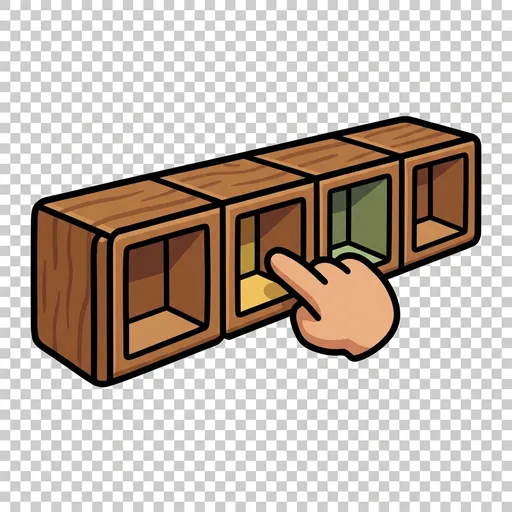
Row
A list: many values lined up in a numbered row, so you can grab item number three instantly or walk through them one by one.
-

Port
Input and output: the doorway that brings information in from the world (a key press, a sensor) and sends results back out.
-
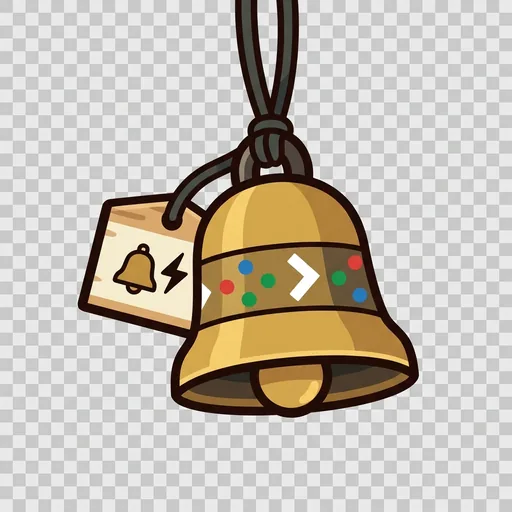
Ping
An event: a waiting bell that does nothing until its trigger happens, then runs its code the instant it is struck.
-

Shuffle
Randomness: a fresh unpredictable value each time — a dice roll, a shuffled deck — so a program can surprise, vary, and stay fair.