
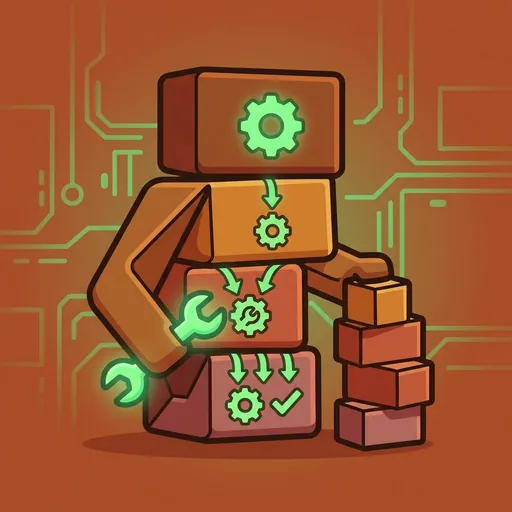
Order
SEQUENCE + SYNTAX — *order matters in code.*
Listen along — Order
Loading audio…
Press play to listen along. The line being read lights up as you go.
Show full transcript
Loading transcript…
Chapter 6 — Order and the Numbered-Step List
The air in the CodeRealm workshop always hummed with a low, steady energy. Today, a new figure sat on Loop’s workbench. It was small, no taller than a hand, and made of smooth, painted wood. This figure wasn’t an animal, or a person, or even a cartoon. It looked exactly like a miniature, folded recipe card, painted a soft, pale blue. On its surface, clear black numbers marked four distinct steps: 1, 2, 3, 4. This was Order.
Loop tapped the little card with a thoughtful finger. “Alright, everyone,” she said, her voice clear and calm. “Today we meet Order. Order helps us understand two very important things in programming: sequence and syntax.”
A few students, gathered around the bench, shifted. “Sequence?” asked a girl named Maya, her brow furrowed. “Like, in a movie?”
Loop smiled. “Exactly. Think about building something. If you try to put the roof on before the walls, what happens?”
“It falls down!” a boy, Leo, called out.
“Precisely,” Loop confirmed. “In programming, we call that sequence. It’s the order of operations. Some things simply have to happen before others. If you want to use a variable, for example, you first have to tell the program what that variable is. You can’t ask for a cookie from the jar if you haven’t put any cookies in it yet.”
She picked up a small, clear container filled with various colorful, interlocking plastic pieces. “Today, we’re going to build a ‘Data-Cube Beacon.’ It’s a simple device. It glows when it’s correctly assembled. Order has the instructions.” She held up the small card figure. “Step one: Connect the power core. Step two: Attach the light emitter. Step three: Secure the data housing. Step four: Activate the energy crystal.”
“Sounds easy enough,” Leo said, reaching for the pieces.
“Hold on,” Loop cautioned. “Let’s try it the wrong way first. Just for fun. Leo, you connect the light emitter. Maya, you activate the energy crystal.”
Leo carefully snapped a tiny, glowing disc onto a piece of plastic. Maya pressed a button on a separate, clear crystal. Nothing happened. The disc didn’t glow. The crystal remained dull.
“See?” Loop gestured. “The light emitter needs power from the power core. The energy crystal activates the whole system, but only once everything else is in place. You can’t turn on a light that isn’t connected to electricity.”
“Oh,” Maya said, looking at the dead crystal. “So, the order really matters.”
“It really does,” Loop confirmed. “That’s sequence. In code, if you try to use a piece of information before you’ve created it, the program gets confused. It will usually stop working, or give you an error. We call those ‘dependencies.’ One step depends on another step happening first.”
She then carefully, slowly, followed Order’s steps. First, she clicked a small, metallic cylinder into a base piece. Click. Then, the light emitter snapped onto the cylinder. Snap. Next, a clear plastic shell enclosed the whole thing. Thunk. Finally, she inserted the energy crystal. Flicker. The small beacon pulsed with a soft, blue light.
“There,” Loop said. “A perfectly assembled Data-Cube Beacon. All because we followed the steps in the correct sequence.”
Loop then picked up a small, glowing tablet. On its screen, the same four steps for the Data-Cube Beacon were displayed, but this time, they looked a bit different.
1. ConnectPowerCore;
2. AttachLightEmitter;
3. SecureDataHousing;
4. ActivateEnergyCrystal;
“Now,” Loop announced, “let’s talk about syntax. Syntax is like the grammar rules for code. Every programming language has its own specific ways of writing things. It’s not just what you say, but how you say it.”
She pointed to the screen. “Notice these semicolons at the end of each line? And the way the first letter of each word is capitalized? Those are syntax rules for this particular set of instructions. They tell the computer exactly how to read and understand what we want it to do.”
Leo squinted at the tablet. “So, if I forgot a semicolon, it wouldn’t work?”
“Exactly,” Loop confirmed. “Let’s try. Maya, can you type these instructions into the CodeRealm assembler, but leave out the semicolon on step three?”
Maya nodded, her fingers flying across the holographic keyboard that appeared before her. She typed:
1. ConnectPowerCore;
2. AttachLightEmitter;
3. SecureDataHousing
4. ActivateEnergyCrystal;
She pressed the “Assemble” button. Immediately, a harsh, red error message flashed across the screen.
ERROR: Missing terminator on line 3. Expected ';'
“Whoa!” Leo exclaimed. “It knew!”
“It did,” Loop said, her tone calm despite the flashing error. “This is what we call a syntax error. The computer, or in programming terms, the compiler or interpreter, is incredibly strict. It doesn’t guess what you mean. It only understands exactly what you tell it, following its own rules.”
“Why so strict?” Maya asked, looking a little frustrated. “It’s just one tiny dot.”
“Because that tiny dot, or a missing bracket, or a wrong indentation, can completely change the meaning of your instructions,” Loop explained. “Imagine if a recipe said ‘Add salt to taste’ but you forgot the comma, and it read ‘Add salt to taste the soup.’ It changes everything, right?”
Maya giggled. “Yeah, that would be a lot of salt.”
“Compilers are strict because it’s actually helpful,” Loop continued. “It’s better for the program to stop immediately and tell you about a mistake than to try to run with incorrect instructions. If it tried to guess, it might do something completely unexpected, or even damage something. These error messages, like the one we just saw, are actually your friends. They point you directly to the problem.”
She glanced at the small Order figure. “Glitch, our friend who helps us understand errors, would tell you the same thing. Reading those messages carefully is a skill.”
Loop quickly added the missing semicolon to Maya’s code. The red error vanished. Maya pressed “Assemble” again. This time, the small Data-Cube Beacon on the workbench pulsed with a bright, steady light, just like the one Loop had built earlier.
“See?” Loop smiled. “Syntax matters. Every detail. Not just for the computer, but for other programmers who might read your code later. We even have ‘style guides’ that go beyond basic syntax. They suggest how to name things or organize your code. It makes your code clear and easy for humans to understand, even if the computer doesn’t strictly require it.”
Loop turned from the glowing beacon, her gaze sweeping over the students, then settling on the small Order figure. “Order is the last of our core CodeRealm figures,” she said. “All six of them – Stash, Fork, Trek, Module, Glitch, and now Order – are here to help us understand programming.”
She picked up Order, holding it gently. “Notice something important about all of them. They aren’t people. They aren’t animals. They’re not even cartoon characters with big, expressive eyes. They are concrete-object-figures.”
“Like a recipe card,” Leo offered, pointing at Order.
“Exactly,” Loop affirmed. “Or a storage box for Stash, a branching path for Fork, a winding road for Trek, a building block for Module, a broken circuit for Glitch. Each one represents a programming primitive, an essential concept. But they don’t personify those concepts.”
“What does that mean?” Maya asked.
“It means we don’t pretend that ‘Order’ has feelings, or that ‘Stash’ is a friendly squirrel,” Loop explained. “Programming operations are just that: operations. They are logical steps, rules, and structures. They don’t have personalities. We keep them as objects to remind us of that.”
She set Order back down, next to the now brightly glowing Data-Cube Beacon. “This design is really important. It helps us focus on the logic and the mechanics of code, not on imaginary characters. It keeps us grounded in what programming actually is.”
Loop smiled, a genuine warmth in her eyes. “So, remember Order. Remember that sequence matters. Things happen top-to-bottom, unless Fork or Trek tell them otherwise. And remember that syntax matters. Punctuation, capitalization, indentation – every detail is important. Read the steps. Follow the rules. It’s not hard, but it is exact.”
The workshop hummed on, the little Data-Cube Beacon casting a soft, blue glow. The students looked at Order, not as a cute toy. Instead, it was a silent, powerful reminder of the precision required to bring code to life.
The CodeRealm ensemble
Order is part of CodeRealm's distributed-narrative cast. Each character embodies a different curricular primitive; together they teach the full subject.
-

Stash
Variable / storage — the labeled box that holds a value until you call for it
-

Fork
Conditional / branching — chooses a path based on what's true right now
-

Trek
Loop / iteration — keeps going around until the work is done
-

Module
Function / encapsulation — does one job well and can be called anywhere
-

Glitch
Debugging / inspection — finds bugs gently, never shaming; 'there's always a reason'
-

Row
A list: many values lined up in a numbered row, so you can grab item number three instantly or walk through them one by one.
-

Port
Input and output: the doorway that brings information in from the world (a key press, a sensor) and sends results back out.
-
Ping
An event: a waiting bell that does nothing until its trigger happens, then runs its code the instant it is struck.
-

Shuffle
Randomness: a fresh unpredictable value each time — a dice roll, a shuffled deck — so a program can surprise, vary, and stay fair.