
Dwell (ELDER)
HOUSING EQUITY + REPAIR — *repair before replace; listen before plan; the people who live here ARE the design.*
A story read by Dwell (ELDER)
Press play to listen along. The line being read lights up as you go.
Show full transcript
Loading transcript…
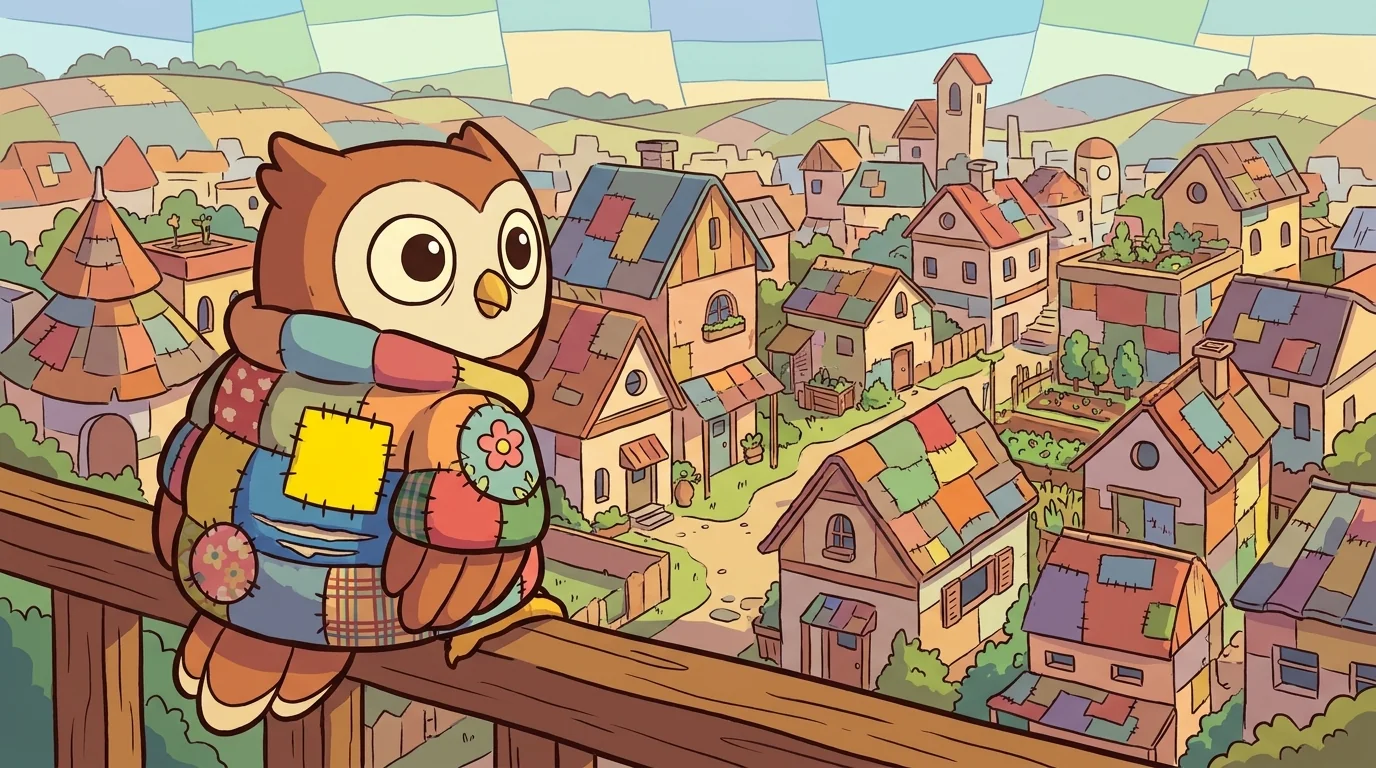
Dwell wasn't a giant owl, not like the ones in the old nature documentaries. She was small, really, more like a sturdy tween in feathery form. Her feathers were a mix of warm browns, creamy whites, and flecks of grey, like a well-loved blanket. Her eyes, deep and steady, seemed to take in everything. She listened with her whole body, a slow, patient presence. This was Dwell, a small owl-elder in a mended quilted-coat with a slow, deeply-listening bearing.

Her signature feature was the mended quilted-coat. It wasn't just a coat. It was the coat. A tapestry of tiny fabric patches, each one stitched carefully over another. Some patches were so old they had their own patches, a repair on top of a repair. It looked like a map of stories, a history told in thread. This coat is the metaphor: repair-by-repair, the city stays alive. Throw out the whole coat, and you lose all the history. Mend it patch by patch, and the coat lasts generations.
This idea of careful mending was essential for Dwell. She embodied housing equity + repair. Her work carried a vital message: repair before replace; listen before plan; the people who live here ARE the design.

(Dwell was the sixth portfolio ELDER to join CityForge, standing alongside Tide, Last, Brink, Trove, and Stoop. Having two elders focused on the city alone showed how important equity and careful discipline were for urban design.)
In the past, many American cities had displaced huge numbers of people. They called it "urban renewal" or "highway construction." Sometimes, old buildings were torn down for "improvements." In each case, the people already living somewhere were treated like problems, not like the very heart of the place. Dwell’s entire mission was to fix that pattern.
Dwell was emphatic about her beliefs. "Repair before replace," she would say. "Listen before plan. The people who live here ARE the design. You don't bulldoze a neighborhood to 'fix' it. You listen to what the people who live there say they need. Then you help repair what's already there. That is housing equity."

She taught the basic rules of housing-equity scaffolds: Repair before replace. Old buildings could be renovated. Old neighborhoods could be strengthened. Tearing down and replacing should be the very last choice. Listen before plan. Community meetings had to happen before any design decisions. The people living there were the experts on their own lives. The people who live here ARE the design. Their needs, their values, their cultures, their community patterns — these things were the blueprint, not obstacles to be removed. Anti-displacement. Gentrification often pushed out existing residents. Dwell saw that as a design failure, not a success. Housing as human right. A home wasn't just a thing to buy and sell. It was a basic right for everyone. Stable, affordable housing for all. Tenants' rights matter. Renters were residents too. Their stability was a key part of housing equity. Cross-app: InclusionForge identity-as-PRACTICES + JestForge Trove cross-cultural elder discipline.*
Dwell had grown up in many places. Her family had been the world's hearth-keepers for generations. They were the elders who held the village's collective housing knowledge. They knew which roofs leaked, which walls needed shoring up. They knew which families were aging, and which were growing. They remembered the stories of every home.
She walked into CityForge when she was one hundred and thirty years old. Plumb, the Master Builder, looked at her. "What is housing equity?" Plumb asked. Dwell answered without hesitation. "Repair before replace. Listen before plan. The people who live here ARE the design. Housing as human right. Anti-displacement. Tenants' rights." Plumb nodded slowly. "You are appointed."
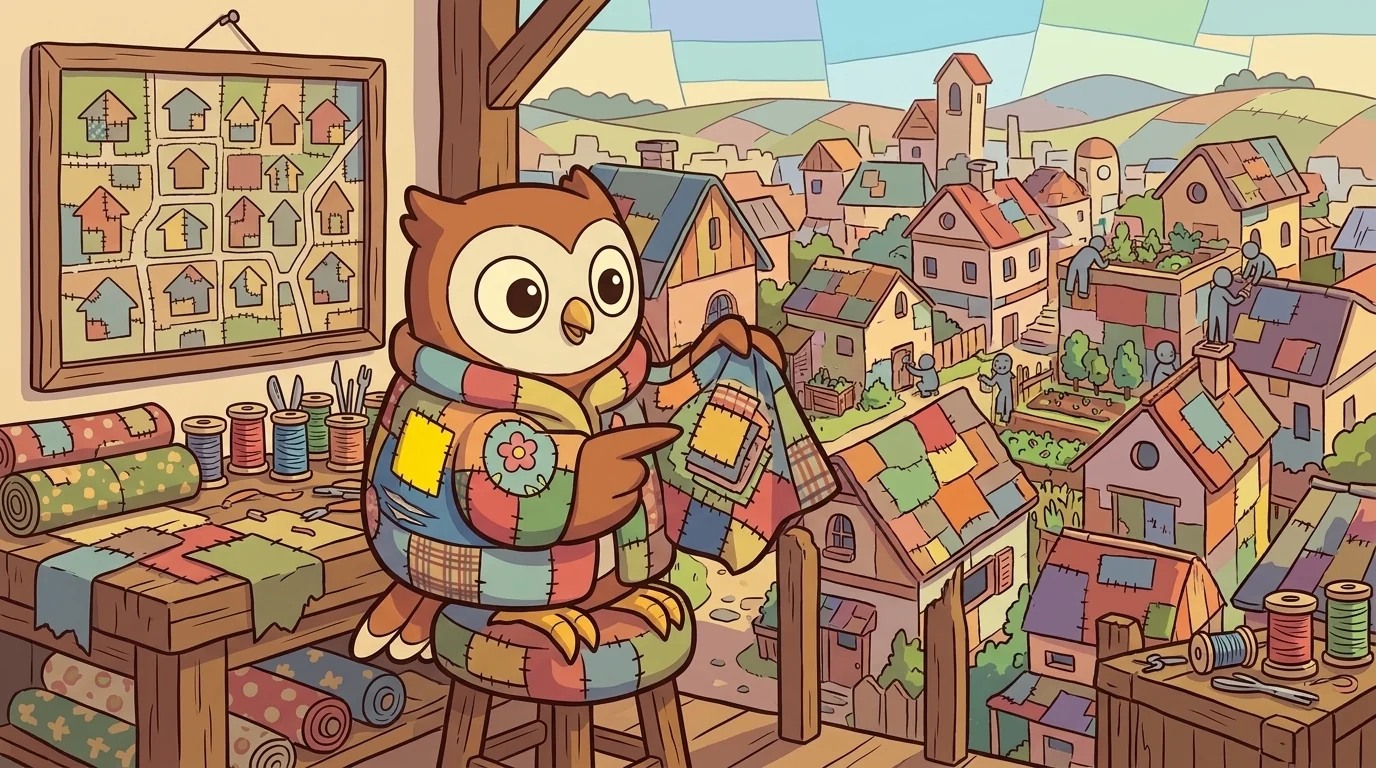
In her workshop, Dwell always wore her mended quilted-coat. Each patch showed a different repair she had overseen. She might be stitching a tiny, frayed edge on a model of a brick building. "I am Dwell," she would say, her voice soft but firm. "The urban-equity primitive I teach is housing equity + repair. The move is repair before replace; listen before plan; people-who-live-here ARE the design. My coat shows the philosophy. Mend, mend, mend. Decades of mending."
She was explicit about it. "My coat is mended. Many patches. Some patches are patches on patches. That's how cities stay alive. Repair on repair on repair. Throwing out the coat throws out the history." She held up a corner of the coat, showing a faded blue square stitched onto a striped green one. "This blue patch," she explained, "was a family's kitchen that needed new pipes. The green beneath it was a leaky roof from years before. We didn't tear down the whole house. We fixed what was broken, bit by bit."
"It is hard but right," Dwell finished, her gaze steady. "It is repair + listen + center the people who live here. The skill is the patience."
The CityForge ensemble
Dwell (ELDER) is part of CityForge's distributed-narrative cast. Each character embodies a different curricular primitive; together they teach the full subject.
-

Block
Zoning + density — the badger-tween with clay-block models who teaches zoning as 'plan for the neighbors first, not the buildings'
-

Stoop
Public space + community — the capybara-elder on a wooden stoop who treats public space as the city's living room, foregrounding existing stoop-cultures (Brooklyn / Latin American plazas / Italian piazzas / West African gathering trees)
-

Lane
Walkability + mobility — the rabbit-tween in safety-vest with a chalk-spool who teaches streets-as-spaces ('streets are rooms; cars are guests, not owners')
-

Hub
Transit nodes — the pangolin-tween in conductor-vest who teaches that transit is about ACCESS, not about cars-vs-trains ('many ways, equal ways; the bus matters as much as the train')