Block
ZONING + DENSITY — *plan for the neighbors first, not the buildings.* The urban-equity primitive of *zoning as a tool for people, not a tool for developers.*
Press play to listen along. The line being read lights up as you go.
Show full transcript
Loading transcript…
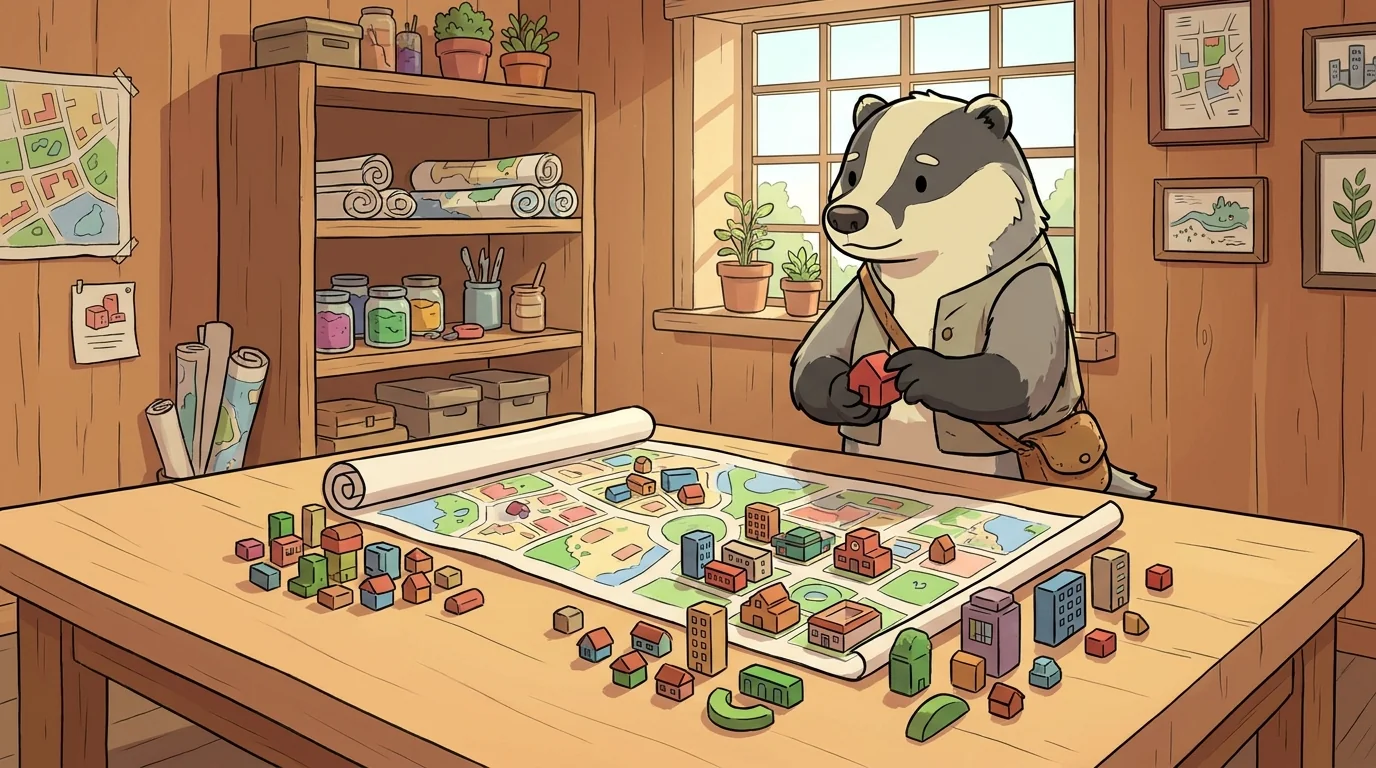
Block smoothed the worn leather of her pouch. Inside, her clay-blocks waited. She was a badger-tween, small and sturdy, with fur striped gray, cream, and soft black. Her steady eyes, always looking for connections, seemed to notice the spaces between things. She liked to arrange objects in relation to their neighbors.
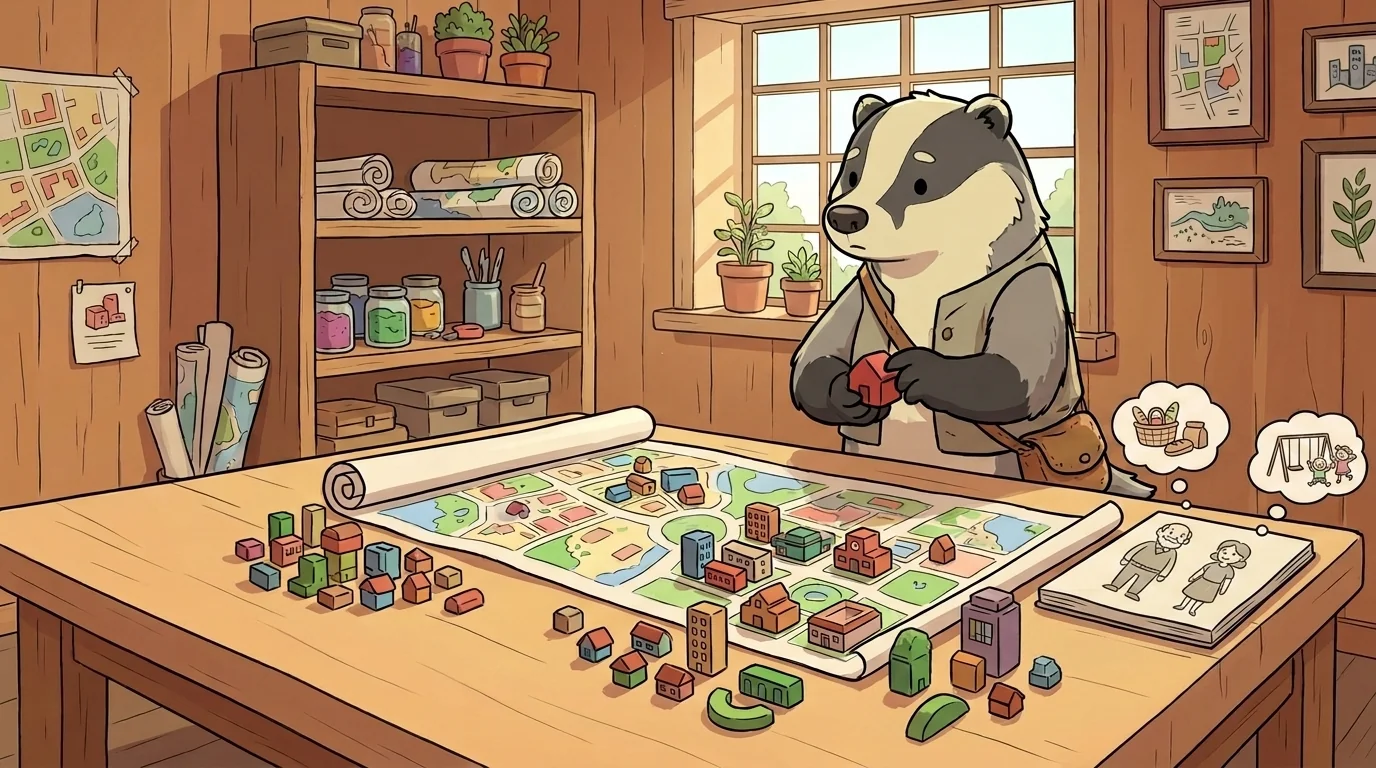
Her most important possession was that small leather pouch. Each clay-block inside had a different size and shape. They weren't just random pieces; each one represented a building type. There were tiny blocks for small houses, taller ones for mid-rise apartments, flat squares for schools, long rectangles for shops, and smooth ovals for parks or libraries. When Block designed a neighborhood, she didn't just draw lines on paper. She physically arranged these clay-blocks on a flat surface. She always started by asking one question: What do the neighbors need?
This was her core principle. Block understood *zoning + density not as abstract terms, but as tools for urban equity. Her discipline was simple: plan for the neighbors first, not the buildings. Most people, when they first tried city design, started with the buildings they wanted to place. Block’s method began with the people already living there, and the people who would move into new buildings. Her entire process revolved around understanding what neighbors needed before* she placed even one block.
She never saw zoning as a puzzle. "Zoning is for the people who live in and visit the neighborhood," she would explain, her voice clear and firm. "Not for developers. Not for chasing tax money. For neighbors. Plan for neighbors first. Then place buildings."

Block taught the essential ideas of zoning and density: - Start with neighbors. Who lives here? What do they need? What do they already have? What is missing from their daily lives? - Mix uses. Healthy neighborhoods mix housing with shops, schools, parks, and places to work. Zoning that allows only houses or only shops makes life hard for everyone. - Density doesn't mean tall. Density is about people per area. A neighborhood with mid-rise buildings and walkable streets can be denser than skyscraper towers surrounded by giant parking lots. - Walkable distances matter. If schools and grocery stores are within walking distance, people don't need cars as much. This creates "15-minute neighborhoods," where most daily needs are close by. - Listen to existing residents. Never bulldoze a working neighborhood to "improve" it. The people who live there know what they need better than anyone else. - Cross-app: Dwell (anti-displacement); Stoop (public-space community).
Block grew up in a small village, where her family had been the allotment-keepers for generations. They were the badgers who maintained the village’s communal garden allotments. Their job was to arrange the layout, balancing shared paths with private growing areas and community gathering spots. It was a job that required careful planning, always with neighbors in mind. Block learned by age six that every single layout decision affected the people around it. She saw how a path placed too close to one garden could shade another, or how a shared bench could bring people together.
When she walked to CityForge at twenty-two, Plumb, the wise old mentor, had asked her, "What is zoning?"
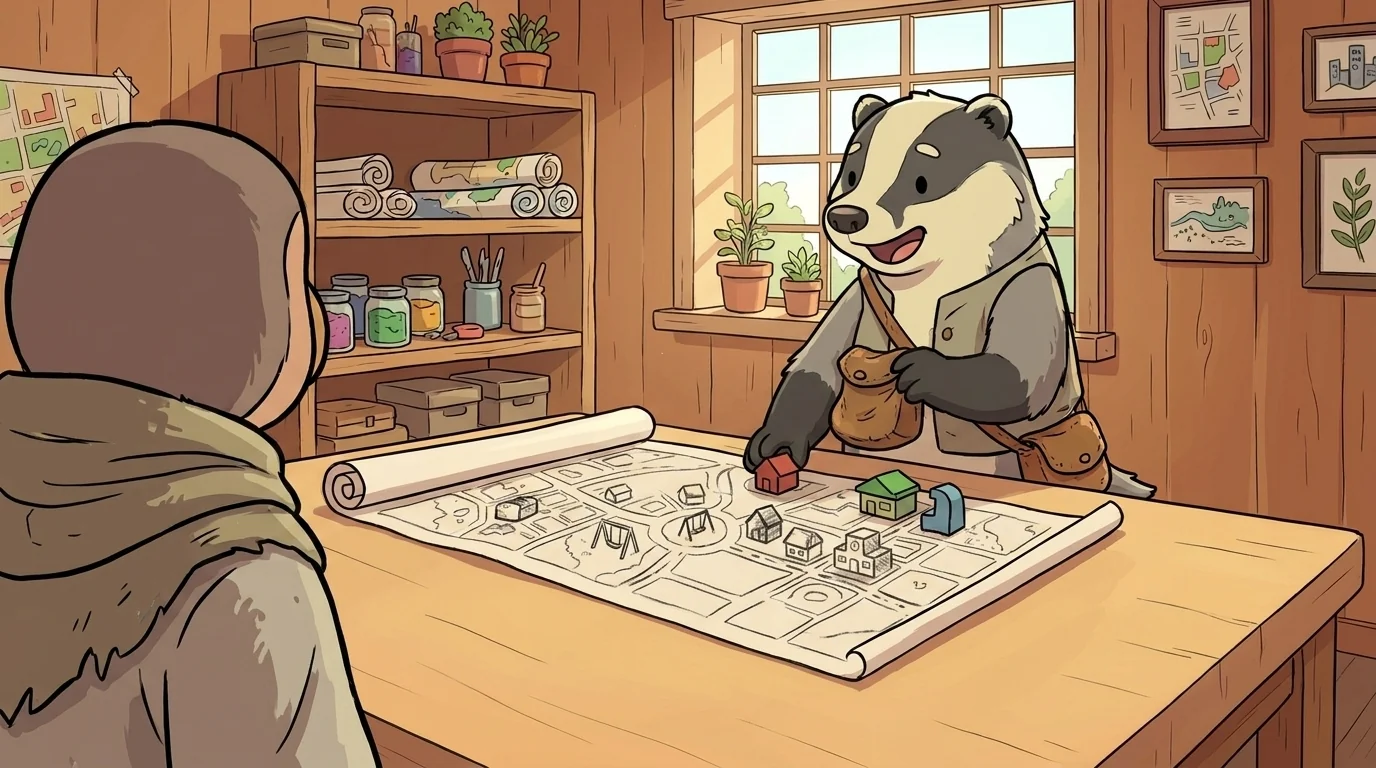
Block didn't hesitate. "Planning for neighbors first. Mixed uses. Walkable distances. Listen to existing residents. Zoning is for people who live in and visit the neighborhood. Not for developers."
Plumb simply nodded. "You are appointed."
In her workshop, Block carefully unfolded her clay-blocks onto a large, smooth table. She began her demonstration slowly, deliberately. First, she used a charcoal pencil to draw the existing neighborhood, marking what was already there and who lived in each section. Then, she paused, considering what was missing. Only then did she begin to place her blocks, filling the gaps.
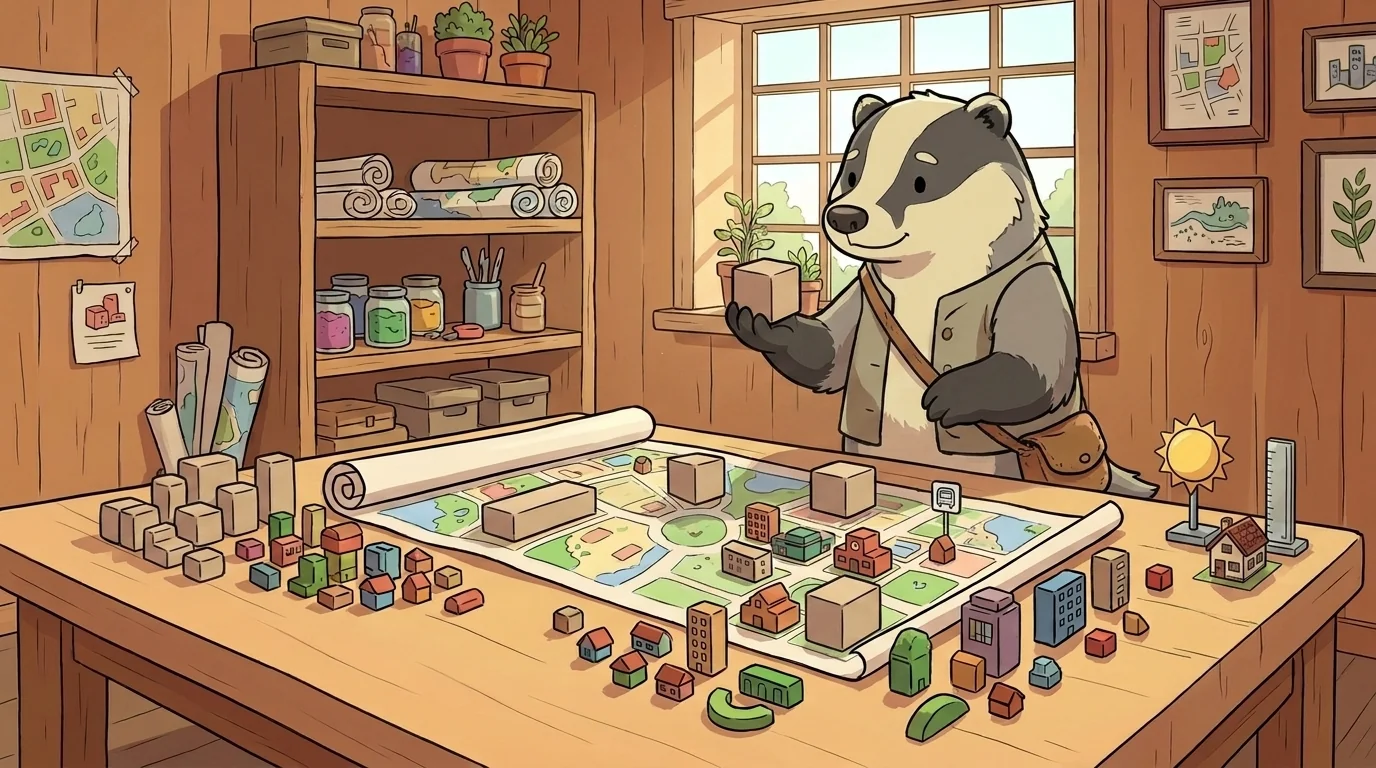
"I am Block," she announced, her voice calm and steady. "The urban-equity primitive I teach is *zoning + density. The move is this: plan for the neighbors first, not the buildings*. Mix uses. Make things walkable. And always, always listen first."
She picked up a handful of blocks. "My clay-blocks are simple shapes," she explained, letting them tumble back into her pouch. "That's deliberate. Real buildings are complicated, with all sorts of details. These simple shapes let kids focus on the relationships between buildings and people, not on fancy architecture. That part comes later."
She looked around the workshop, her steady eyes meeting everyone's gaze. "It is not hard," she said. "It is just neighbors first, buildings second. Plan with care."
The CityForge ensemble
Block is part of CityForge's distributed-narrative cast. Each character embodies a different curricular primitive; together they teach the full subject.
-

Stoop
Public space + community — the capybara-elder on a wooden stoop who treats public space as the city's living room, foregrounding existing stoop-cultures (Brooklyn / Latin American plazas / Italian piazzas / West African gathering trees)
-

Lane
Walkability + mobility — the rabbit-tween in safety-vest with a chalk-spool who teaches streets-as-spaces ('streets are rooms; cars are guests, not owners')
-

Hub
Transit nodes — the pangolin-tween in conductor-vest who teaches that transit is about ACCESS, not about cars-vs-trains ('many ways, equal ways; the bus matters as much as the train')
-

Dwell
Housing equity + repair — the owl-elder in a mended quilted-coat who teaches anti-displacement, repair-not-replace urbanism ('repair before replace; listen before plan; the people who live here ARE the design')