Mask
MONOALPHABETIC SUBSTITUTION — *every letter has a fixed substitute.* The cryptography primitive of *arbitrary one-to-one alphabet remapping (more general than shift; same letters always become same substitutes).*
Listen along — Mask
Loading audio…
Press play to listen along. The line being read lights up as you go.
Show full transcript
Loading transcript…
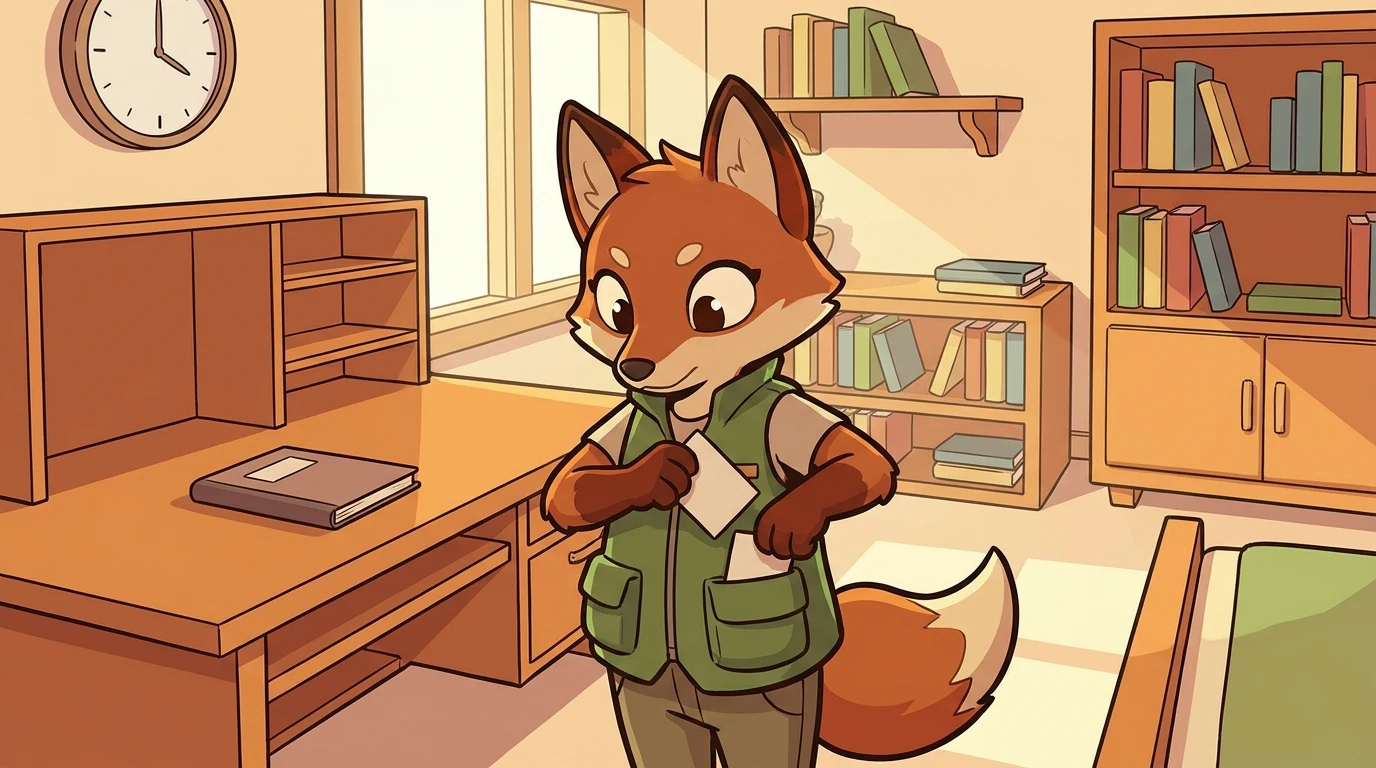
Mask stood at the front of the small classroom, her russet-and-cream fur gleaming under the lamplight. She was a fox-tween, quick and bright-eyed, with a focused energy that usually made her students sit up a little straighter. In her paw, she held a small, folded card, its edges softened from countless uses. This was her substitution-table.
“Alright,” she began, her voice clear. “Who remembers Caesar’s cipher?”
A paw shot up. “It shifts letters!” offered a badger cub named Pip. “Like, A becomes D, B becomes E, and so on.”
“Exactly,” Mask said, nodding. “A uniform shift. Every letter moves the same number of places. Simple, right?” She paused, letting the thought settle. “But what if we wanted something a little… less predictable?”
She unfolded her card. On the top row, the alphabet marched from A to Z in neat, block letters. Below it, a different alphabet lay, scrambled. For example, under A, there was a Q. Under B, an X. “This,” she explained, tapping the card, “is a substitution-table. It’s a map. For every letter in the alphabet, it tells you exactly which other letter it becomes.”
She wrote a simple word on the slate: “FOX.” Then, using her card, she carefully wrote the substituted letters below it. F became R, O became P, X became T. “So, FOX becomes RPT,” she announced. “See? Each letter gets a unique substitute. F will always be R, O will always be P, and X will always be T, in this message, using this table.”
“But what if you wanted to change it?” asked a squirrel kit named Squeak.
“You could make a completely new table,” Mask replied. “There are so many ways to scramble the alphabet. Imagine if you had twenty-six different slots, and you had to put a unique letter in each one. The first slot has twenty-six choices. The second has twenty-five, and so on. That makes for hundreds of millions of millions of millions of ways, actually. It feels incredibly secure, doesn’t it? Like finding a needle in a haystack the size of a mountain range.”
She tapped the card again. “One famous historical example is the Atbash cipher. It’s an ancient Hebrew cipher. A becomes Z, B becomes Y, C becomes X, and so on. The first letter swaps with the last, the second with the second-to-last. It’s a very specific kind of substitution-table.”
“So, it’s totally safe?” Pip asked, his eyes wide.
Mask smiled, a dry, knowing smile. “It feels safe. But here’s the trick. My cipher, the substitution-table, has a weakness. A big one. It’s called frequency analysis.”
She walked to another part of the slate. “Think about English. What’s the most common letter?”
“E!” several kits chorused.
“Right. And then T, A, O, I, N, S, H, R,” she listed. “They all have their own typical ‘frequency’ in any long piece of writing. Now, with a substitution-table, every time you write an ‘E,’ it becomes the same substitute letter. Every single time. Do you see what that means?”
Pip squinted. “Oh! The substitute for E will show up the most often in the secret message!”
“Precisely!” Mask clapped her paws together. “The substitute letter inherits the frequency of the original letter. So, if you get a long enough message, you just look for the most common letter in the encrypted text. That’s probably the substitute for E. Then you look for the second most common, and so on. Sift teaches this method. It breaks my cipher easily.”
She sighed, a small, almost imperceptible sound. “My cipher is strong against someone just guessing tables. But it’s weak against someone who knows about letter frequencies. The strength of a cipher depends on the attack method.”
Mask had learned about fixed mappings long before CipherForge. Her family had been the village mask-makers for generations. They carved festival masks, each one representing a specific character or spirit. The Harvest-Keeper mask always looked a certain way, with its broad, smiling face and leafy crown. The Bell-Ringer mask always had its own distinct features, often with a mischievous grin and tiny bells carved into its ears. Each mask was a fixed substitute for a role, a one-to-one mapping in wood and paint. That discipline, that exactness, had been part of her earliest memories, shaping the way she saw patterns in the world.
When she was twenty-two, she had walked the long road to CipherForge. Cypher, the old owl, had sat behind his enormous desk. “What is monoalphabetic substitution?” he had asked, his voice like rustling leaves.
Mask had stood tall. “Every letter has a fixed substitute. The same letter, the same substitute, everywhere in the message. There are many possible tables, but frequency analysis breaks them.”
Cypher had blinked slowly. “You are appointed.”
She still carried that small, folded card. It was a reminder of something foundational. A simple, elegant idea: one-to-one mapping, consistently applied. It was a powerful step beyond Caesar’s shifts, but it carried its own clear vulnerability. And knowing that vulnerability, understanding it completely, was the real lesson.
The CipherForge ensemble
Mask is part of CipherForge's distributed-narrative cast. Each character embodies a different curricular primitive; together they teach the full subject.
-

Caesar
Caesar shift / monoalphabetic shift cipher
-
Vigenère
Vigenère / polyalphabetic keyword cipher (the Caesar-on-a-rotating-keyword pattern)
-
Echo Pair
Playfair digraph cipher (letters encoded in pairs through a 5×5 grid)
-
Rail
Rail-fence + columnar transposition ciphers (rearrange letter order without changing the letters themselves)
-

Tally
Number-based codes (A1Z26, ASCII, binary, book ciphers — any mapping that converts letters to numbers)
-

Sift
Frequency analysis + cryptanalysis-by-statistics (the cipher-breaking method, not a cipher itself)
-

Lattice
Modern cryptography fundamentals — XOR, public-key concept, hashing (the irreversible / asymmetric family)
-

Hollow
Hides a secret message inside something ordinary, so nobody even knows there is a message to look for.
-
Tome
Keeps a shared code-book where whole words stand for secret words, so only someone with the same book can read the note.