
Caesar
CAESAR SHIFT — *the simplest cipher: shift every letter by a fixed number.* The cryptography primitive of *substitution by uniform alphabet rotation — the entry point to symmetric-key cryptography.*
Listen along — Caesar
Loading audio…
Press play to listen along. The line being read lights up as you go.
Show full transcript
Loading transcript…
Chapter 1 — Caesar and the Spinning Cipher-Wheel
Caesar was a blur of motion, a ferret-tween on the move. Her long, warm-russet-and-cream body seemed to hum with an eager energy, bright eyes darting, a quick tail flicking behind her. She was fond of anything that spun, but especially the small brass cipher-wheel pendant that rested against her chest. It was her signature feature, two concentric discs of polished brass, each rim engraved with the alphabet. A tiny rivet held them together, allowing the inner disc to spin freely against the outer one.
When Caesar spun the inner disc, the polished brass caught the light. She could line up ‘A’ on the inner disc with ‘D’ on the outer. Suddenly, every letter on the outer disc mapped to a new letter on the inner, shifted by three places. This simple trick was called the Caesar shift cipher. It was the first step into a world of secret messages and clever puzzles.
Caesar loved to demonstrate. She’d write a message, maybe a silly note about finding a hidden pear, on a small slip of paper. “Okay,” she’d announce, her voice bright. “Let’s say we agree on a shift of three. That’s our secret key.” She’d set her wheel, A to D. Then she’d carefully encrypt the message, letter by letter, transforming each original letter into its shifted counterpart. “Now, if you know the key – the shift-three – you can decrypt it. You just shift back three places, or twenty-three forward. It’s the same thing.” This was symmetric-key cryptography: the same key both encrypts and decrypts. Both sender and receiver share the secret. Both use it the same way.
Caesar was firm about one thing. “Ciphers are puzzles!” she’d declare, her eyes wide and earnest. “Fun-coded, club-coded, community-coded. Not spy-thriller. Not military secrets. Definitely not about hostile states or anything scary.” She’d shake her head, her tail giving a quick, emphatic flick. “Our puzzles are about coded notes for pear recipes, clues for a treasure hunt, or challenges to join a club. They are playful, never threatening.”
The shift cipher was simple: every letter moved by the same amount. A to D, B to E, C to F, all the way to Z, which would become C. Encrypting and decrypting were mirror images. If you shifted forward three to encode, you shifted back three to decode. The shift number itself was the key. Without it, the message was just gibberish. That’s why both people had to know it.
Her cipher-wheel was a perfect tool. Spin it to set the shift, then read off the mapping. It made the abstract idea of shifting letters feel real, something you could hold in your hand. Of course, the Caesar shift was easy to break. There were only twenty-five possible shifts. Someone could just try them all, one by one. But Caesar always said, “Its simplicity is the lesson. It’s an entry point, not a fortress.” Many modern ciphers use shifts and substitutions as building blocks, and the Caesar shift is the simplest example of both.
Caesar came from a small village, tucked away in a valley. Her family had been the village’s coded-recipe-keepers for generations. They guarded the secrets of the best apple pie and the perfect berry jam, all written in a code only their family understood. It was a tradition of cleverness and community, not of spies.
When she was twenty-two, Caesar walked all the way to CipherForge. Cypher, the stern but fair leader, had asked her a single question. “What is the Caesar shift?” Caesar didn’t hesitate. “Two discs,” she’d answered, holding up her pendant. “Spin one. Every letter maps to the letter shifted by N. It’s a symmetric key – both parties share the shift number. It’s the foundational entry to cryptography. Easy to break by trying all twenty-five shifts, but its simplicity is the lesson.” Cypher had simply nodded. “You are appointed,” he’d said.
In her workshop at CipherForge, a room filled with the quiet hum of gears and the gleam of polished metal, Caesar began every lesson the same way. She’d stand before her students, her cipher-wheel pendant glinting as she spun the inner disc. The brass caught the light, a tiny sun in her hand. “I am Caesar,” she’d announce, her voice clear and bright. “The cryptography primitive I teach is the Caesar shift cipher. The move is spin to set the shift, then apply that shift to every letter. Same key both ways. Always.”
She was always explicit about its purpose. “My cipher is foundational, yes, but also easy to break. That’s the whole point, really. You start here. You learn how substitutions work, how one letter can stand in for another.” She’d gesture to a chart on the wall. “Mask will teach you fixed substitutions. Vigenère will show you rotating substitutions, where the shift changes. Echo Pair will teach you pair-substitutions, like a secret code for partners. Then Sift will teach you how to break them all.” She’d pause, her gaze sweeping over her students. “And eventually, Lattice will show you what modern, truly unbreakable crypto looks like. But you can’t get there without understanding this first step.”
It was not hard, she insisted. It was just spin and apply. Same key both ways. Foundational. The little brass cipher-wheel, gleaming on its leather cord, waited for the next shift. It was ready to unlock another secret, ready to teach another student.
The CipherForge ensemble
Caesar is part of CipherForge's distributed-narrative cast. Each character embodies a different curricular primitive; together they teach the full subject.
-

Mask
Atbash + general monoalphabetic substitution (every letter has a fixed substitute)
-
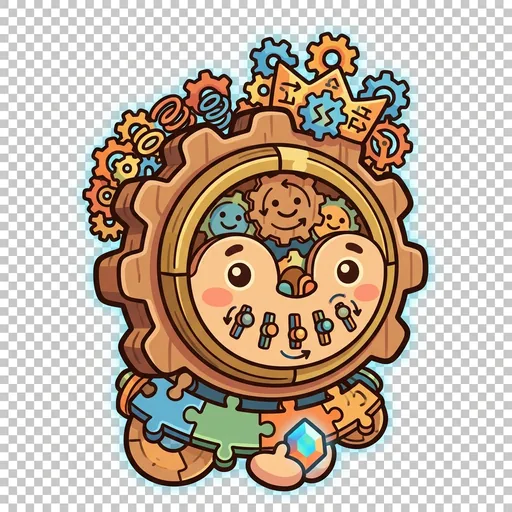
Vigenère
Vigenère / polyalphabetic keyword cipher (the Caesar-on-a-rotating-keyword pattern)
-

Echo Pair
Playfair digraph cipher (letters encoded in pairs through a 5×5 grid)
-

Rail
Rail-fence + columnar transposition ciphers (rearrange letter order without changing the letters themselves)
-

Tally
Number-based codes (A1Z26, ASCII, binary, book ciphers — any mapping that converts letters to numbers)
-

Sift
Frequency analysis + cryptanalysis-by-statistics (the cipher-breaking method, not a cipher itself)
-

Lattice
Modern cryptography fundamentals — XOR, public-key concept, hashing (the irreversible / asymmetric family)
-

Hollow
Hides a secret message inside something ordinary, so nobody even knows there is a message to look for.
-

Tome
Keeps a shared code-book where whole words stand for secret words, so only someone with the same book can read the note.