
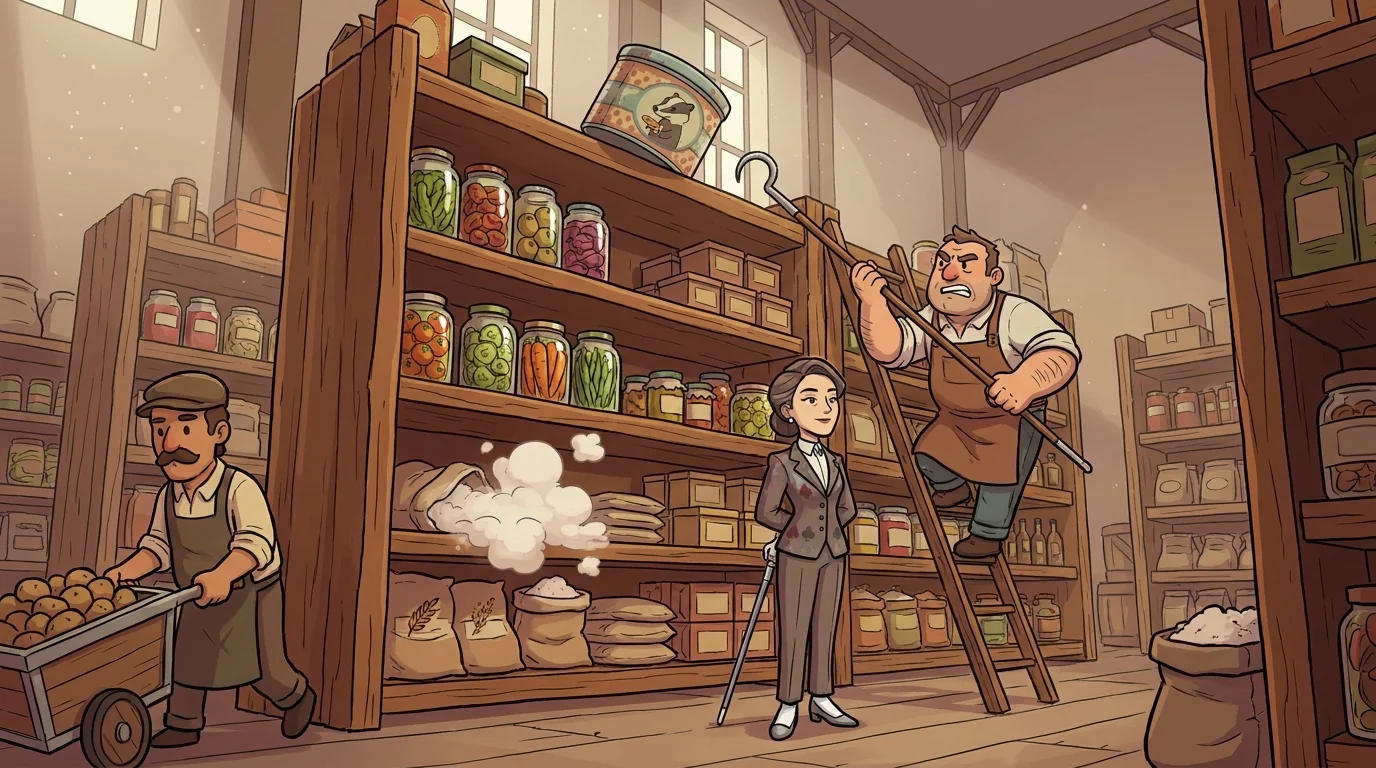
The Finesseur
FINESSE — *force the high card down by sitting in the right seat.*
Listen along — The Finesseur
Loading audio…
Press play to listen along. The line being read lights up as you go.
Show full transcript
Loading transcript…
Chapter 1 — The Finesseur and the Seat That Wins
Elara, known to her friends as The Finesseur, was not one for grand gestures. She preferred the quiet precision of a well-placed card, the subtle shift in an opponent’s gaze. Her movements were quick, almost foxy, as she settled into her favorite chair. It was a deep velvet burgundy, striped with soft cream, a chair she’d chosen for its perfect height at the kitchen table. Her dealer-vest, a chunky knit that looked like it belonged on a cartoon character, settled around her small frame. She held a single, smooth card, a finesse card, between her thumb and forefinger. Its edges were worn from countless practice hands. Next to her, on the worn oak table, sat a small, intricate position-tracker. Its tiny gears and arrows waited, ready to map the flow of play.
The air in the kitchen hung still, thick with the scent of lukewarm tea and the quiet hum of concentration. Liam, Maya, and Noah leaned in, their elbows resting on the checkered tablecloth. Their eyes were fixed on Elara, their faces mirroring the complex puzzle laid out before them. Tonight, it was Bridge, a game Elara loved for its hidden information and the elegant dance of strategy. She loved how the cards, once dealt, whispered secrets if you knew how to listen.
“Okay, Finesseur,” Liam said, adjusting his glasses. “Walk us through this one. My brain is already twisting.”
Elara gave a small, dry smile. “It’s a classic scenario. We’re in No Trump, so no suit is special. Our goal is tricks. And we’re missing the King of Clubs.” She gestured to the ‘dummy’ hand, laid out for all to see. In it, the Ace and Queen of Clubs gleamed. A strong pair, but vulnerable. “The King is out there, with either East or West. And it’s a problem.”
Maya frowned, tracing the pattern on the tablecloth. “Why is it a problem? Don’t you just play the Ace, then the Queen? That’s two tricks.”
“Not necessarily,” Elara explained, her voice even. “If we play the Ace, then the Queen, and the King is held by an opponent, they’ll play it on our Queen. We’d lose that trick. The King would capture our Queen. So, if we play them straight, we only get one trick for sure, the Ace. The Queen is a coin flip, but if the King is played correctly, we get zero tricks from the Queen.” She tapped the position-tracker. “This is where finesse comes in. It’s the card-craft of forcing the high card down by position.”
Noah leaned forward, intrigued. “Forcing it down? How?”
“It’s all about the order of play,” Elara said, her gaze sweeping across the table, mentally mapping the opponents. “Imagine the King is with West, the player to my right. If I lead a low club from my hand – say, the Two of Clubs – West has to play a club. If they have the King, they might play it to win the trick. Or they might play a low one, hoping to save the King for later. But either way, after West plays, it comes to dummy, where we have the Ace and Queen.” She paused, letting them visualize it. “If West played the King, our Queen wins the next trick. If West played low, we play our Queen from dummy, and it wins because the King is still with East, who plays after dummy. The King gets trapped.”
“So you need the King to be on your right?” Liam clarified.
“Exactly,” Elara confirmed. “We need the King to be with the player before the hand that has the Ace and Queen. That’s the key to the finesse. If the King is with East, the player to my left, it’s a different story. If I lead low, West plays low, then I play the Queen from dummy, East, holding the King, will play it after my Queen and take the trick. My Queen gets captured. So, the finesse only works when the missing high card is in the right seat.”
Maya chewed on her lip. “So it’s a guess?”
“It’s a fifty-fifty guess,” Elara agreed. “The King is either to my right or my left. Half the time the finesse works, half the time it doesn’t. But think about it: if we play Ace then Queen, we get one trick for sure, and the second trick is lost if the King is out. With the finesse, we have a fifty percent chance of getting two tricks. That’s a much better probability. The math is the same; the seat changes the answer.” She adjusted the tiny arrow on her position-tracker, aligning it with West’s imaginary seat. “Position is the whole point.”
Elara picked up the Two of Clubs from her hand. Her movements were precise, almost ritualistic, as she placed it in the center of the table. “Leading low toward the strength,” she murmured, a phrase she often used. West, their invisible opponent for this practice hand, ‘played’ the Three of Clubs. Elara watched, unblinking, as the card slid across the worn wood. Then, from the dummy hand, she carefully selected the Queen of Clubs. She placed it down with a soft thwack. East, the other unseen player, ‘played’ the Six of Clubs.
“It worked!” Maya exclaimed, her eyes wide. “The Queen won!”
Elara nodded, a small, satisfied smile playing on her lips. “The King was with West. They had to play it first, or play low, letting our Queen win the trick. That’s the finesse. It’s all about understanding who plays when, and how to use that order to your advantage.” She gathered the cards, adding the trick to her pile. “It’s not about luck, not really. It’s about probabilities, and knowing how to stack the odds in your favor, even if it’s just by a little bit. And sometimes, that little bit is everything.”
Liam leaned back, a thoughtful expression on his face. “So it’s like, you’re not just playing your cards, you’re playing the seats.”
“Exactly,” Elara said. “The cards are just tools. The real game is in the arrangement, the sequence.” She believed that every game, every puzzle, was a system waiting to be understood. She saw the same underlying patterns in diverse challenges. In chess, for instance, a knight could ‘pin’ a piece, forcing a higher-value piece to move, much like the King was forced to play here. Or a rook could ‘skewer’ two pieces, threatening both with a single, well-timed move. In Go, the ancient board game, controlling a key intersection could ‘position’ you for a larger territory, making future moves almost inevitable. Even in their school’s annual ‘PuzzleLogic’ competition, she’d seen how narrowing down constraints – like knowing which seat the King couldn’t be in – often led directly to the solution. The core idea, the method of thinking, was always the same: observe the order, understand the rules, and use position to force the outcome you wanted. It was a kind of quiet power, she thought, knowing that the arrangement of things could change everything.
For Elara, card games were never about betting money or taking big risks. They were about the intricate dance of logic, memory, and spatial reasoning. Like a master chess player mapping out moves, or an architect planning a building, she saw the game as a series of interconnected choices, each one influencing the next. Her finesse card and position-tracker weren’t just props; they were symbols of her careful, calculated approach. They reminded her that sometimes, the smartest move wasn’t the biggest, but the one that subtly shifted the balance, forcing the high card down by sitting in the right seat. She found a deep satisfaction in that subtle control, in the way a simple card game could reveal so much about the world’s underlying systems.
The CardForge ensemble
The Finesseur is part of CardForge's distributed-narrative cast. Each character embodies a different curricular primitive; together they teach the full subject.
-

The Squeezer
Squeeze (force a discard that gives up a winner; advanced bridge + hearts)
-

The Endplayer
Endplay (throw opponent in to force a losing lead; bridge / hearts / whist)
-
The Counter
Card-counting / pip-tracking (track played cards to deduce remaining hands; gin / bridge / blackjack-style)
-
The Long-Suit
Suit establishment (set up a long suit to run for tricks late in the hand; bridge / whist / spades)
-

The Bluffer
Deception under uncertainty (poker betting; representing a hand you don't have)
-
The Discarder
Strategic discard (hearts: avoid points; spades / gin / rummy: shed dead wood)
-

The Trumpkeeper
Trump management (when to ruff, when to hold; whist / spades / euchre / pinochle)
-

The Forcer
Magic forcing (the spectator "freely chooses" the card you intended)
-
The Shuffler
False-shuffle / stack management (control card order while appearing to randomize; mathematical card magic)