
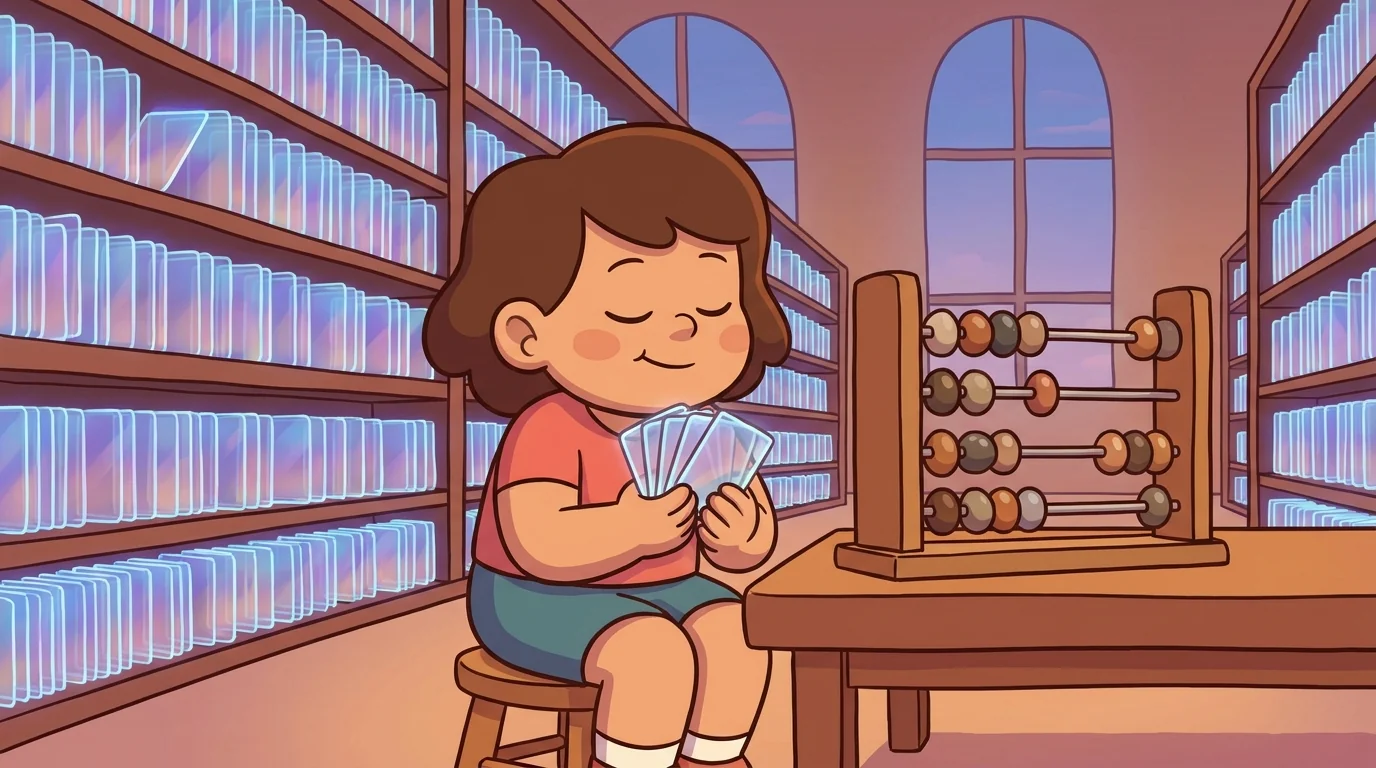
The Counter
COUNTER — *cards played are cards gone. memory is the whole game.*
Listen along — The Counter
Loading audio…
Press play to listen along. The line being read lights up as you go.
Show full transcript
Loading transcript…
Chapter 4 — The Counter and the Memory That Wins
The Counter was a quiet kid, small for their age, with hair the color of cool slate and soft ink-blue stripes woven through it, like faint pencil marks on a page. They often wore a vest, not a fancy one, but a practical garment with small, well-worn pockets. Inside one pocket, The Counter kept a tiny pip-tracker, a device no bigger than a postage stamp. It was a tool that helped them keep track, a silent partner in their constant observation.
The Counter was known for being deeply attentive. Nothing escaped their notice, especially during a game of cards. They held a simple, yet profound, philosophy: “Cards played are cards gone. Memory is the whole game.” For The Counter, the true challenge wasn’t just knowing what cards you held, but understanding what cards weren’t there anymore. This mental discipline was their craft, their particular genius. They called it card-counting.
This wasn’t about gambling for money, not in the way some people might think. For The Counter, card-counting was an intellectual sport, a fascinating puzzle. In games like gin rummy, bridge, or hearts, fifty-two cards begin in play. Every card revealed, every card discarded, every card picked up, chipped away at the unknown. It was a process of subtraction. Each visible card removed a piece of uncertainty about the invisible ones. The goal was to subtract until certainty emerged, until the hidden became known.
The Counter taught this skill not with lectures, but by example. They showed how active observation and careful subtraction could transform a jumble of unknowns into a clear picture. It was a rigorous mental exercise, a kind of working memory training in real time. They demonstrated the power of tracking, of understanding that what you don’t see is just as important as what you do. For The Counter, the mind was the ultimate tool, and memory, when used precisely, could feel like magic.
“I am The Counter,” they would say, their voice soft but firm. “My skill is card-counting. The fundamental move is this: cards played are cards gone. Memory is the whole game.” They paused, then added, a slight smile touching their lips, “Subtract until certain.”
The kitchen table hummed with the low chatter of a gin rummy game. The Bluffer sat opposite The Counter, a casual smirk on their face. The Forcer, usually focused on their own intricate puzzles, watched from the side, intrigued. The air smelled faintly of toast and the metallic tang of new cards.
The game began. The Counter’s eyes, the color of wet slate, scanned the table. They watched each card dealt, each card picked up, each card discarded. Their hand moved almost imperceptibly to press a tiny button on the pip-tracker in their pocket. It was a silent, internal tally, a running calculation.
“My turn,” The Bluffer announced, tossing a Seven of Clubs onto the discard pile. “Don’t need that.”
The Counter didn’t speak. They simply noted the card, a small mental tick. Seven of Clubs: gone. They picked up a card from the draw pile, glanced at it, and then, after a moment’s consideration, discarded a Two of Diamonds. The game continued, turn after turn. The discard pile grew, a small mountain of revealed information.
The Bluffer picked up a card. They paused, a tell The Counter instantly registered. A hesitation means a decision, The Counter thought. A decision means a choice between two useful cards, or a difficult choice with no useful ones. The Bluffer then discarded a Queen of Hearts.
The Counter’s internal map of the deck became clearer with each passing moment. They weren’t just memorizing cards; they were building a logical structure. If the Bluffer discarded a Queen, they don’t need it for a run or a set. If they hesitated, perhaps they needed the Queen for a set of Queens, but had a better option for a run. The possibilities narrowed.
After ten turns, the game reached a critical point. The Bluffer had a handful of cards, their expression unreadable. The Counter, however, knew. They had tracked every discard, every pickup. They knew which cards were gone from the deck, and therefore, which cards must still be in The Bluffer’s hand. The math had left no other option.
With a soft tap on the table, The Counter announced, “Knock.”
The Bluffer’s smirk faltered. They laid down their hand, a collection of cards that almost formed a run, but not quite. They needed a specific card, a Nine of Spades, to complete their sequence.
“How did you know?” The Bluffer whistled, genuinely surprised. “I was so close!”
The Counter tapped the pip-tracker in their pocket, a small, almost invisible gesture. “I watched,” they explained, their voice calm. “Every discard. Every pickup. After enough turns, the unknown shrinks. I subtracted until I was certain.”
The Forcer, who had been observing intently, shook their head slowly. “That’s not magic,” they said, a note of awe in their voice. “That’s MEMORY.”
The Counter smiled, a rare, genuine expression. “Good,” they replied. “Memory should look like magic.” For them, the real magic was in the mind’s ability to take scattered pieces of information and weave them into a tapestry of certainty. It was a quiet triumph, a testament to the power of careful attention and logical deduction. The joy of the puzzle, solved.
The CardForge ensemble
The Counter is part of CardForge's distributed-narrative cast. Each character embodies a different curricular primitive; together they teach the full subject.
-

The Finesseur
Finesse (force an opponent's high card via positional play; bridge / hearts / spades)
-

The Squeezer
Squeeze (force a discard that gives up a winner; advanced bridge + hearts)
-

The Endplayer
Endplay (throw opponent in to force a losing lead; bridge / hearts / whist)
-

The Long-Suit
Suit establishment (set up a long suit to run for tricks late in the hand; bridge / whist / spades)
-

The Bluffer
Deception under uncertainty (poker betting; representing a hand you don't have)
-
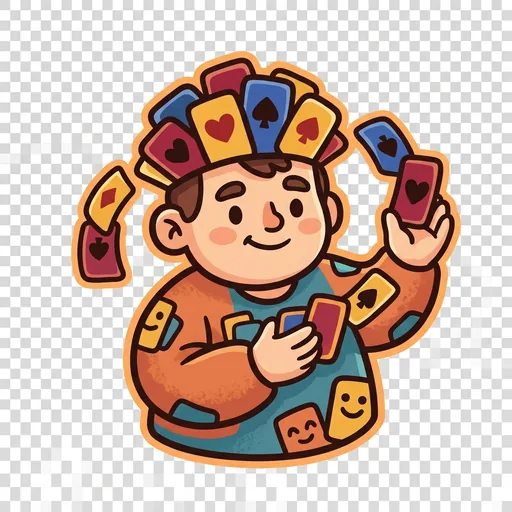
The Discarder
Strategic discard (hearts: avoid points; spades / gin / rummy: shed dead wood)
-

The Trumpkeeper
Trump management (when to ruff, when to hold; whist / spades / euchre / pinochle)
-

The Forcer
Magic forcing (the spectator "freely chooses" the card you intended)
-

The Shuffler
False-shuffle / stack management (control card order while appearing to randomize; mathematical card magic)